
Blog
Banking
The Advantages of Bancassurance for Modern Banks
- 7 min read
IN THIS ARTICLE
Banks’ net interest margin keeps getting harder to defend, as digital challengers pull share with lower-cost accounts, deposit products grow more commoditized, and customers switch banks more freely than they once did.
The advantages of bancassurance, banks distributing insurance products to their own customers, speak directly to that pressure, opening a revenue stream that does not move with interest rates while giving customers one more reason to stay instead of shopping around. None of this is news to banks, which have leaned on insurance income for decades. What has changed is how completely a bank can actually capture it.
The traditional model limits the real advantages of bancassurance
Bancassurance is not a new idea. Banks have partnered with carriers to sell life, health, and property coverage since the practice took hold across Europe and Asia in the twentieth century. The logic has always been sound. Banks already hold the customer relationship, the trust, and the transaction data that carriers need, while carriers bring the products and underwriting expertise banks don’t have. Put those together, and both sides win.
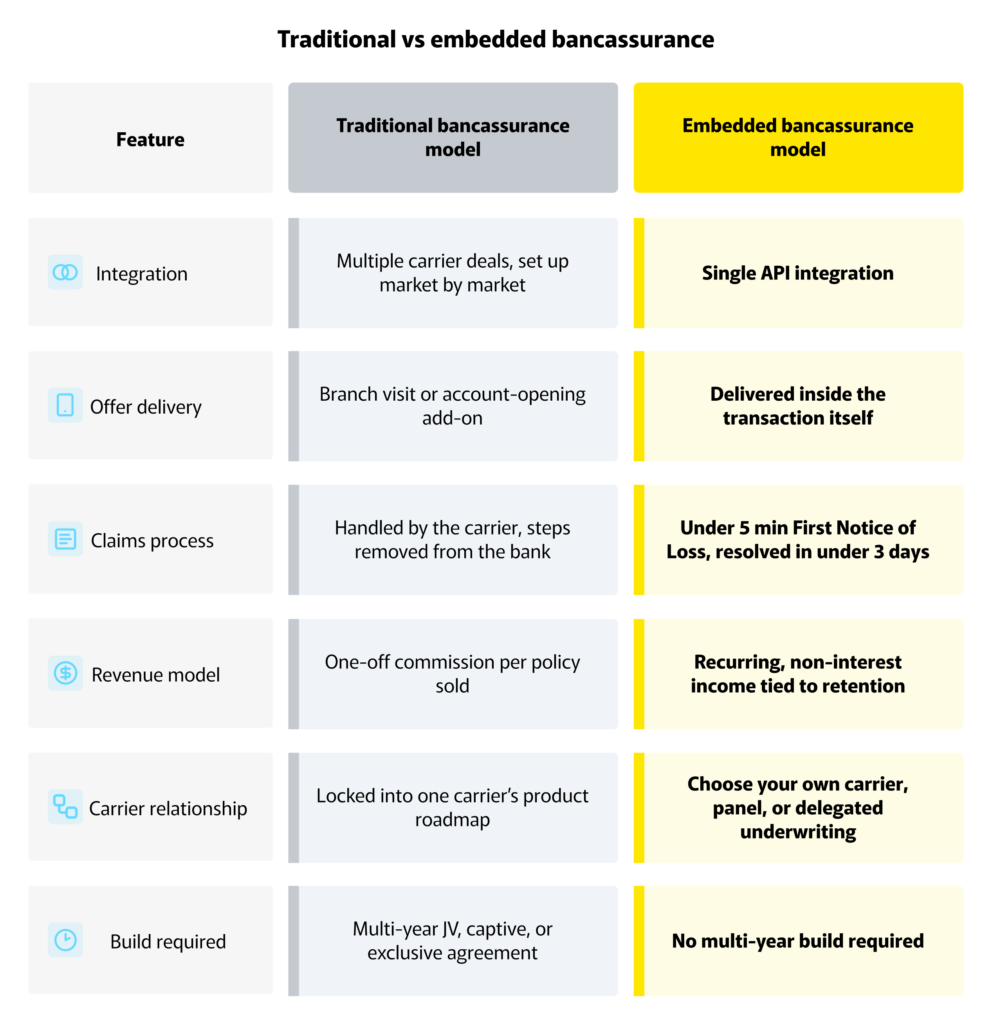
The problem is how most banks have implemented it. Traditional bancassurance strategies center on one of three structures. A bank might sign an exclusive distribution agreement with a single carrier, form a joint venture where the bank and carrier share risk and reward, or build and own a captive insurance company outright. Each of these can work, but each also takes years to stand up, locks the bank into one carrier’s product roadmap, and depends on branch staff selling insurance as a side task on top of their actual job.
For a bank trying to move at the pace its digital-native competitors move, that is a slow, rigid way to capture a good opportunity. A more modern approach, embedding protection directly into the bank’s digital channels, gets a bank back to what bancassurance was supposed to deliver in the first place.
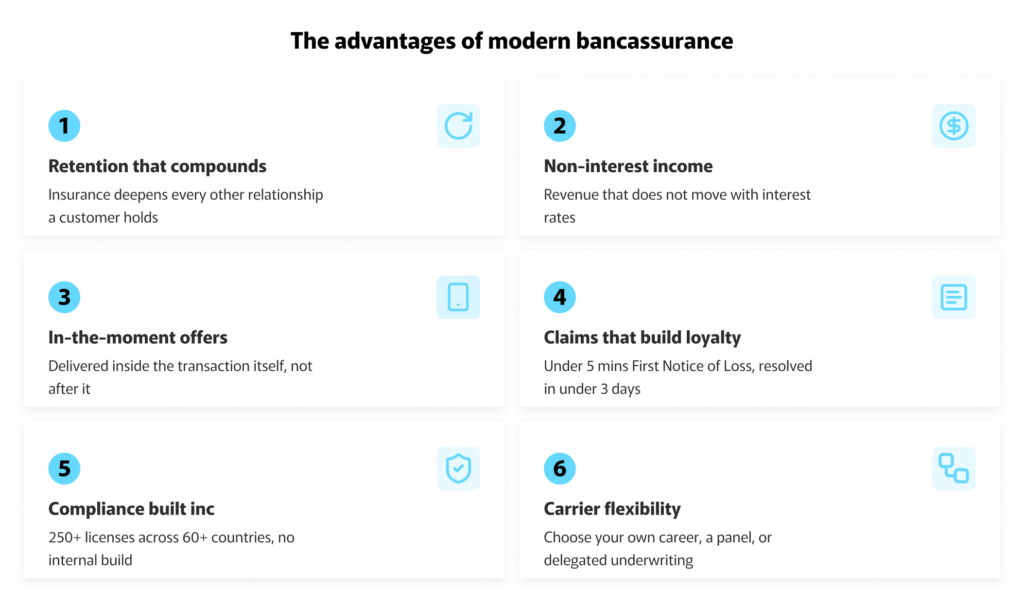
1. Retention that compounds across every product a customer holds
Ask most banks to list the advantages of bancassurance, and commission income comes up first. This is a less strategic approach, as commission income is smaller and less durable than retention
A customer who has insurance that comes with their checking account, mortgage, or credit card has more reasons to stay and more moments where the bank proves its value beyond a monthly statement.
2. Non-interest income that does not move with interest rates
The retention benefit above compounds directly into this one. BCG has found that carriers making bancassurance their primary distribution channel were roughly 40% more profitable than carriers that did not, from 2017 through 2022, and that retail banks getting bancassurance right can grow profits by 15% to 20%.
Those numbers hold because insurance is a noncyclical revenue stream sitting on top of a banking book that is otherwise entirely exposed to interest rate swings. When a customer buys insurance from their bank, they are also more likely to come back to that bank for their next financial product. Retention and non-interest income are not two separate line items. They compound off the same customer behavior, just tracked in two different places on the bank’s financial statements.
3. Offers delivered inside the transaction, not after it
This is where bancassurance strategies diverge, and where most of what gets written about this topic stops short. A joint venture or an exclusive agreement distributes insurance through the bank’s branch network or a bundled add-on at account opening.
An embedded model distributes insurance at the exact moment a transaction happens, like when a customer takes out a mortgage, upgrades to a premium account, or makes a large purchase on their card. A referral asks the customer to make a separate decision at a separate time, while an embedded offer meets them inside a decision they are already making, when the relevance of the coverage is personalized.
Delivering that requires infrastructure most banks were never built to have in-house. It takes a single integration that can plug into carrier partners, price and personalize offers using the bank’s own transaction data, and operate across every market and currency the bank serves without a separate build for each one.
This is the kind of signal-based personalization that makes the offer relevant instead of intrusive. A customer’s spending pattern, transaction type, and stated needs can inform which protection product actually gets shown to them, rather than every customer seeing the same generic bundle regardless of fit. That distinction determines whether an embedded offer feels like a helpful nudge or an unwanted upsell. This is the model a platform like Cover Genius exists to support, structuring the technical and carrier relationships so a bank can launch a modern bancassurance program without building an insurance operation from scratch.
4. A claims experience that turns a stressful experience into a loyalty moment
The sale is not where a bancassurance program earns or loses a customer’s loyalty. It’s when a customer has a smooth, fast claims experience and associates that competence with their bank. A customer who has a slow, difficult experience associates the opposite, often permanently. Exclusive-agreement and joint-venture models struggle most here, since the carrier handles the claim on its own and the bank has little visibility into or control over how that experience actually goes.
An embedded claims experience keeps the bank in the loop instead of handing that moment off to the carrier alone. An under five-minute First Notice of Loss with instant digital payouts, and average claim resolution under three days, turns a moment of financial stress into a moment where the bank’s judgment about the partnership actually pays off for the customer. Consider a customer whose flight cancellation trips a travel protection benefit tied to their premium account, or whose new purchase protection kicks in after a damaged delivery.
In both cases, the claim resolves in days, not weeks, and the bank’s name is attached to that outcome even though a carrier partner is doing the underwriting. That is the dual-benefit case in its simplest form. The bank gets a lower complaint rate and a stronger retention signal, and the customer gets their claim resolved before the disruption compounds into a bigger problem.
5. Compliance and licensing handled without building an internal function
Anyone running bank operations will fairly ask what this actually costs to stand up and maintain. Embedding insurance distribution does not remove the need for good judgment about staff readiness, product fit, and customer communication. Those still require real attention regardless of which delivery model a bank chooses.
What it does remove is the need to build an internal insurance compliance function from the ground up. A platform holding 250-plus licenses and authorizations across 60-plus countries and all 50 US states, audited to SOC 1, SOC 2, and ISO standards, carries the regulatory overhead that would otherwise sit with the bank’s own legal and compliance teams.
That overhead compounds quickly for a bank operating in more than one market or jurisdiction, since each new geography can otherwise mean a fresh licensing process before a single policy is sold. That is a meaningfully different lift than negotiating and maintaining a single-carrier exclusive agreement market by market.
6. Flexibility to choose how much carrier risk you own
Not every bank wants the same amount of control, and a modern bancassurance strategy does not force a single answer. A bank can bring its own existing carrier relationships if it already has them, source from a broader carrier panel when it wants more product choice without managing each relationship directly, or delegate underwriting authority entirely when speed matters more than hands-on control.
That flexibility is itself an advantage most traditional exclusive agreements do not offer since a single-carrier deal locks in one answer to a question a bank’s strategy might answer differently by market.
The risk of falling behind on bancassurance strategies
None of this means the traditional models are worthless everywhere. A joint venture can still make sense when a bank wants to share underwriting risk and reward directly, and an exclusive agreement can still work for a bank entering a single, well-understood product line. However, falling behind carries its own cost, since every year a bank spends locked into a single-carrier deal, or with no bancassurance strategy at all, is a year a digital-native competitor spends turning insurance into the retention and income advantage described above.
That gap compounds, because a traditional build already takes years to stand up, so a bank that waits to start is choosing to fall further behind banks already capturing that retention and non-interest income today rather than simply missing out on a future opportunity. The banks moving first aren’t doing so because bancassurance is new, but because they can see what happens to the ones who wait, a widening distance between a bank whose insurance program deepens the customer relationship and one that still treats it as an afterthought.
Explore what embedded protection could mean for your bank
The advantages of bancassurance are clearest when the distribution model gets out of the way of the strategy. Explore how embedded protection fits into a modern bancassurance strategy and see what it would take to bring insurance into the moments your customers already trust you with.
Get in touch
See how embedded protection can work for your bank.
Related Articles
Consumers trust their banks the most when purchasing protection. Why aren’t banks taking advantage?
Deblock and Cover Genius Partner To Build Protection Into Everyday Banking
Bancassurance Market Report: Trends Shaping Bank-Distributed Protection
Get in touch
All we need is some quick background info to understand how we can best help.