
How Banks Can Better Leverage Transactional Data To Create Tailored, Embedded Insurance
Every time a customer taps their card, banks capture a signal. They have instant access to a customer’s real-time purchasing, and buried in that everyday transactional data is a roadmap of exactly what insurance each customer needs and when they need it.
Danny Poole, Cover Genius’ VP of Banking, Commerce, & Platforms, sat down in an interview with PYMNTS.com to discuss this opportunity for banks. Poole broke down why banks have a natural advantage in embedded insurance, why so many are still failing to capitalize on it, and how transactional data closes that gap.
Full transcript
[0:04] I’m Danny Poole, I’m VP of Strategic Partnerships for EMEA at Cover Genius. We are the embedded insurance company that protects the global customers of the world’s largest digital companies, including Booking Holdings, Intuit, eBay, Shopify, and many, many more. We work with partners across multiple verticals including retail, travel, logistics, fintech, payments, gig economy, and more, offering them a single insurance solution with global coverage, industry-best NPS, and a minimal operational burden to manage and to scale at speed. I’m delighted to be here with PYMNTS.com, looking forward to talking a little bit about how banks and fintechs can leverage customer data and available technologies to enhance and simplify how their customers purchase and receive insurance.
[0:55] I mean, this correlates strongly with what we know to be true in both the UK and the broader European markets. If you think about it from a customer perspective, it’s intuitive, right — we are used to our bank being the financial hub for all of our transactions and broader products, and insurance sits as an intuitive extension of that. With respect to transactional data and tailoring products, that’s the nature of the day that we live in — we expect our digital experiences to be tailored and customized to our needs, and we’re very accepting and welcoming of available data points being used in order to execute on that. For banks, these guys have struggled with commoditization of traditional financial services for years, and a loss of contact with their customer. If you think going back 20 years — I’m showing my age — we used to go into a bank maybe once a week, then we used to call our bank, then we would log into our banking platform. Now you can go day-to-day on your mobile phone and not see your bank manager for months or years on end. So, for them it’s an opportunity to build an ecosystem of ancillary services around their customer, reintroducing touch points, increasing engagement, and building up that customer value again. Banks are uniquely positioned within this space — in an age where everyone is a fintech, they are custodians of that transactional data that can be used to create these tailored experiences and really be the optimal provider of this insurance. So, it’s a real call to action for them to capitalize on that opportunity and to make waves in this space.
[2:36] Okay, sure. So, if you think about the context of these smaller, challenger banks — they are all typically chasing high-level business goals of customer acquisition, geographic expansion, and finding pathways to profitability, and typically they’re doing it with smaller teams. So, these guys are trying to accomplish many parallel priorities with quite a small team. In terms of routes to insurance, there are two traditional paths: you can build it, or you can acquire it by strategic partnerships with an institution such as Cover Genius. Building it is a time-consuming, resource-intensive process which presents many operational and product challenges along the way. You think about insurance, you’re talking about a complex regulatory landscape with many hoops to jump through legally and in different markets. You’ve then got fragmented supply, which would mean if you want a product set that will cater for your customers across all of your markets and all of the different needs, you’re talking about multiple integrations with multiple partners, many contracts, a disjointed and choppy customer experience as they navigate across this, and generally this complex operational overhead that will expand above your business. The flip side is to acquire by strategic partnerships with an insurtech such as Cover Genius — these typically offer fast, flexible, and low-resource entry into market, so with a single API integration and set of commercial agreements, you can access fast and flexible growth across multiple product lines anywhere in the world.
[4:23] As you say, we know there’s parity around openness and interest in receiving offers across customers of both traditional and digital banks, so we’ve got to look at what is driving conversion of that interest into purchases, and what is not — where the legacy banks are being left behind. We found in the data that convenience and ease is the number one purchase trigger for interested customers. Convenience and ease is simply the right product, right time, and making it easy to purchase. Transactional data can be used here to tailor protection to the exacting requirements of that customer and that purchase, rather than presenting customers with a one-size-fits-all — or one-size-fits-none — product; you’ve got that perfectly customized and more useful product. And right time — transactional data is potentially the ultimate trigger of right time, i.e. exactly after you’ve bought that product or that valued thing that you’re looking to protect. And easy to purchase — transactional data here is used to take the pain out of the insurance purchase and to make that distribution as seamless as possible. The bank already holds all of the data necessary to quote and buy the insurance, therefore it’s just about putting it to use and taking the legwork out of the customer insurance purchase.
[5:47] It’s an important distinction — it’s not enough to have the data. You’ve got to be able to use the data. All banks have the data to execute in this area, but it’s about the digital banks’, the smaller banks’ ability to have these different data centers talk to each other in a more cohesive backend that allows them to leverage data points from one area into a different area, i.e. transactions to insurance — whereas in a legacy or older bank, transactional data might sit over here, insurance purchases over here, current accounts, etc. So it’s the ability to have visibility and to make strategic use across all of those data points that really creates the upside for challenger banks, and that’s where partnerships with companies such as Cover Genius come in — the ability to access that data, ingest it, and put it to good use.
[6:48] So, we know within financial services how important life stages, or particularly life stage transitions, are in causing customers to re-evaluate and acting as a trigger for acquisition of new products. Transactional data is probably the most reliable predictor of life stage transition that there is. We recently had our second child in this house, so I like to think about an example that’s close to home — if you think about a mum-to-be, your bank manager and Google probably know way before anyone else in your life, potentially even your partner. If you run through the transactions that play out: first of all, you’re buying a pregnancy test, or in our case, 10 or 15 pregnancy tests just to make sure; then you’re on Amazon buying What to Expect When You’re Expecting; then you’re looking at nursery equipment, furniture, buggies, and prams. All of these things indicate that there is a new family member inbound, and that’s way before you update your Facebook profile or tell friends and family at the 12-week stage.
[7:52] So banks are crucially positioned to access customers earliest and to present these convenient and tailored insurance offers to the customer when they need them — and that life stage transition is a similar story whether you’re looking at university-goers, first-time buyers, newly married, or retirement. Having that data is a real cornerstone of a bank’s strategy in terms of providing embedded insurance offers, and should be capitalized upon.
In this video, Poole covers:
– (0:55) Why banks are the natural hub for embedded insurance, and why the UK and European markets already back this up
– (2:36) The fastest, lowest-resource go-to-market path for smaller and challenger banks
– (4:23) Why convenience and ease, not interest, is what actually decides whether a customer buys
– (5:47) Why having transactional data isn’t enough. It’s what a bank’s backend can do with it that separates digital challengers from legacy players
– (6:48) How life stage transitions, like Poole’s own example of an incoming baby, show up in transaction data before a customer tells anyone in their life
Insurance sits as an intuitive extension of banks
Banks sit at the center of nearly every financial transaction a customer makes. That gives them a structural advantage that fintechs and insurers spend years trying to replicate, which is a single, trusted view of a customer’s financial life.
Poole says this lines up with what Cover Genius sees across both the UK and broader European markets.
"We are used to our bank being the financial hub for all of our transactions and broader products, and insurance sits as an intuitive extension of that."
- Danny Poole
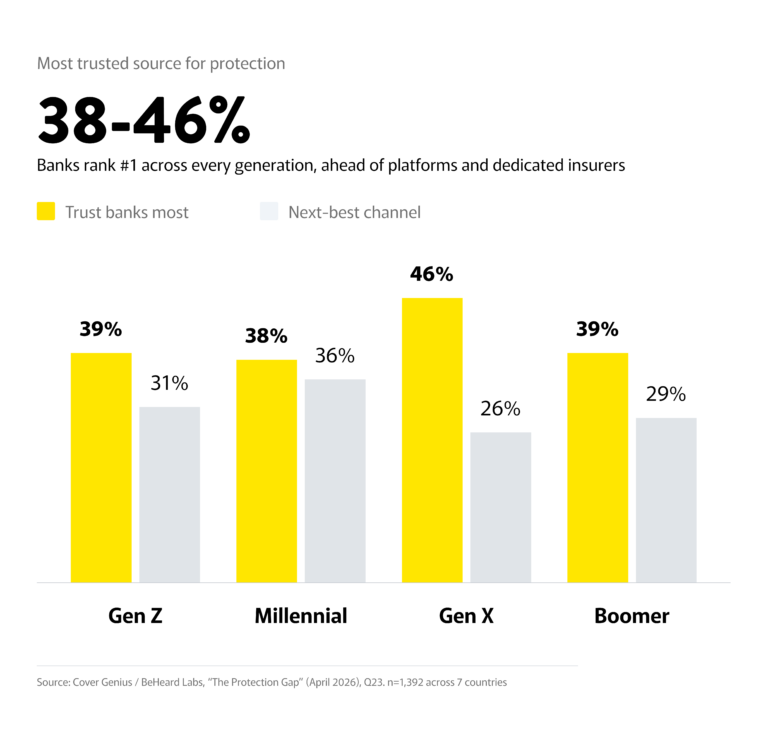
The catch is that trust alone doesn’t convert into revenue. A recent Cover Genius survey found that banks are the most trusted source for protection across every generation, ahead of platforms and insurers. The opportunity is sitting right in front of most banks. What separates the banks that capture it from the ones that don’t is what they do with the data they already hold.
Embedded insurance rebuilds the touchpoints banks lost
Poole traces the urgency behind this back to a shift most of us have lived through. Twenty years ago, customers visited a branch weekly, then called their bank, then logged into a banking app. Now, as Poole says, “you can go day-to-day on your mobile phone and not see your bank manager for months or years on end.”
That loss of contact has flattened traditional banking products into commodities and worn away the touchpoints banks once used to build customer value. Poole frames embedded insurance as a direct answer: an opportunity to rebuild an ecosystem of ancillary services around the customer, reintroducing touchpoints and re-engaging a relationship that’s gone quiet. Banks are uniquely positioned to do this because, in Poole’s words, “they are custodians of that transactional data that can be used to create these tailored experiences.”
Banks can build it or acquire it through a partnership
For smaller and challenger banks in particular, Poole lays out two routes into insurance: you can build it, or you can acquire it through a strategic partnership.
- Build it in-house. This means navigating complex, market-by-market insurance regulation, sourcing fragmented supply across every product line and geography, and managing multiple integrations and contracts.
- Acquire it through a strategic partnership, such as one with Cover Genius. This route offers a single API integration and one commercial agreement, giving banks fast, flexible access to multiple insurance product lines in any market, without the operational overhead of building it themselves.
Convenience and ease is the number one motivator for consumers
Interest in embedded insurance is fairly evenly spread across all types of banks. Conversion is where the gap opens up. Poole states, “we found in the data that convenience and ease is the number one purchase trigger for interested customers.”
He breaks that down into three parts, all of which run on transactional data:
– Right product: transactional data tailors protection to the customer’s actual purchase, instead of a one-size-fits-all policy.
– Right time: transactional data is the ultimate trigger of right time, surfacing an offer at the exact moment a customer has bought something worth protecting.
– Easy to purchase: the bank already holds the data needed to quote and bind the policy, so the customer never has to re-enter information or leave the app to get covered.
It’s not enough to have the data, banks have to use it
If most banks already hold this data, why hasn’t every bank built this? Poole says, “It’s not enough to have the data. You’ve got to be able to use the data.” Every bank has transactional data. Few have it structured so it can actually drive a real-time insurance offer.
Digital, challenger banks tend to have the advantage here. Their backend systems were built to let data centers talk to each other, so a transaction signal can flow straight into a personalized offer. Legacy banks, by contrast, often keep transactional data, insurance records, and current accounts in separate systems that were never designed to share signals. Poole identifies this as exactly where a partnership model, rather than a multi-year backend rebuild, lets legacy banks catch up fast.
A bank (and Google) knows before anyone else in a customer’s life
Some of the most reliable predictors of insurance need aren’t single transactions, they’re patterns. Poole illustrates this with an example close to home: a customer expecting a baby. Poole says, “if you think about a mum-to-be, your bank manager and Google probably know way before anyone else in your life, potentially even your partner.”
“You’re buying a pregnancy test … then you’re on Amazon buying What to Expect When You’re Expecting … then you’re looking at nursery equipment, furniture, buggies, and prams,” Poole explains. Every one of those transactions signals a life stage change, and they happen well before that customer updates a Facebook profile or tells extended family. The same pattern applies to university enrollment, a first home purchase, marriage, or retirement.
Banks that can read these patterns get to the customer first, with an offer that’s actually relevant, rather than a generic cross-sell.
A cornerstone of bank strategy that should be capitalized upon
The data needed to power tailored, embedded insurance already sits inside every bank’s core systems. Poole explains that having that data is a real cornerstone of a bank’s strategy in terms of providing embedded insurance offers, and it should be capitalized upon.
That’s the gap Cover Genius’ embedded insurance platform is built to close for banks, pairing a single integration with the tailored, data-driven offers Poole describes.