
Blog
Agentic Protection
How Much Do Consumers Actually Trust AI Shopping Agents?
- Nidhi Daga
- 7 min read
IN THIS ARTICLE
The agent can shop. The human still decides.
AI shopping agents are moving from concept to checkout. Consumers already use them to compare flights, track prices, and assemble a cart across multiple sites, and travel and retail brands are racing to add new agentic features.
This is what the industry calls agentic commerce: letting an AI agent act on a person’s behalf to make a purchase, not just recommend options for a person to click through themselves. The open question isn’t whether people will use it. It’s how much control they’re willing to hand over once they do, particularly for the moments where the unexpected costs them something: like a delayed flight, a stolen phone, or a canceled trip.
To find out, Cover Genius partnered with Gather to survey 1,392 consumers across seven countries and four generations. The results describe a narrow, consistent line: consumers are comfortable with an AI agent doing almost everything up to the moment of commitment, and much less comfortable with it crossing that line unsupervised.
78% of consumers are open to an AI agent helping them shop or book travel. Only 5% are comfortable with an agent making purchases unilaterally on their behalf.
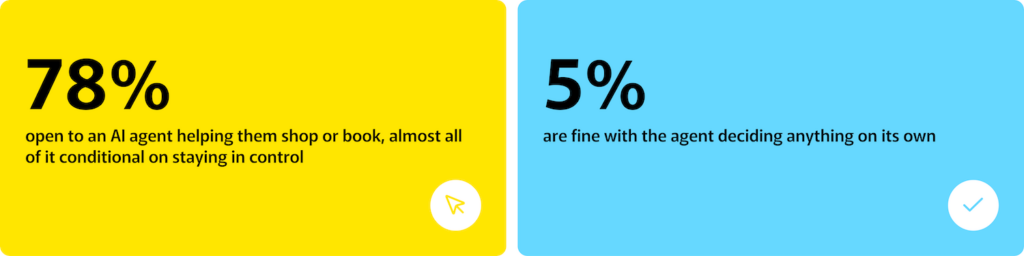
The 78% of those open to AI assistance breaks into four groups:
- 32% want the agent to propose and wait for approval
- 26% want it to only recommend while they buy
- 15% will let it transact inside rules they set
- Just 5% want it fully autonomous without human intervention before the point of purchase
If you review each cohort’s comfort-level, all were conditional except the 5%.
Consumers aren’t undecided about agentic commerce, and they aren’t waiting for better security or a slicker interface. They’ve already specified what they’ll hand over: the browsing, the comparing, and the booking. But making the decision that costs them if something goes wrong? No, not without approval. To scale and meet consumer needs, the future of AI commerce must be rooted in human decision making.
The real barrier is trust
Agentic commerce’s real obstacle is trust. Luckily, that’s a narrower, more solvable problem than the one it’s often mistaken for: fraud and security.
Better fraud safeguards won’t close this particular gap. The breakdown above already shows what 78% of consumers want: AI assisting, with a decision point where the end-consumer makes the final choice.
That instinct isn’t unique to this survey. A 2023 Frontiers in Psychology study on algorithmic decision-making found that resistance to an automated decision rises when it undercuts a person’s own sense of control, even when the algorithm is accurate, and eases considerably when the AI supports a human who keeps the final call rather than replacing them.
What people are protecting isn’t their card. It’s their recourse.
The industry building this infrastructure is landing on the same answer. Checkout.com’s 2026 Agentic Commerce Survey found that 64% of younger consumers are comfortable letting an AI shopping agent complete a purchase. Deloitte’s 2026 Retail Industry Global Outlook goes further: almost two-thirds of retail leaders don’t expect customers to fully embrace agents purchasing on their behalf before 2028, even as they race to build the agentic checkout workflows into their infrastructures. PwC’s 2026 Global Digital Trust Insights survey frames the fix the same way this report does: the brands that lead won’t be the ones that automate fastest, but the ones that let customers see, verify, and revoke what the agent is doing on their behalf.
87% of consumers weigh what could go wrong before they commit to a purchase, and 81% engage seriously when protection is offered. Yet, 43% don’t fully understand the coverage they already have, in a market where 79% were satisfied the last time they actually bought protection. The industry hasn’t reliably solved visibility on a page it fully controls. Inside a conversation it controls even less, the odds only get worse.
Personalization is part of the reassurance, not just the pitch
It would be easy to view personalization as an opportunity to scale and protection as the trust layer underneath that opportunity. They’re two separate features doing different jobs. The research says otherwise: how an offer is personalized changes whether the consumer interprets the offer as attentive or invasive, and that interpretation is itself a trust signal.
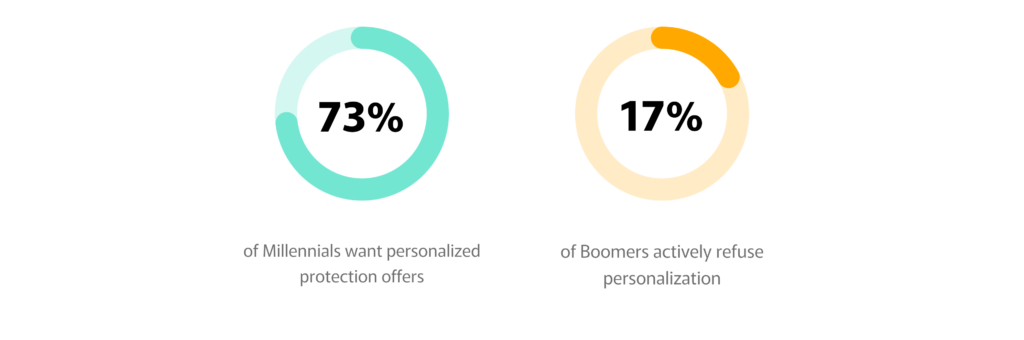
Personalization resonates the most with Millennials: 73% of Millennials want tailored protection offers, and 17% of Boomers completely reject personalization.
A welcome offer and an intrusive one can carry the identical amount of personalization. What separates them is whether the offer is tied to something the customer is actually doing. For example, coverage for a ski trip, surfaced because the agent is already booking the ski trip, reads as context, not surveillance. The agent notices what matters and skips the part where the customer would need to research their options.
That distinction matters for a trust story. Personalization done well isn’t a monetization tactic riding alongside it, and it isn’t a privacy trade-off either. It’s the agent doing the work a customer would otherwise have done manually: checking the itinerary, sizing the risk, and finding the relevant coverage, and handing back a relevant answer. That’s evidence the agent paid attention, delivered in the same moment as the time it saved.
Keeping a human-in-the-loop enhances trust further
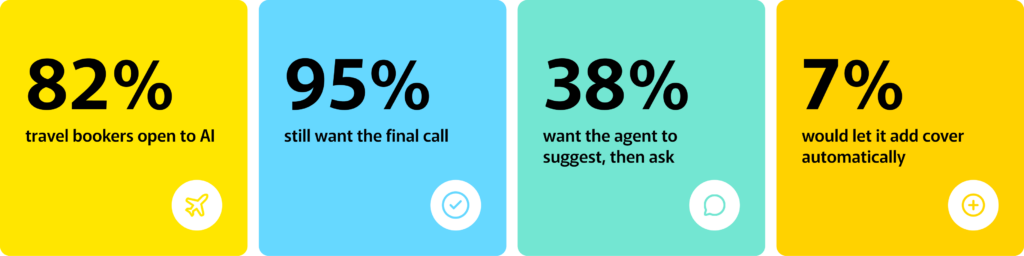
Most agentic commerce roadmaps treat a confirmation step as one more step between the agent and a completed task, worth eliminating as capability improves. Our survey found that 38% of consumers want the agent to suggest and let them decide, and only 7% would let it add cover automatically.
The instinct holds even in the segment most comfortable handing over the transaction. Travel bookers are more open to AI-assisted purchasing than the average consumer, at 82% against 78%, and 95% of them still want to decide whether to purchase protection.
The takeaway? Build AI into your workflows as a helpful assistant, and let the customer approve a tailored offer in one tap. Make AI a feature that streamlines the process of browsing, comparing, and deciding on a protection offering for a consumer.
Protection with automatic payouts seals the deal
None of this works if the offer, once accepted, isn’t fulfilled. The strongest purchase driver in our report was certainty about what happens after something goes wrong:
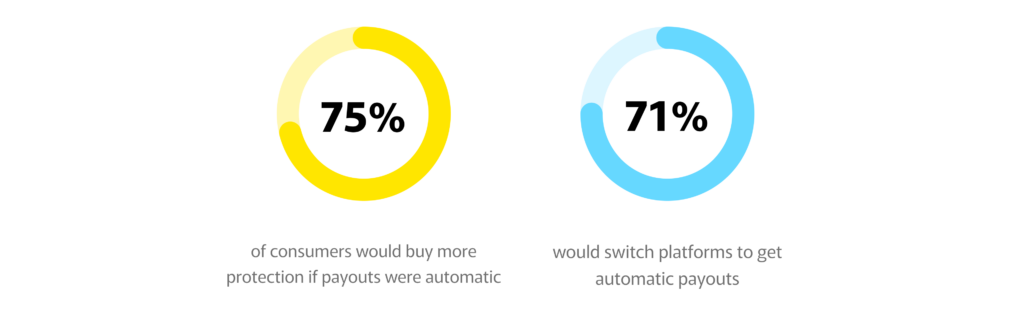
A customer three messages from committing to a purchase wants to know what happens if the purchase goes wrong and get an honest answer. Automatic payouts were the biggest motivating factor for consumers across the board.
Put the three together
Personalization, the human decision, and fast, certain resolution aren’t three features on a roadmap. They’re one trust mechanism, each answering a different part of the same question: What happens if something goes wrong?

The trust layer is the product
Agentic commerce isn’t waiting on a smarter agent. It’s waiting on someone to build the layer that makes people comfortable handing over the transaction in the first place. That layer is personalization, a human decision, and resolution that actually works for the consumer, all working together. The good news? This process is buildable today.
The platforms that build this layer into their agents now will own the default before the habit forms for everyone else.
See it on your own journeys
Request a demo and walk through how a personalized offer, a human decision, and a real claim look inside your own agent.
Related Articles
Bancassurance Market Report: Trends Shaping Bank-Distributed Protection
How Do Generations Differ When Purchasing Protection?
What Travel Companies Should Know: Top Findings from the 2026 Embedded Protection Market Research Report
Get in touch
All we need is some quick background info to understand how we can best help.