
Dynamic Product Bundling Increases Insurance Purchases by 23%. Here’s How It Works.
Insurance has spent decades solving the wrong problem. Most platforms still offer every customer the same policy, at the same price, in the same static bundle, regardless of who they are or what they’re actually buying.
A business traveler on a two-day trip and a family booking a two-week holiday get an identical protection offer. It’s no surprise conversion suffers. Dynamic product bundling fixes that by assembling the offer around the customer instead of the other way around.
The cost of one-size-fits-all protection
Traditional insurance distribution was built for a world of static catalogs and manual underwriting, not real-time commerce. That model assumes every customer has the same risk profile and the same willingness to pay, an assumption that breaks down the moment you look at actual purchase data.
A corporate traveler on a business trip doesn’t have the same protection needs as a couple headed to the Bahamas. A first-time online shopper buying a $40 accessory isn’t a candidate for the same warranty terms as someone buying a $2,000 appliance.
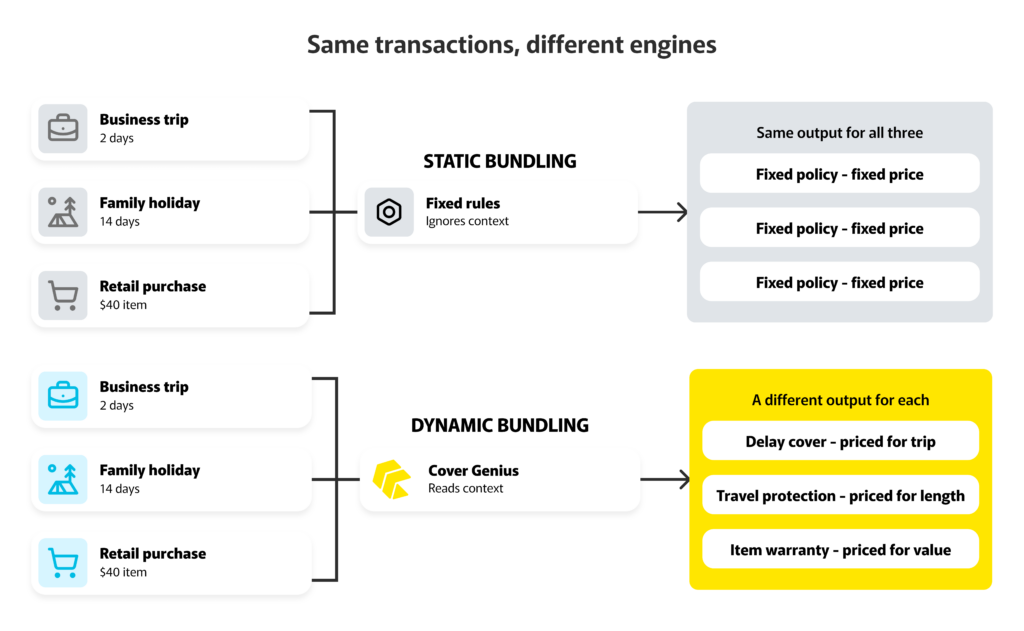
When platforms flatten these differences into a single offer, they leave two things on the table: conversion, because the offer feels irrelevant to a large share of customers, and revenue, because pricing isn’t calibrated to what each segment will actually pay.
What dynamic product bundling actually means
Dynamic product bundling replaces the static, one-size-fits-all offer with real-time protection products given a specific customer, their transaction, and their exact needs. It uses transaction context to assemble a bundle of relevant products, drawn from any insurance category and any underwriter, rather than pushing a single default policy to everyone.
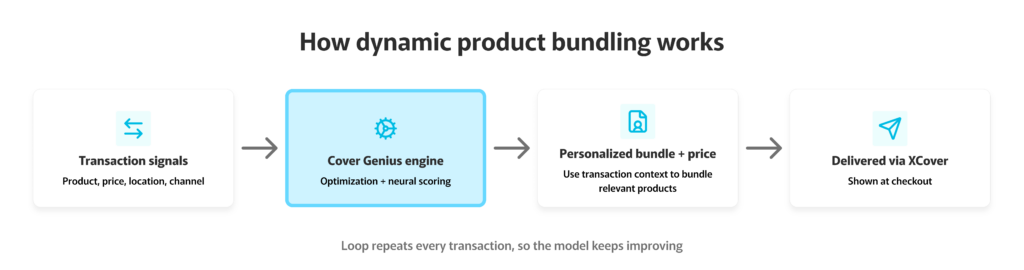
This is different from simple upselling or a fixed add-on checkbox. It’s a continuously optimizing system that treats every offer as a test, and every outcome as a data point that improves the next offer.
How Cover Genius powers dynamic bundling
This is the problem Cover Genius is built to solve. Our data-driven embedded protection platform works to dynamically bundle policies so that every customer sees the product and price combination most likely to convert, calculated in real time rather than set once and left alone.
Real-time personalization
Instead of relying on fixed if-then rules, Cover Genius combines human optimization strategies and a cutting-edge personalization engine to recommend policies whenever multiple products are available to sell. It’s continuously testing and refining, so the offer a customer sees reflects the latest signal from millions of prior transactions.
Multi-category, multi-underwriter bundling
Because Cover Genius isn’t tied to a single insurance category or a single underwriter, it can pull the most relevant products from across the available catalog, whether that’s travel protection, product warranties, shipping cover, or event ticket refund protection, and combine them into one coherent offer. That bundle is then served through our embedded protection platform so partners’ customers can select multiple relevant products at the right point in their transaction, in the right language and currency.
Cover Genius also generates dynamic pricing recommendations alongside product recommendations. In a case study on retail price optimization in a US market regulated by insurance filings, this pricing engine was applied in a compliant, filed-rate environment, showing that dynamic optimization can work even inside heavily regulated pricing structures.
How dynamic bundling drives 23% more insurance purchases
Moving from static to dynamic bundling delivers a 23% increase in insurance purchases. That lift comes from matching relevance and price to the individual customer instead of applying a blanket offer, which is the same logic that has driven personalization gains across e-commerce and fintech for years, now applied to insurance distribution.
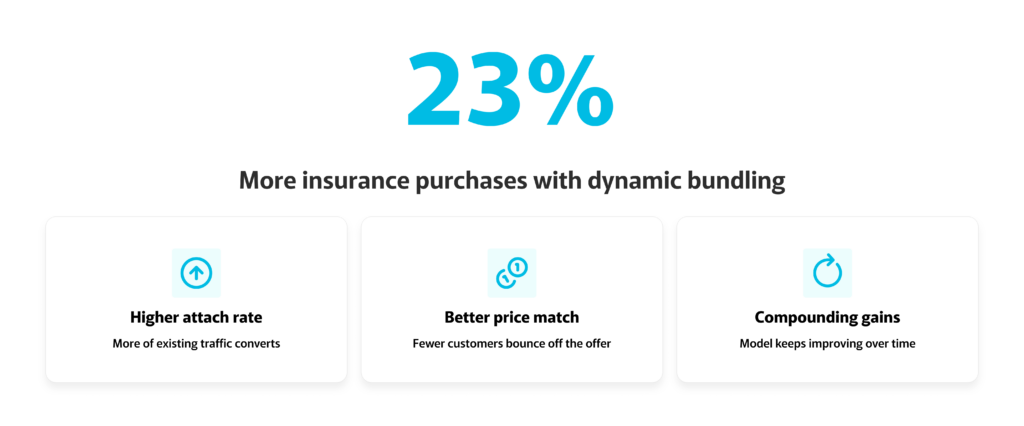
For platform partners, that translates into three compounding effects:
– Higher attach rates convert more of the traffic that’s already there, without any additional acquisition spend
– Better price-to-value matching means fewer customers bounce off an offer that felt wrong for them
– Performance improves over time rather than decaying the way a static bundle typically does
Where dynamic bundling delivers the most value
Dynamic product bundling isn’t a single-vertical play. It applies anywhere a platform sells a core product or service and has an opportunity to attach protection at the moment of transaction:
– Retail and e-commerce: matching warranty, shipping, and damage protection to basket value and product category.
– Travel: tailoring trip protection, cancellation cover, and delay compensation to trip length, destination, and traveler type.
– Logistics: attaching cargo and shipment protection based on shipment value and route risk.
– Gig economy and mobility: offering the right driver, rider, or vehicle protection based on trip type and duration.
– Banking, neobanks, and fintech: surfacing protection products at the moment customers are already making a financial decision.
– Live event ticketing: presenting refund protection calibrated to ticket price and event type.
In every case, transaction context is used to decide what to offer and at what price, rather than defaulting to one option for everyone.
Getting started with dynamic bundling
The shift from static to dynamic bundling doesn’t require ripping out an existing insurance program. It requires a distribution layer that can read transaction context and a recommendation engine that can act on it in real time.
Cover Genius solves this problem with one integration that gives partners access to relevant products across categories and underwriters, priced and bundled dynamically for each customer.