
Blog
Embedded Protection
Embedded Insurance Market Trends: What's Driving Growth
- 8 min read
IN THIS ARTICLE
If you run a platform or marketplace, or you own a checkout flow, you may have considered whether to sell embedded insurance. Your customers are already buying from you and may want protection for that purchase, and coverage can add a new source of revenue for your business. One way to do this is embedded insurance, which is coverage offered at the moment of a purchase, like travel protection on a flight booking or device coverage on a new phone. BCG expects the embedded insurance market to grow quickly through 2030.
Let’s look at what the embedded insurance industry statistics say about that growth, the embedded insurance trends in how coverage is distributed, and what to measure before you decide whether it makes sense for your business.
Key takeaways:
- More businesses are offering insurance as part of what they sell, and the push is coming from companies that sell directly to customers, not from insurers.
- A single generic insurance product fits poorly inside a platform's checkout, so coverage and pricing need to be built around each platform's customers.
- Claims are best handled inside the platform, because that's where customers judge the experience.
- Market forecasts show the direction, but your own customer and claims data decide whether it makes sense for your business.
Embedded insurance industry statistics: what the forecast says
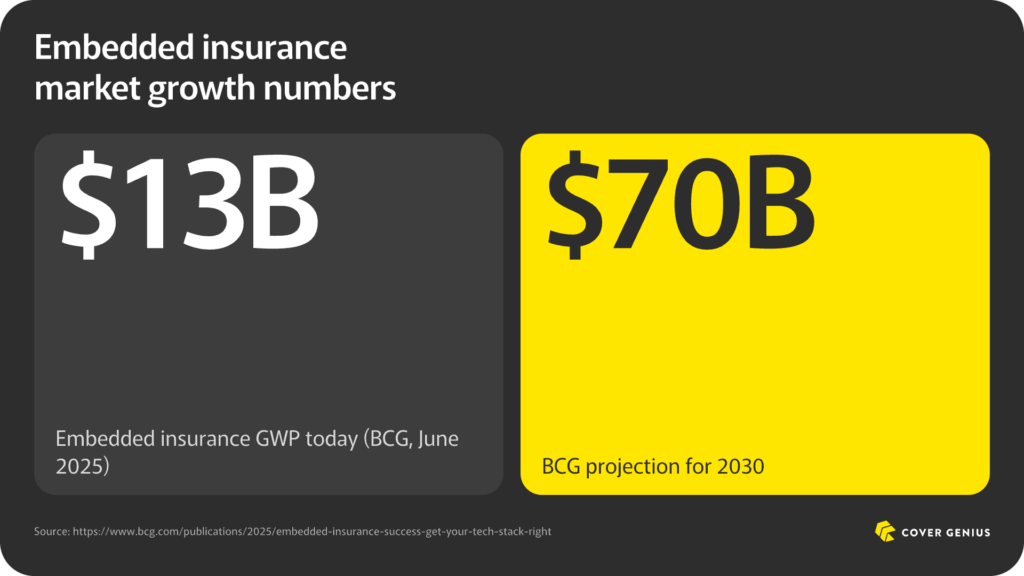
BCG‘s June 2025 analysis shows that embedded insurance could account for more than $70 billion in gross written premiums (GWP) by 2030, up from around $13 billion in 2025. GWP is the total premium an insurer writes before any deductions for reinsurance. With those figures, embedded insurance would grow to more than five times its 2025 size by 2030.
Key statistics at a glance:
- About $13 billion in embedded insurance gross written premiums in 2025, according to BCG's June 2025 analysis.
- More than $70 billion by 2030, according to BCG's projection.
- About 66% of embedded insurance growth in Asia through 2030 is expected to come from premium moving out of traditional channels such as agents and banks, according to McKinsey.
- Digital-focused consumers in Asia were 37% more likely than the average consumer to buy non-life insurance, such as travel or device cover, from digital platforms, according to McKinsey.
Embedded insurance trends driving growth
The forecasts above show how much the embedded insurance market could grow. The trends below demonstrate how that growth is expected to happen, from who owns the customer relationship to where claims get handled.
Consumer businesses are building insurance into their own products
BCG notes that an increasing number of consumer businesses are building insurance into their own products and services. The customer buys through the platform’s app or checkout, so the customer deals with the platform instead of the insurer. That changes what insurers have to offer.
BCG says insurers need to tailor coverage, pricing, and the customer experience to each platform’s products and users, so a single generic package gives way to platform-specific products. According to BCG, traditional insurers that have adopted this model already turn more customers into buyers than when they sell the same products as standalone insurance.
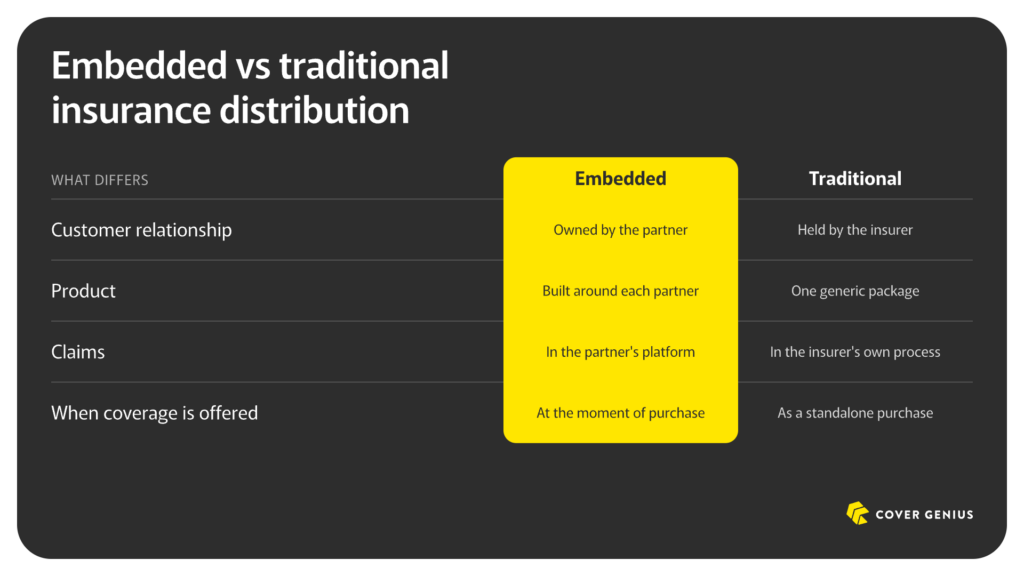
For a platform, this means you are in a strong position to offer coverage since the customer is already in your checkout. It also means the insurance becomes part of your product. Customers will judge it by the same standard as the rest of your experience, so the coverage and the insurer behind it need to fit what your customers buy.
Premium is moving out of traditional channels
McKinsey estimates that about 66% of embedded insurance growth in Asia through 2030 would come from premium moving out of traditional channels such as agents and banks. The estimate covers Asia, and other markets may follow a similar path, so it’s worth watching how your own customers buy.
Most of the growth McKinsey expects comes from customers who already buy insurance and will start buying it through a different channel. Customers already have a rough idea of what coverage costs, so your offer needs to hold up against what they could buy elsewhere. Insurers losing ground in traditional channels have a reason to want access to your customers, which is useful when you negotiate terms with them.
Digitally active customers are more likely to buy online
McKinsey‘s Asia analysis found that digital-focused consumers were 37% more likely than the average consumer to buy non-life insurance from digital platforms.
Comfort with buying online seems to carry over to insurance. If your customers already shop, book, and pay digitally, they are likely to be more open to an offer inside that flow.
Claims are moving toward the platform
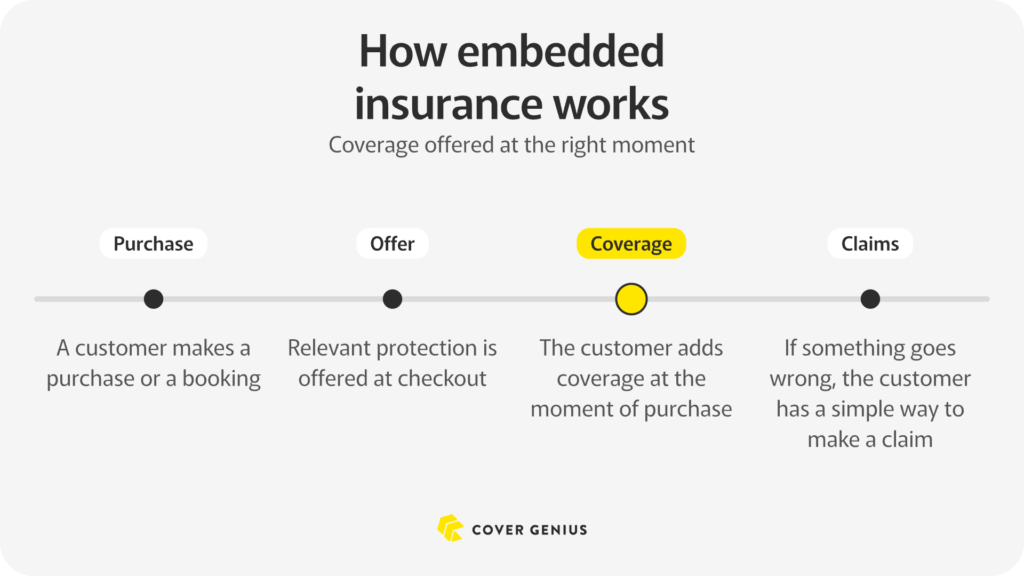
BCG says claims should be handled inside the platform, with software that processes them in real time. That includes parametric claims, which pay out automatically when a defined event occurs, such as a flight delay or a weather disruption. It also says insurers should support renewals and other policy changes in the same place.
Claims handling is a product decision that is easier to settle before launch than after. Where the claim happens shapes what the customer experiences at the moment they most need the coverage, and how much of that experience your team has to build. Parametric coverage goes the furthest, since the customer files nothing and the payout follows the event.
What this means for platform leaders
Judge the opportunity with your own data. Market projections show where the category may go, but they cannot tell you what your platform will earn. Three things are measurable: potential attach rate (the share of eligible purchases that could include the coverage), your possible claim experience, and partner economics (what the program could earn for your business and what it would cost to run).
Claims decide how customers remember the sale. If a claim goes badly, customers can end up blaming the platform instead of the insurer. If that happens, the platform can lose the customer’s trust. Claims handling and regulatory compliance in each market are things to confirm with any provider before you launch.
Decide how coverage is underwritten before you choose products. Underwriting means deciding which insurer carries the risk. Coverage can be underwritten by one insurer, by several insurers, or by your own insurance company. That choice affects how fast you can add markets and products. BCG also names legacy systems and rigid product structures as major obstacles for insurers, so it is worth asking any insurer you consider how flexible its systems are.
Where Cover Genius fits in
Cover Genius is a global embedded protection platform that gives platforms the technology to offer protection at the moment of purchase. Through a single API across 60+ countries, we connect your customers with the right coverage at the right time so you don’t need to build separately for each market.
We work with a wide range of insurers, so you can decide how your embedded protection program is underwritten, whether through one insurer or several. We handle regulatory compliance in each market, and our Partner Portal gives you insight on how the program is performing so you can continuously improve it.
We also handle claims, with a digital process built for speed, including instant digital payouts and average claim resolution under 3 days.
The outlook for embedded insurance trends
More insurance is being sold online, at checkout, by the businesses customers already buy from. As the category grows, the platforms that offer the right protection at the right moment will be in the strongest position.
If you’re exploring embedded insurance for your platform, reach out and our team can show you how it could work in your checkout flow.
FAQs
What is embedded insurance?
Embedded insurance is a protection experience built into a purchase or booking, so a customer can add coverage easily within the same checkout flow instead of going through a separate insurance process. The business selling the product or service offers the coverage, and an insurer provides and manages it.
How big is the embedded insurance market?
BCG estimates that embedded insurance generated around $13 billion in gross written premiums in 2025 and could pass $70 billion by 2030.
What is gross written premium?
GWP is the total premium an insurer brings in from the policies it sells, counted before it pays reinsurers to share the risk.
What are the main embedded insurance trends?
Three shifts stand out. Businesses outside insurance are selling coverage themselves, premium is moving from agents and banks to digital channels, and claims are moving toward the platform that made the sale.
What should a platform measure before adding embedded insurance?
Start with attach rate, claim experience, and partner economics. Attach rate is the share of eligible purchases that include the coverage, claim experience is how quickly and smoothly claims are handled, and partner economics is what the program earns your platform and what it costs to run.
Related Articles


How to Sell Bancassurance Products: A Digital Distribution Playbook

What Is Embedded Protection?
Get in touch
All we need is some quick background info to understand how we can best help.