
How To Stay at the Forefront of Growth in the Insurance Industry
Insurance industry growth has moved faster in the past few years than in the several decades before it. That shift isn’t happening because carriers suddenly discovered risk models faster, it’s happening because the transaction itself, buying a policy, filing a claim, getting paid, has gotten dramatically more efficient, and customers have noticed.
That was the starting question for the OnRamp Insurance 2022 panel “How to Keep Up With the Change of Pace,” moderated by Chase Huey of RGAX, with Cover Genius’s Daniel Chavenson, Molly Hoffmeyer of SixThirty Ventures, and Alex Traum, Special Counsel at Cooley, unpacking why the shift is happening and where it’s headed next.
Key Highlights
0:25 Panelist introductions: Chase Huey (RGAX, moderator), Molly Hoffmeyer (SixThirty Ventures), Daniel Chavenson (Cover Genius), and Alex Traum (Cooley)
2:50 Daniel Chavenson on what’s driving the industry’s new rate of change, plus Alex Traum on shifting customer expectations for digitization
9:35 Alex Traum on regulation as an educator role rather than a gatekeeper, followed by Daniel Chavenson on navigating regulation as an entrepreneur operating in 60+ countries
15:10 How the panel tracks market signals and where they see distribution heading next
23:45 Molly Hoffmeyer and Daniel Chavenson on building a culture that keeps pace with change
Why the insurance industry is shifting
When asked what was driving the industry’s shift, Daniel Chavenson, SVP of Insurance at Cover Genius, pointed to collaboration across the value chain. Carriers and distribution partners that were once hesitant to experiment are now willing to collapse the transaction process and cut out redundant overhead that never needed to exist in the first place, and that shows up directly as a better customer experience.
Customers now expect the same level of digitization from insurance that they get everywhere else in their lives, and that expectation is pulling the industry forward as much as any single piece of technology.
The First Notice of Loss turning point
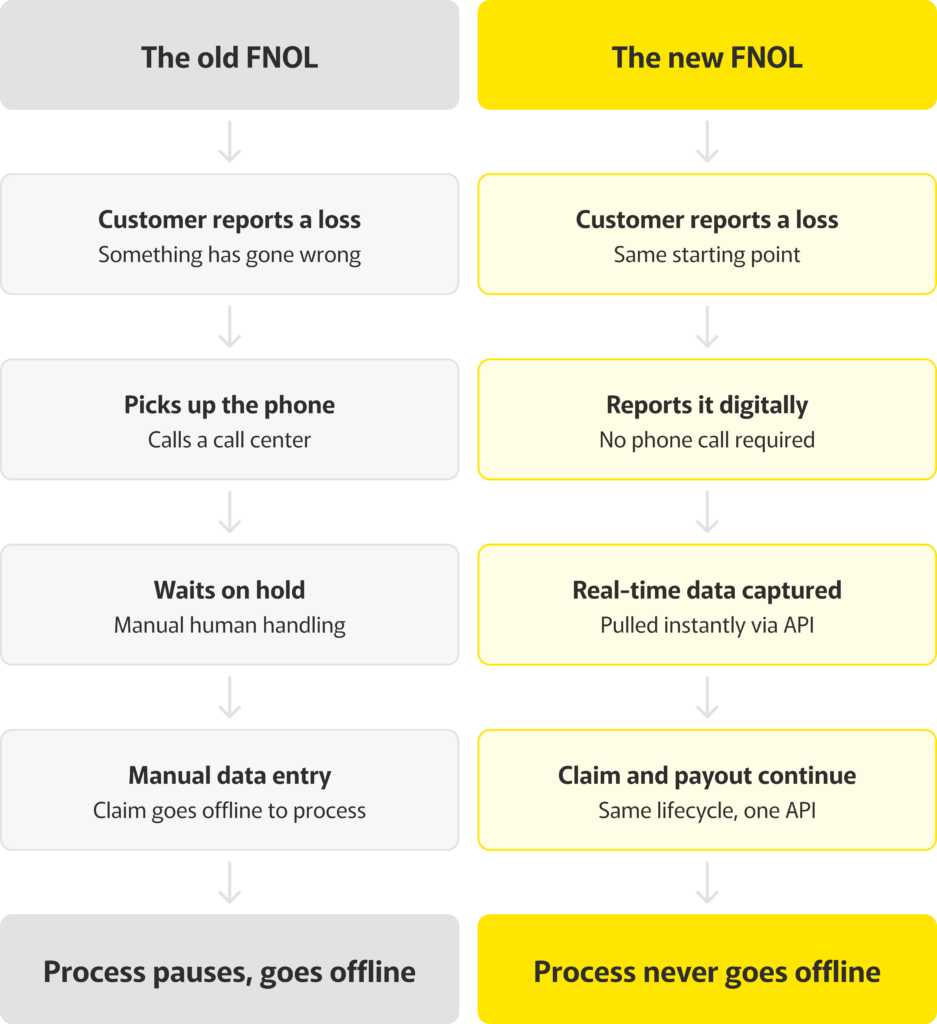
The clearest example is the First Notice of Loss (FNOL) the moment a customer reports that something has gone wrong. Historically, that meant picking up a phone and waiting on hold with a call center. Insurtechs rebuilt that moment using real-time data, so a loss can be reported instantly without ever going offline.
At Cover Genius, that same real-time approach now carries the entire transaction lifecycle, from first notice of loss to claims payout, through a single API.
Where insurance industry growth is headed
During the panel, Chavenson explained that embedded solutions were solving a problem that had plagued insurance for years, a fragmented, expensive distribution model that served neither carriers nor customers particularly well. Embedded protection changes those economics for everyone in the chain, giving carriers more predictable margins and giving customers a better experience, which is why the panel expected the embedded approach to keep expanding into new lines of business and new sectors like auto and mobility, gig economy platforms, and neobanks.
Traum added a data point from his own client conversations. Embedded insurance had become the single most common question he was fielding from clients and prospective clients that year, a clear signal of where market attention was headed.
Regulation as an accelerant, not an obstacle
The panel also tackled a tension specific to insurance. It’s a highly regulated, risk-averse industry, and regulation is usually treated as a brake on innovation. Traum described his own role less as a gatekeeper and more as an educator. Insurance law has real black-and-white rules, but also plenty of gray area where a company can be creative about how it structures a rebate, a referral program, or a new underwriting approach. His job, as he described it, is to lay out the rules of the road and then help clients find a way to get to yes rather than simply saying no.
The moderator then turned the same question on Chavenson directly, asking him to speak from the entrepreneur’s seat: how do you navigate regulation and risk aversion while still shipping something new? Chavenson pointed out that Cover Genius operates across more than 60 countries, so it’s never just US or state-level regulation, it’s an entire patchwork of international rules. His answer was that treating compliance as protecting the customer, rather than as an obstacle, and making that commitment visible from the top of the company, is what lets a highly regulated business still move fast.
Why culture determines whether you keep pace
Technology alone doesn’t explain why some insurtechs keep up with this rate of change and others stall. The moderator put the culture question to Hoffmeyer first, given her seat at the intersection of corporate partners, insurtechs, and venture capital. Her answer centered on speed to learning. Innovation has to be driven both top-down and bottom-up, built into KPIs and into the day-to-day work of each line of business, not parked in a separate innovation lab that operates on its own. Done well, she said, that culture should feel a little uncomfortable and exciting, not scary.
Chavenson’s answer built on that from the inside of an insurtech specifically. The most critical factor in maintaining pace is close collaboration between the people who hold the insurance subject matter expertise and the Product and Engineering teams building the platform. When that collaboration works, it accelerates innovation. When it doesn’t, the two functions end up talking past each other and progress stalls.
Getting that right, in his experience, has been one of the harder problems in insurtech, though not an unsolvable one, and it starts with leadership treating it as a priority rather than assuming it will happen on its own. He added one more piece of advice, empower people to ask “why do we do it this way” rather than defaulting to how a legacy business has always done things, since much of insurance’s complexity is habit and terminology, not real legal or technical constraint.
What this means for platforms today
For platform leaders evaluating embedded insurance today, the panel’s underlying lessons still apply. Regulatory and compliance involvement works best as an early collaborator in the design process, not a final checkpoint bolted on afterward. Keeping track of market signals matters more than reacting to every new headline. And the platforms that will stay at the forefront of this growth are the ones that treat insurance expertise and engineering as a single team, not two departments handing work back and forth.