
Blog
Travel
Parametric Insurance Coverage: Real-World Examples
- 5 min read
IN THIS ARTICLE
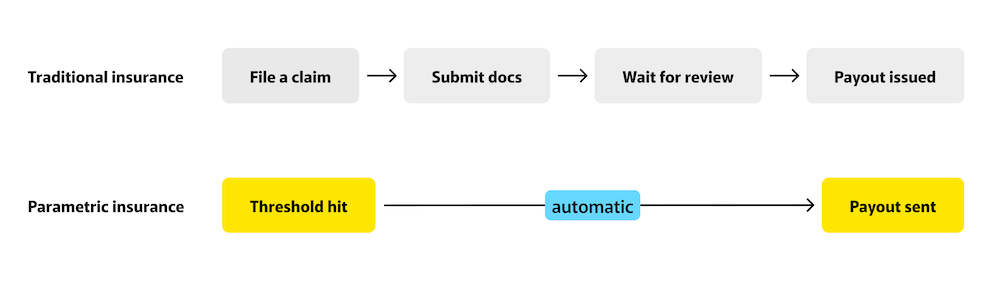
A payout that arrives before the policyholder ever files a claim still sounds far-fetched, but it’s quickly becoming the future of insurance. This is parametric insurance coverage, insurance that pays out automatically the moment a set condition is met, like a flight delay or bad weather. There’s no need for the customer to prove a loss, the event itself is the trigger.
If a qualifying event occurs, the payout is processed and delivered, no claims process required. Some examples of what could be considered qualifying events:
- A flight is delayed past two hours
- A rainfall reading passes 10mm
- An earthquake passes a given magnitude
The global parametric market is now valued at $22.6B, and it continues to grow as the trigger-and-payout model keeps proving itself across very different kinds of risk.
How parametric insurance coverage works in the real world
Here are some examples of how parametric insurance can work in real-life situations.
Flight delay
Travel is where most people encounter parametric insurance first. Airlines and airports already track flight delays to the minute, for their own operational reasons like scheduling and passenger rebooking, long before insurance ever gets involved. That existing data is what makes a trigger possible without anyone having to build new tracking infrastructure just for insurance.
Delays are common due to weather, staffing, and mechanical issues, and a passenger whose flight lands two hours late may miss a connection or lose time at their destination. Under a typical travel insurance policy, they still have to file a claim and produce documentation to get anything back for it, unlike parametric insurance.
Situation: A traveler books a flight through an online travel platform, with a connecting flight scheduled tight enough that any delay puts it at risk. A mechanical issue at the gate pushes the initial flight back three hours, and by the time the flight lands, the connection has already left. The traveler is now rebooking a new flight.
Solution: The online travel platform offers delay protection when a traveler is booking a flight at checkout. The moment a flight lands more than two hours late, a fixed payout fires automatically to the card used at booking and a notification is sent to the traveler. The payout uses airline data to automatically detect the delay once it reaches a certain threshold, and the traveler is never required to make a claim for the payout.
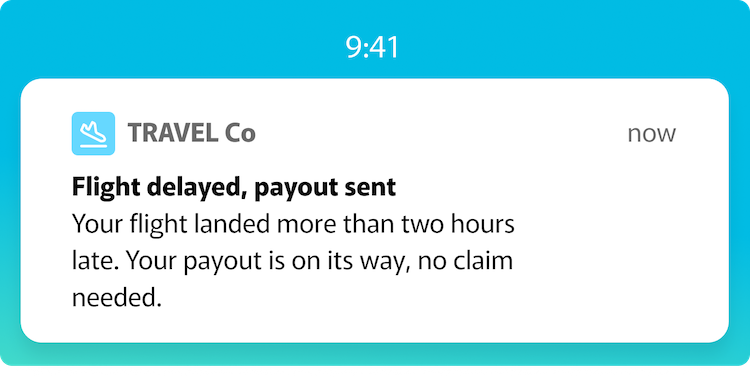
Flight delay payouts can also vary, depending on the agreement between the airline or booking platform and the protection provider. A shorter delay threshold can trigger other benefits like instant lounge access instead of cash. The platform may even opt to offer parametric insurance for baggage delay, relying on real-time baggage tracking data that pays out according to a specific timeline.
Weather events
Bad weather doesn’t always show up as a delay. Sometimes it cancels a flight completely. A grounded flight resets a traveler’s plans entirely with a new flight, a same-day hotel, and a different way to reach their connecting flight.
Situation: A traveler books a flight through a travel platform for an upcoming trip. A winter storm sits over the departure airport, and conditions cross the point where the airport itself halts departures. The traveler is now rebooking a new flight, covering a same-day hotel, and missing whatever connection flight came next.
Solution: The travel platform ties the payout to the airport’s own published weather data instead of the airline’s delay feed, sustained winds above 50 miles per hour or visibility under a quarter mile at the scheduled departure time. Once the reading crosses that threshold, a fixed payout fires automatically to the card used at booking.
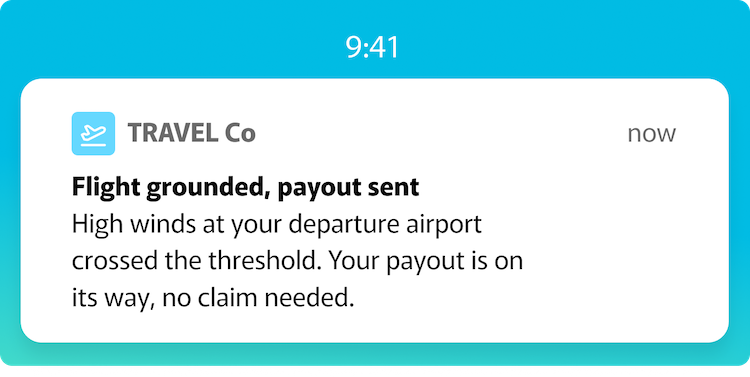
The threshold itself is set in advance, not fixed by any industry standard. A platform and its protection partner agree upfront on the exact reading that counts, a wind speed, a visibility minimum, a rainfall total, and that number can flex by route, season, or risk appetite.
Event cancellation
Rhino’s mission is to make housing more affordable for renters while ensuring property owners have what they need to operate sustainable businesses.
Fans buying tickets to an outdoor event have historically had little recourse when the show gets rained out. Whether they get a refund is usually decided later, case by case, by the venue, not something built into the ticket itself. Parametric insurance can solve this.
Situation: A fan buys tickets to an outdoor festival months in advance, with no way to know what the weather will be on that day. A storm rolls through and the show is cancelled, and the fan has no fast or objective way to get a refund back.
Solution: The ticketing platform offers event protection into the ticket purchase itself, setting a rainfall trigger for the event date agreed in advance. If rainfall at the venue crosses that threshold, the fan gets a refund credited automatically to the card they bought with. A claim isn’t required and the weather station reading is the only evidence needed.
Rather than the customer waiting on the venue to issue a refund or credit, a solution comes directly from the platform that the fan used to book their tickets.
Three things every parametric insurance example shares
Every scenario above shares the same three things:
- A trigger is drawn from data the platform or provider already has
- A payout that does not depend on proving loss after the fact
- A decision to embed the coverage into the moment of purchase rather than sell it as an afterthought
Parametric insurance addresses claims payout speed, provides easier protection options for the customer, and turns protection into a positive customer experience and retention lever.
How Cover Genius makes the payout arrive faster
Trigger-based payouts only build trust if they actually arrive fast. That’s the problem Cover Genius is built to solve. Our claims infrastructure settles instant payouts in 90+ currencies, 60+ countries, and all 50 US states. We built this for platforms embedding protection into a purchase flow, whether that flow is a flight booking, a hotel, or an event ticket. What we focus on is making sure the payout actually arrives the moment the condition is met, that’s what turns protection into something customers trust and come back for.
Related Articles
What Is Parametric Insurance? Definition, Examples, and How It Works
What Travel Companies Should Know: Top Findings from the 2026 Embedded Protection Market Research Report
New Global Research: Consumers Are Underprotected at the Moments That Matter Most
Get in touch
All we need is some quick background info to understand how we can best help.