
Blog
Travel
What Is Parametric Insurance? Definition, Examples, and How It Works
- 8 min read
IN THIS ARTICLE
What is parametric insurance?
Parametric insurance is a type of coverage in which the insurer agrees, in advance, to pay a predetermined, fixed amount if a specific, measurable event occurs, regardless of the actual financial loss the policyholder ultimately experiences.
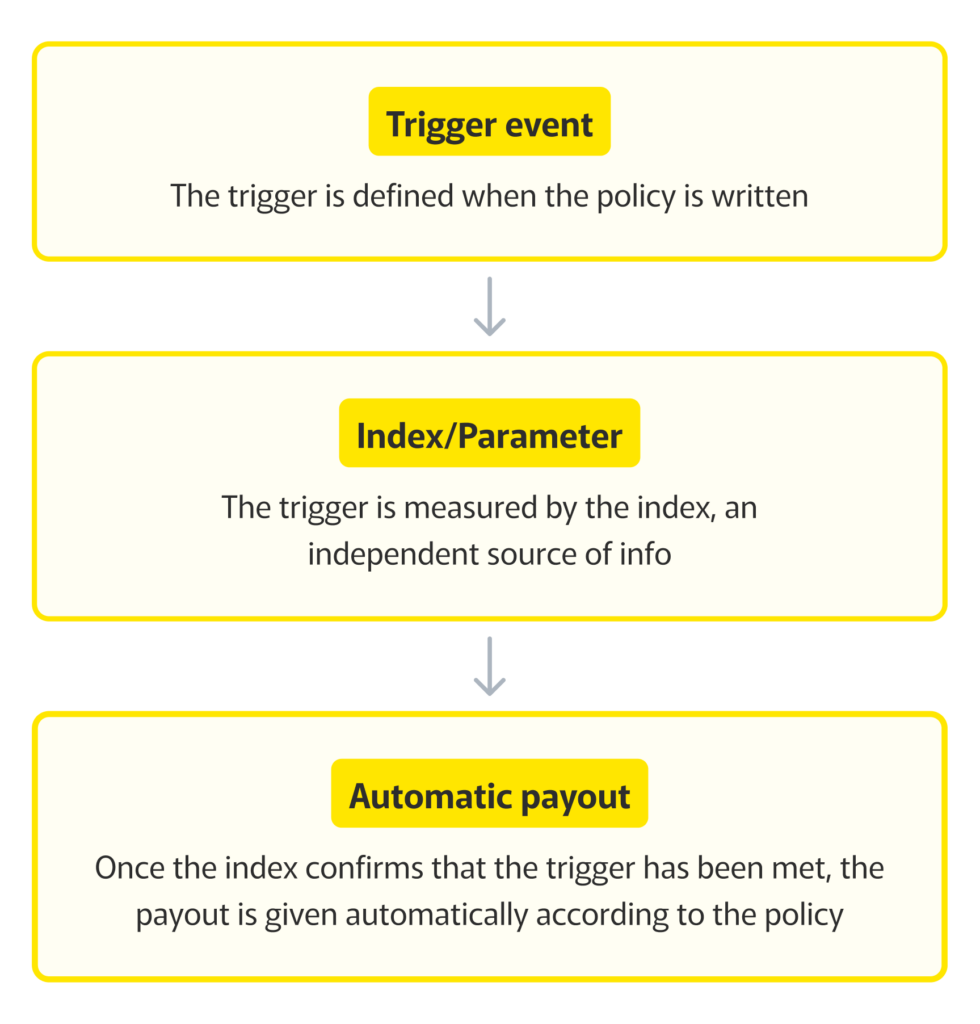
Every parametric policy consists of three elements:
- The trigger: the specific event the policy is written against
- The index or parameter: The objective, independently reported measurement used to confirm whether the trigger occurred
- The payout: The fixed amount specified in the policy, sent automatically once the index confirms the trigger has occurred
This differs fundamentally from traditional, indemnity-based insurance. Traditional insurance pays out based on an assessment of damage actually incurred, that a claims adjuster has to verify. For example, an indemnity-based insurance policy could pay out 80% of the damage associated with a car crash. On the other hand, parametric insurance payouts are tied to the occurrence of an event, not to an assessment of damage. A traveler’s parametric policy could pay out $20 automatically if it rains more than 0.5 inches on a vacation day.
How parametric insurance works
The trigger event
A parametric policy begins with a trigger defined at the time the policy is written. The insurer and the policyholder agree on the exact conditions in advance, including: the type of event, the threshold that counts as significant, the geographic area covered, and the time period during which the policy applies. For example, a travel policy might specify that any flight delay of two hours or more, departing from a named airport, triggers a payout.
The index or parameter
Once a trigger is defined, it is measured by the index, which comes from a source independent of both the insurer and the policyholder. This could be a flight-tracking database, a national meteorological agency, a seismographic network, or satellite imagery, depending on the trigger involved. Because neither party controls the data, neither party can dispute the outcome once the index reports it.
The automatic payout
When the index confirms that the trigger has been met, the payout follows automatically, calculated using the fixed amount specified in the policy. Depending on the product, the policyholder might not need to file a claim at all: some parametric platforms initiate payment as soon as the trigger is confirmed, rather than waiting for the policyholder to notice and report it. This is the structural reason parametric claims typically settle in days, not weeks.
Parametric vs. traditional insurance
The two models differ at almost every stage of the claims process, from what triggers a payout to how long that payout takes to arrive.
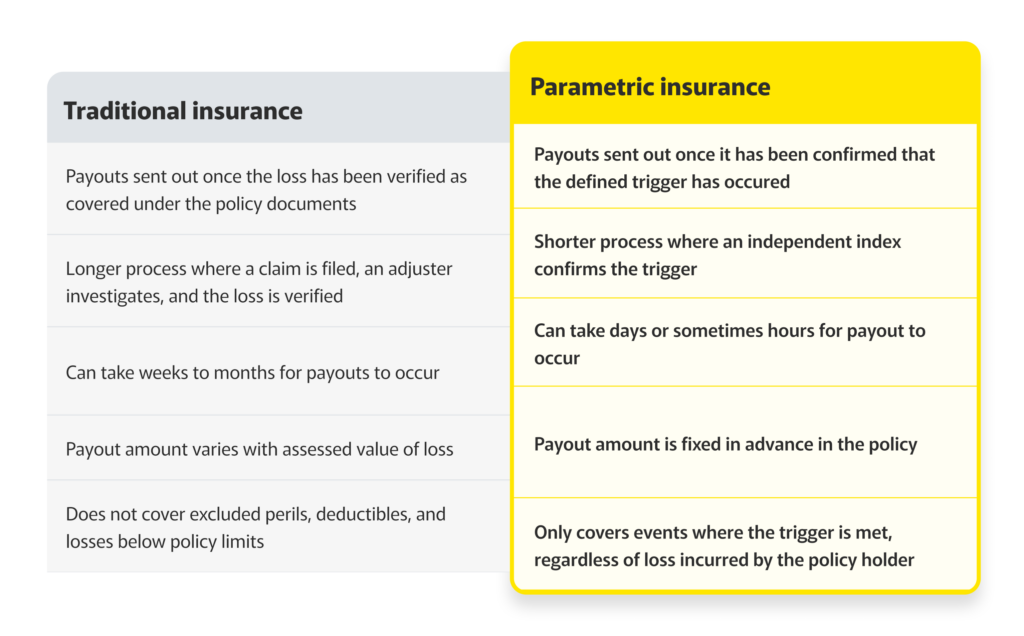
Neither model is objectively better; they simply have different uses. Traditional insurance is built to provide payout for an actual loss, however long that takes to determine. Parametric insurance trades precision for speed and certainty, which is why it tends to be used for situations where timing matters most, such as disaster relief, agriculture, and travel disruption.
Real-world examples
Few insurance mechanisms adapt as easily across industries as parametric insurance. It is a flexible mechanism that can be reused wherever a measurable event and a financial loss are reliably connected.
Climate and disaster relief
Parametric insurance has the deepest roots in disaster relief, where speed of payment can determine how quickly a government or community recovers. The Caribbean Catastrophe Risk Insurance Facility (CCRIF), established in 2007, lets Caribbean and Central American governments pool risk and buy coverage against hurricanes and earthquakes at a lower cost than any one country could secure alone. Payouts are triggered by wind speed or seismic readings, not by a post-event damage assessment, which allows funds to reach affected governments within weeks rather than months.
The model has been used at national scale more than once. After Cyclone Harold struck the Pacific in 2020, the government of Tonga received a $4.5M payout from the Pacific Catastrophe Risk Insurance Company, the largest payment in the program’s history, providing immediate funding for disaster response. In Mexico, the state of Quintana Roo insures part of the Mesoamerican Reef against storm damage. The policy, triggered by wind speed, paid out $850,000 after Hurricane Delta in 2020, funding reef restoration before any formal damage survey was complete.
Agriculture
Agriculture is another of the earliest and largest use cases for parametric insurance. If precipitation in a defined region falls outside an agreed threshold during the growing season, a rainfall-indexed policy pays a farmer automatically, regardless of that specific farmer’s actual yield. This matters in regions where assessing individual crop losses field-by-field would be too slow or too costly to be practical. For example, the United States Department of Agriculture’s (USDA) Pasture, Rangeland, Forage program insures ranchers against a lack of rainfall using an area-based index. Payouts are tied to an area’s deviation from normal precipitation.
Parametric coverage has also been adopted widely across developing economies. In Kenya, Rwanda, and Tanzania, ACRE Africa bundles index-based insurance with agricultural credit and farm inputs, using satellite vegetation data to trigger livestock payouts once forage conditions fall below a critical threshold during drought. By 2018, the program had insured more than 1.7 million smallholder farmers against roughly $180 million in weather-related risk. In February 2026, Ecuador became one of the latest countries to adopt parametric coverage, placing its first agricultural policies to protect smallholder rice and maize farmers from extreme rainfall and drought through automatic, threshold-triggered payouts.
Travel
Flight delay protection is one of the fastest-growing applications of parametric insurance and the one most travelers are likely to encounter directly. Once flight-tracking data confirms that a delay has passed an agreed length, the policy pays out automatically, with no forms to complete and no claim to file. Cover Genius builds this same trigger-based model into its own flight delay compensation, converting live flight-tracking data into automatic cash, lounge access, or flight credit the moment a covered delay is confirmed.
Benefits and limitations
The greatest advantage of parametric insurance is speed. Because payment depends only on confirming that a trigger occurred, rather than assessing the size of a loss, claims settle in days rather than weeks, sometimes without the policyholder taking any action at all. The terms are also transparent, with the trigger, the index, and the payout all agreed upon at policy signing, so there is nothing left to interpret or dispute once an event occurs.
However, parametric insurance comes with a known limitation called basis risk, the possibility that the trigger and the actual loss do not line up. Because payouts are tied to an index rather than an inspected loss, it is possible to suffer real damage without qualifying for a payout, or to receive a payout for an event that caused little practical harm. A flight delayed 1 hour and 55 minutes produces the same missed connection and the same frustration as one delayed 2 hours and 5 minutes, but only the second qualifies for coverage if the policy’s threshold is set at two hours. A rainfall-indexed crop policy can miss losses caused by a hailstorm, if the underlying peril (hail) was never part of the index in the first place. Because of this tradeoff, parametric insurance is typically positioned as a complement to traditional coverage rather than a replacement.
A growing market
Parametric insurance is no longer a niche product. The global market was valued at roughly USD $19.4 billion in 2025 and is projected to reach USD $63.8 billion by 2035, growing at a compound annual rate of about 12.2% over that period. North America currently holds the largest share, while Asia-Pacific is growing the fastest, driven in part by large agricultural insurance programs and expanding weather-data infrastructure across the region.
Much of that growth traces back to the rising frequency of climate-related disasters, faster claims settlement than traditional insurance can offer, and growing adoption in agriculture and food security programs. As satellite observation and weather-data analytics keep improving, the triggers behind these policies are also becoming more precise.
To wrap it up
Parametric insurance is not a replacement for traditional coverage, but it solves the specific problem of getting help to someone quickly, without asking them to first prove how much they lost. For travelers, farmers, and communities alike, that speed can be the difference between a minor inconvenience and genuine hardship. For businesses offering this kind of protection, the same trigger-based model removes much of the overhead traditional claims handling requires, with fewer investigations, fewer disputes, and a faster path to resolution for everyone involved.
As more industries build products around measurable, real-time triggers, parametric insurance is likely to keep expanding well beyond its origins in disaster relief and agriculture. Curious how this applies to travel specifically? See how Cover Genius thinks about real-time, trigger-based protection for travelers.
FAQ
What is parametric insurance?
Parametric insurance is a type of coverage in which the insurer agrees, in advance, to pay a fixed and predetermined amount if a specific, measurable event occurs, regardless of the actual financial loss the policyholder ultimately experiences.
Is parametric insurance the same as traditional insurance?
No. Traditional insurance typically reimburses a policyholder for the actual loss experienced, verified through a claims investigation. Parametric insurance pays a predetermined amount once an independent source confirms that a specific trigger event occurred, without any investigation into the loss itself.
What happens if my actual loss doesn’t match the trigger?
This is called basis risk, and it is the main limitation of parametric coverage. Because a parametric payout is based entirely on whether the trigger was met, it is possible to experience a real loss without qualifying for payment, or to receive a payout for an event that caused little practical harm.
Can individuals buy parametric insurance, or is it only for governments and businesses?
Individuals can also buy parametric insurance. Governments use it for disaster relief, businesses use it for supply chain and revenue protection, and individuals increasingly encounter it directly, most often through travel products like flight delay compensation or hotel weather guarantees.
Glossary
Area-based insurance: A type of coverage where payouts are calculated based on conditions in a geographic area, rather than on an individual policyholder’s specific losses.
Basis risk: The gap between what a parametric insurance trigger measures and what the policyholder actually experiences as a loss.
Claims adjuster: A professional who investigates insurance claims and determines the amount of compensation a policyholder should receive in traditional insurance.
Caribbean Catastrophe Risk Insurance Facility (CCRIF): a regional risk pool established in 2007 that allows Caribbean and Central American governments to buy disaster insurance (against hurricanes and earthquakes) at lower cost than any single country could secure alone.
Index (or parameter): An objective, independently reported measurement used to confirm whether a parametric insurance trigger has occurred. Common indices include wind speed, rainfall, earthquake magnitude, flight-tracking data, or satellite-derived vegetation measurements. Because neither the insurer nor the policyholder controls the index, neither party can dispute the outcome.
Index-based insurance: Another term for parametric insurance; coverage triggered by a measurable, independent metric rather than by a claims adjuster’s assessment of loss.
Parametric insurance: A type of coverage in which the insurer agrees, in advance, to pay a fixed, predetermined amount if a specific, measurable event occurs, regardless of actual loss.
Payout: The fixed amount of money specified in a parametric policy that is paid automatically once the trigger is confirmed by the index, with no claims investigation required.
Rainfall-indexed policy: A parametric insurance product triggered by precipitation measurements in a defined region. Commonly used in agriculture to protect farmers from drought, regardless of how each individual farm’s crops actually performed.
Trigger: The specific event defined in a parametric policy that, once confirmed by an independent index, automatically initiates a payout.
Traditional insurance (or indemnity-based insurance): Insurance that reimburses a policyholder for verified actual losses, determined through a claims investigation process. Payouts vary based on the assessed value of the loss and can take weeks or months to arrive.
Weather guarantee: A type of parametric coverage that reimburses a customer (such as a hotel guest) if specific weather conditions occur during a defined period.
Related Articles



Get in touch
All we need is some quick background info to understand how we can best help.