The 2026 Embedded Protection Market Research Report
The Protection Gap: What Consumers Reveal about Embedded Protection
Consumers think about risk every time they transact, yet most don’t fully understand the protection they already have. Additionally, the products they want most aren’t the ones they’re offered. New research from Cover Genius and Gather maps where consumer readiness and market execution diverge, and what it means for travel, banking, and shipping.
12 min read
IN THIS ARTICLE
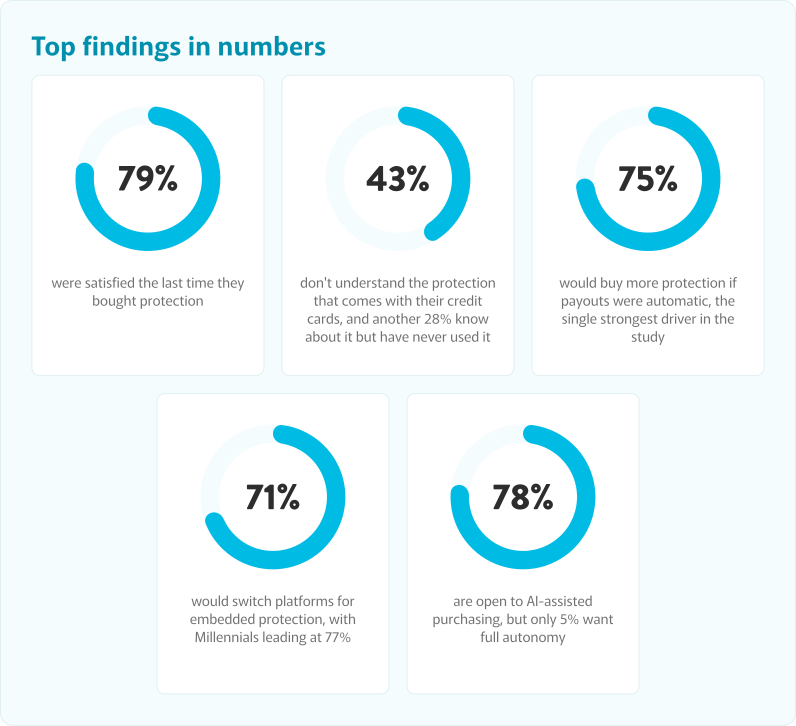
Consumers are ready to buy protection. They think about risk when they transact, they value the coverage offered, and when they have purchased protection before, 79% walked away satisfied. The problem isn’t demand. What fails is visibility: the protection people already have stays invisible to them, and the protection they want most is rarely the protection they’re shown.
Embedded insurance is everywhere consumers transact. It’s in the card that covers rental car damage, the booking platform that offers trip cancellation at checkout, and the loyalty program with built-in travel benefits. Most of the time, consumers never notice it. Cover Genius and Gather surveyed 1,392 consumers across seven countries and four generations in March and April 2026, mapping risk awareness, product preferences, and the delivery mechanics that convert intent into purchase. The finding underneath every chapter is the same: the gap is execution, not appetite.
Chapter 1
Protection is already there.Consumers just cant see it.
Risk awareness is nearly universal. 87% of consumers weigh what could go wrong when they book travel or purchase a product, and 81% engage seriously when protection is offered. The shortfall is visibility, not attention: most consumers can’t see the coverage they already hold, and can’t act to purchase protection they don’t know exists.
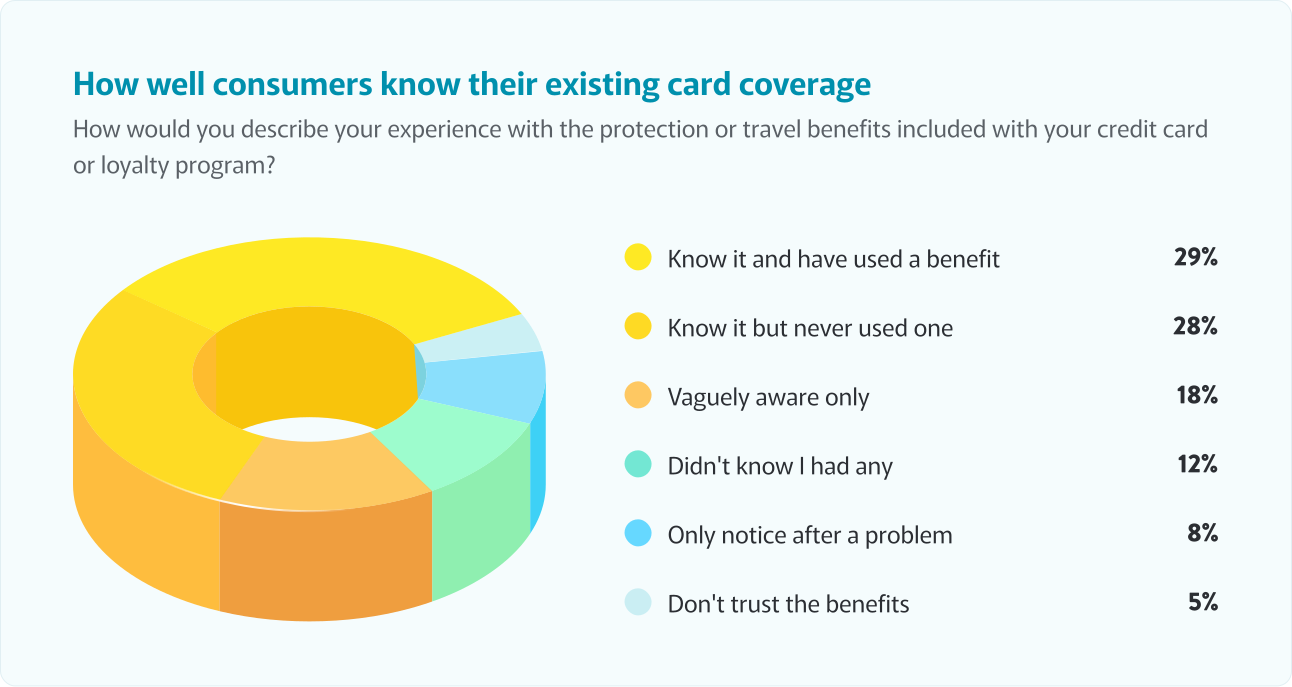
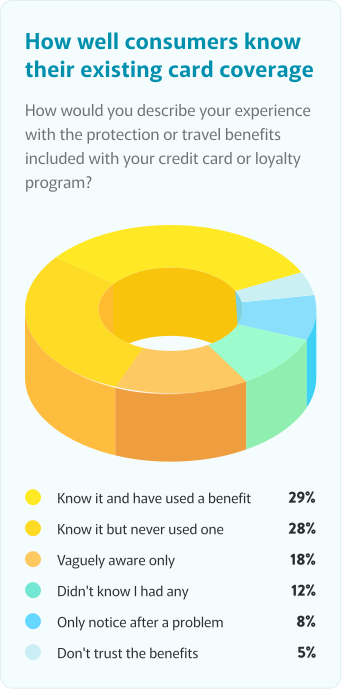
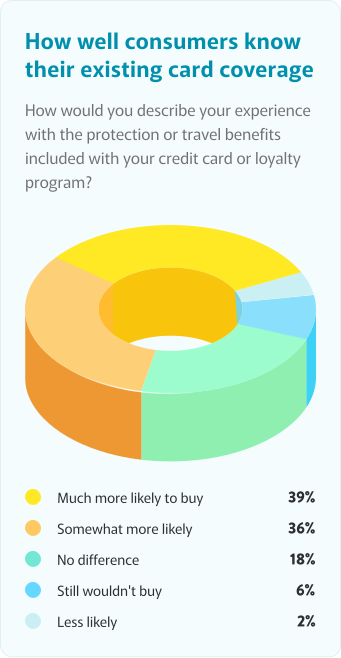
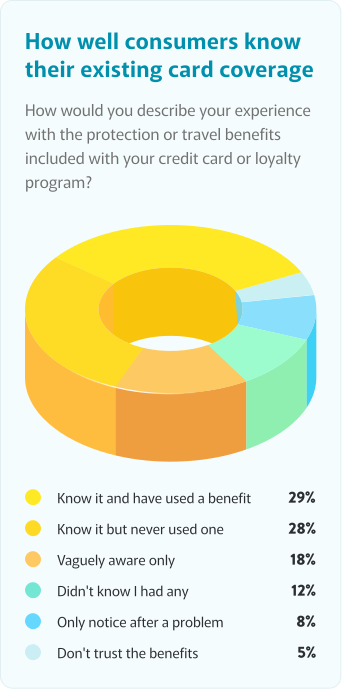
The market splits three ways. Only 29% understand their coverage and have actually used a benefit. Another 28% know their coverage but have never used it, a pool of dormant value sitting unclaimed. 43% don’t fully understand their coverage at all.
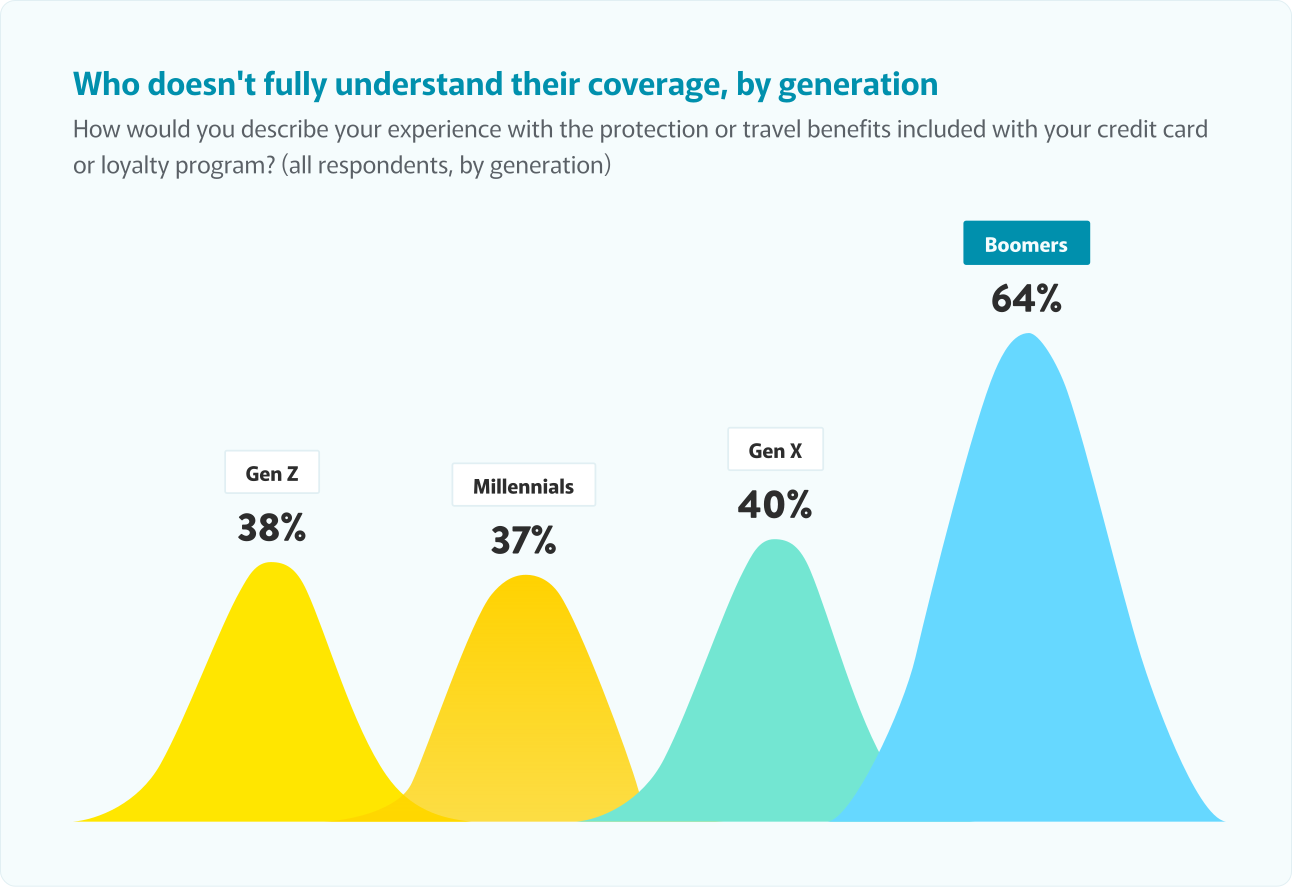
The confusion isn’t evenly spread. It concentrates among Boomers, the group least likely to have ever used a card benefit, which means the customers that are hardest to reach are also the ones sitting on the most unclaimed value. For an issuer, that’s where a plain-language nudge earns the most.
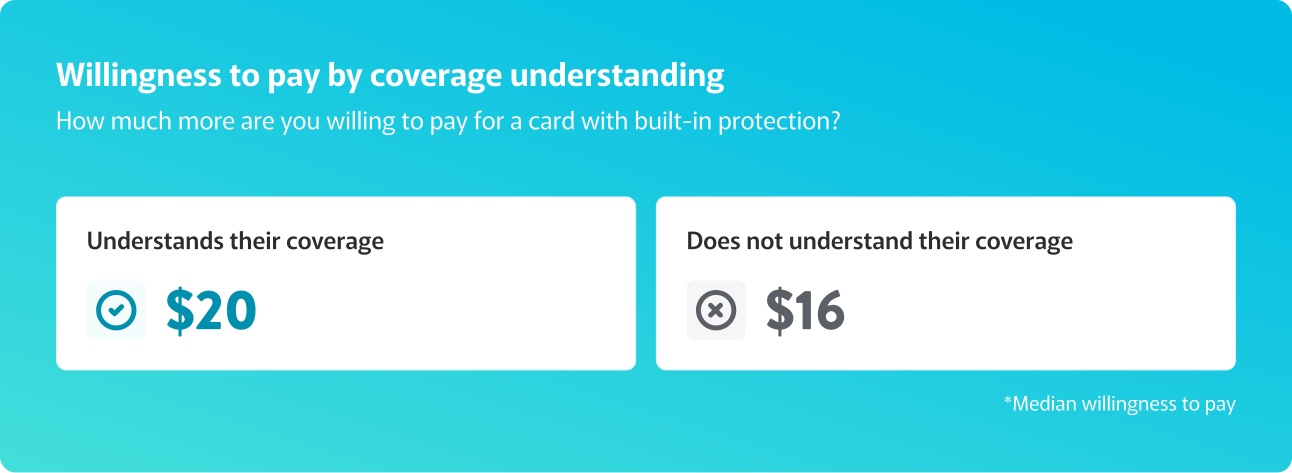
Understanding pays. The customers who understand what their protection covers will pay a 25% premium for it, which turns plain-language explanation from a service task into a margin lever. Clarity isn’t a courtesy here; it’s pricing power.
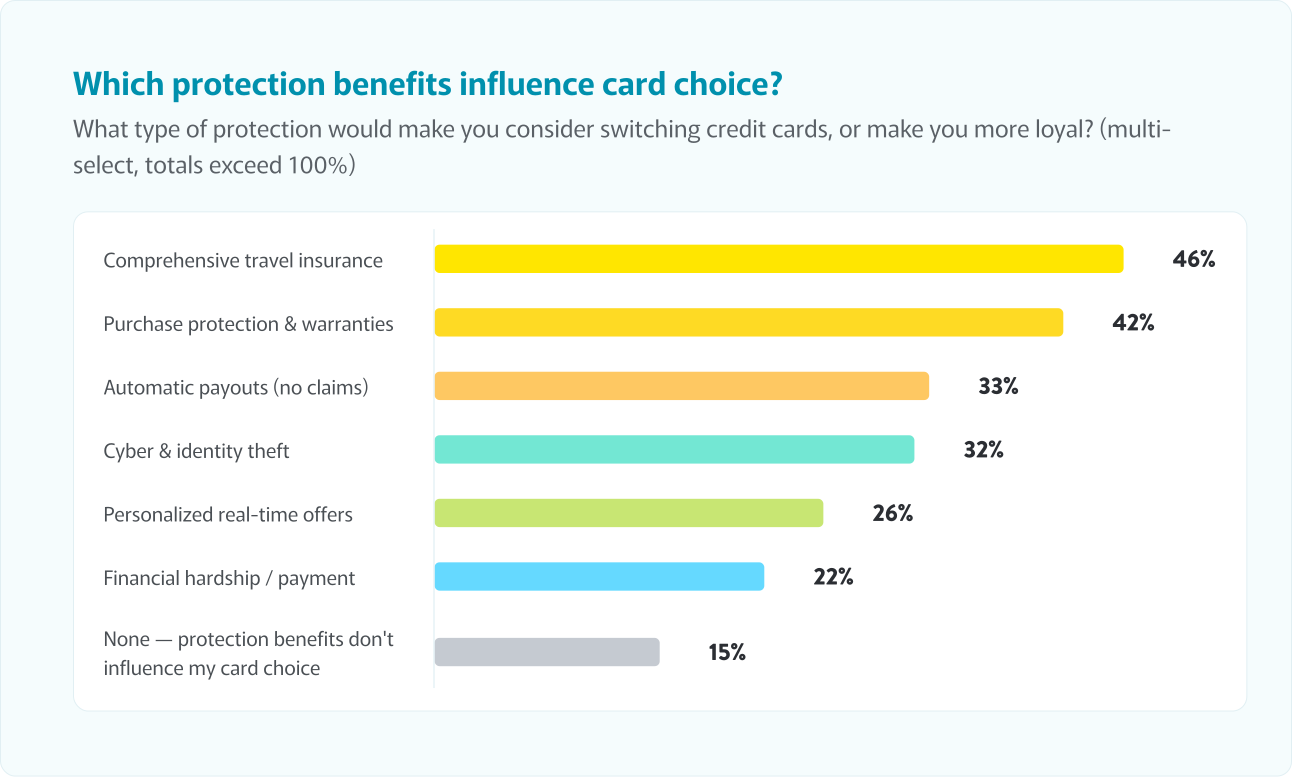
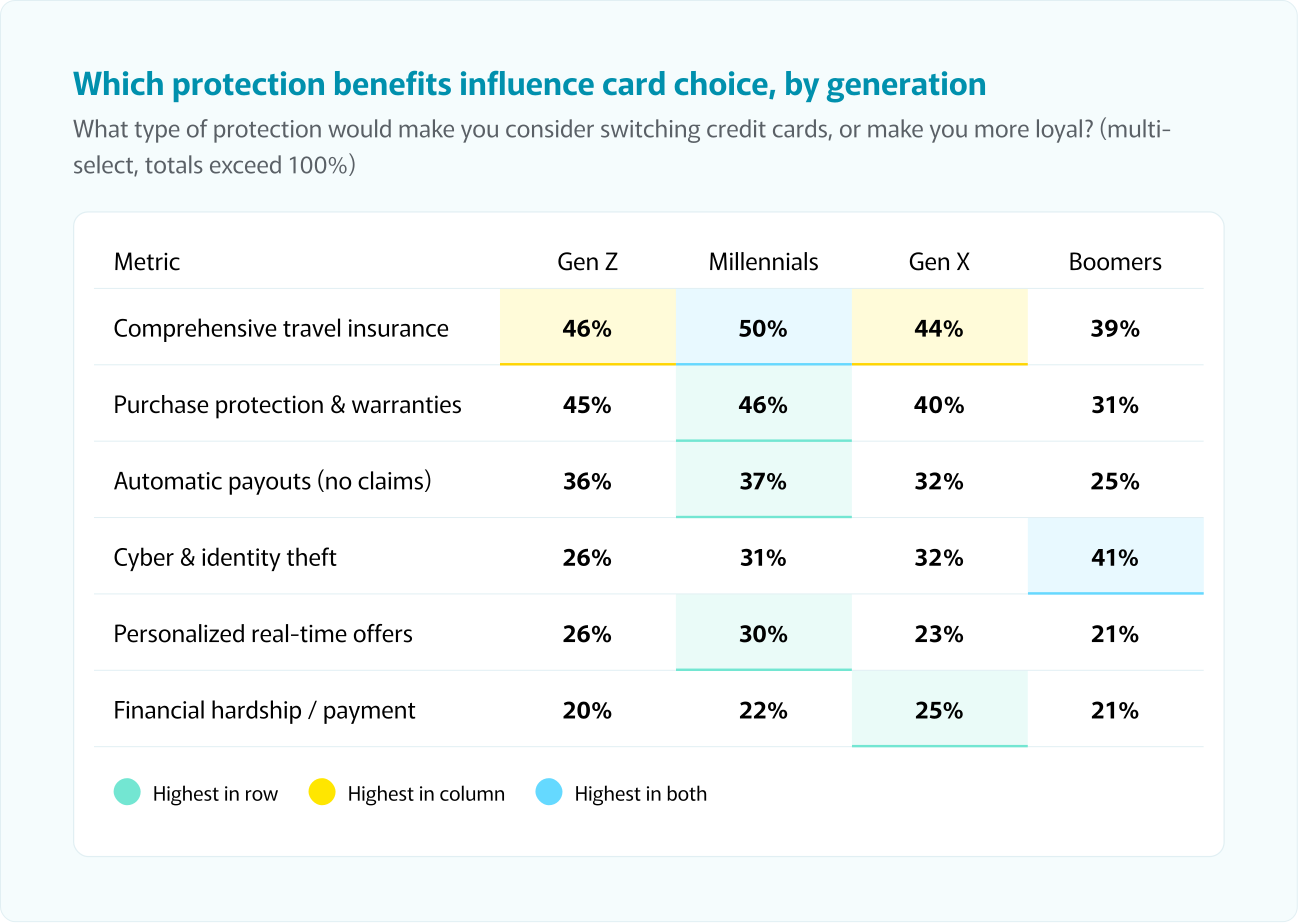
Protection isn’t a nice-to-have on a card. 85% say these benefits influence which card they carry (only 15% said that protection benefits don’t influence their choice of card), which makes protection a retention lever hiding in plain sight. For an issuer, that reframes protection spend as a loyalty investment: the benefits already on the card can be marketed as a reason to keep it rather than a cost to absorb.
Cyber and identity theft protection is the one benefit that climbs with age, from 26% among Gen Z to 41% among Boomers, where it outranks every other benefit. Every other benefit peaks with Millennials and tapers toward older cohorts, so the offer should change by age: travel and purchase protection for younger cardholders, and cyber and identity protection for older ones.
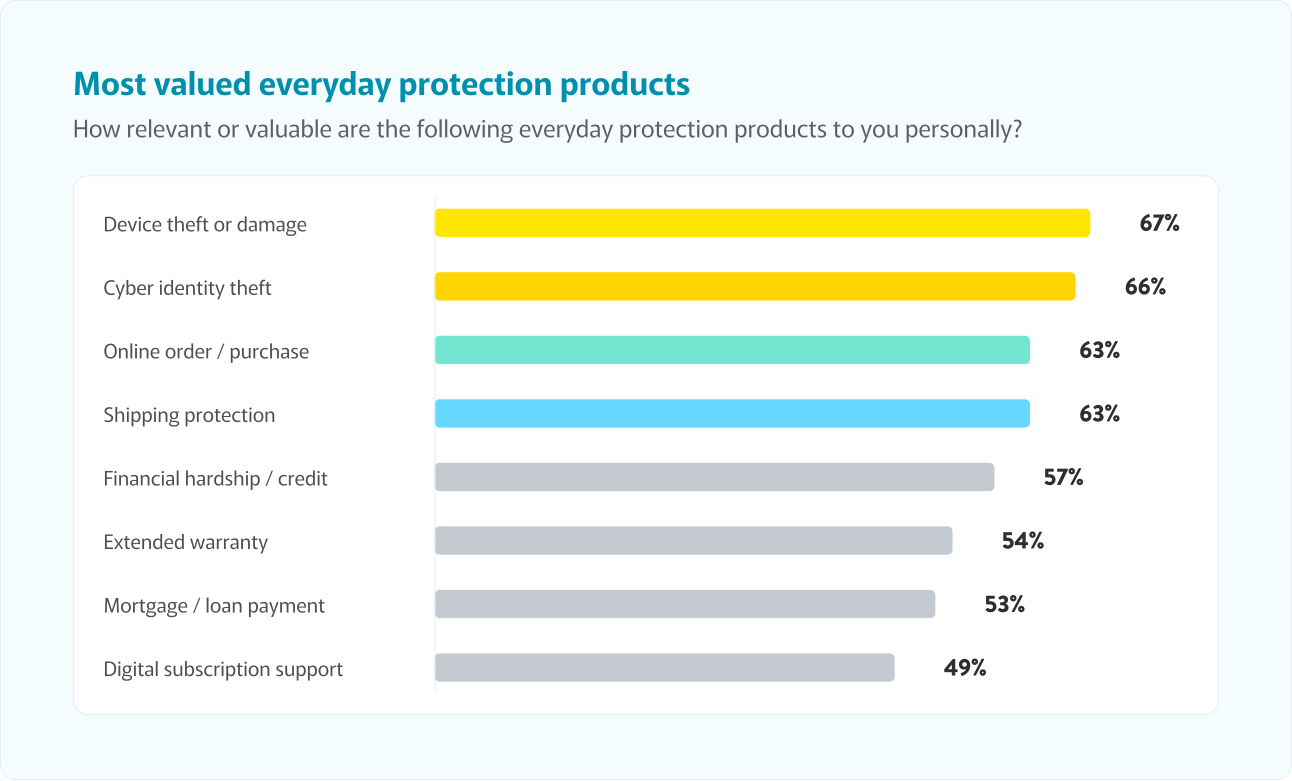
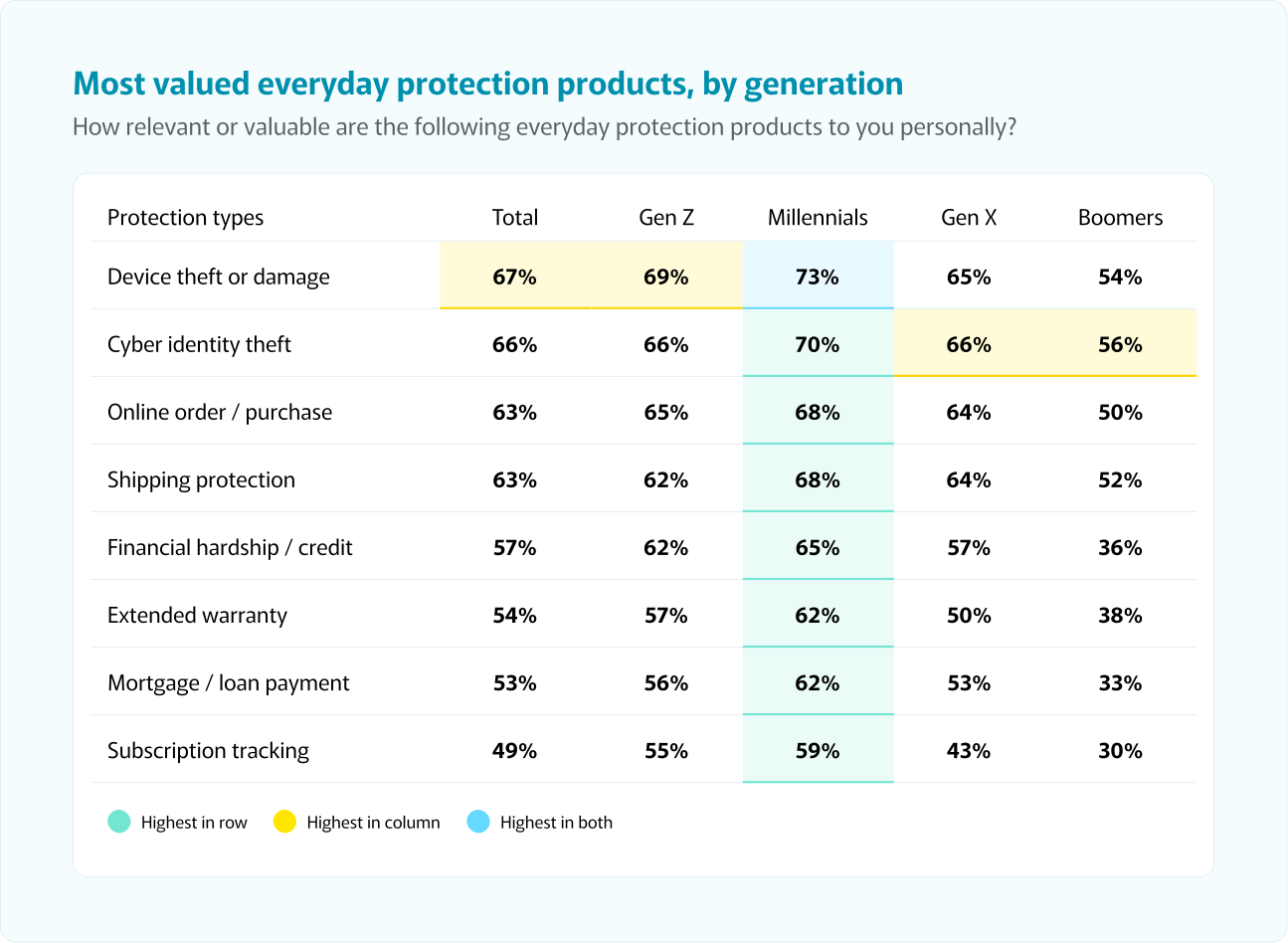
Device theft leads in every generation. For issuers and platforms whose protection lineup is built around trips, that’s a signal to broaden the portfolio: the everyday risks consumers now rank highest are the ones current offers cover least.
Millennials are the peak everyday-protection buyers, ranking highest on all eight products rather than device theft alone. The generational gap also widens as risk gets more financial: device and cyber protection hold up fairly evenly across ages, but interest in financial hardship, loan, and subscription protection falls off sharply for Boomers (from the low 60s among Millennials to the low 30s). Older consumers want protection against theft and cyber loss; they’re far cooler on financial-lifecycle cover. The takeaway for issuers is to lead the everyday-protection pitch with device, cyber, and shipping cover for all ages, and reserve the financial-protection products for younger, higher-engagement cardholders.
Chapter 2
Removing friction: Automatic payouts and contextual offers
No single trigger converts everyone, but one mechanic outperforms all the others. The clunky and long claims process is the moment protection most often fails the customer, so streamlining the claim removes the biggest reason people walk away from coverage they already want.
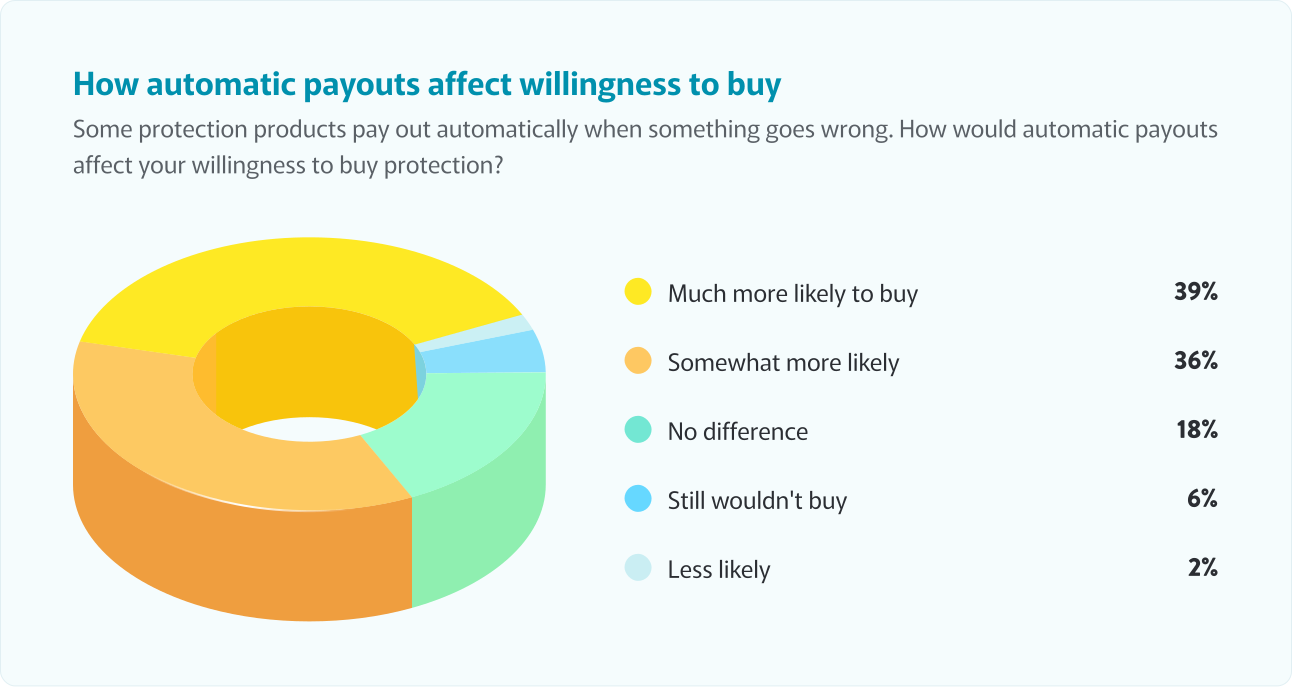
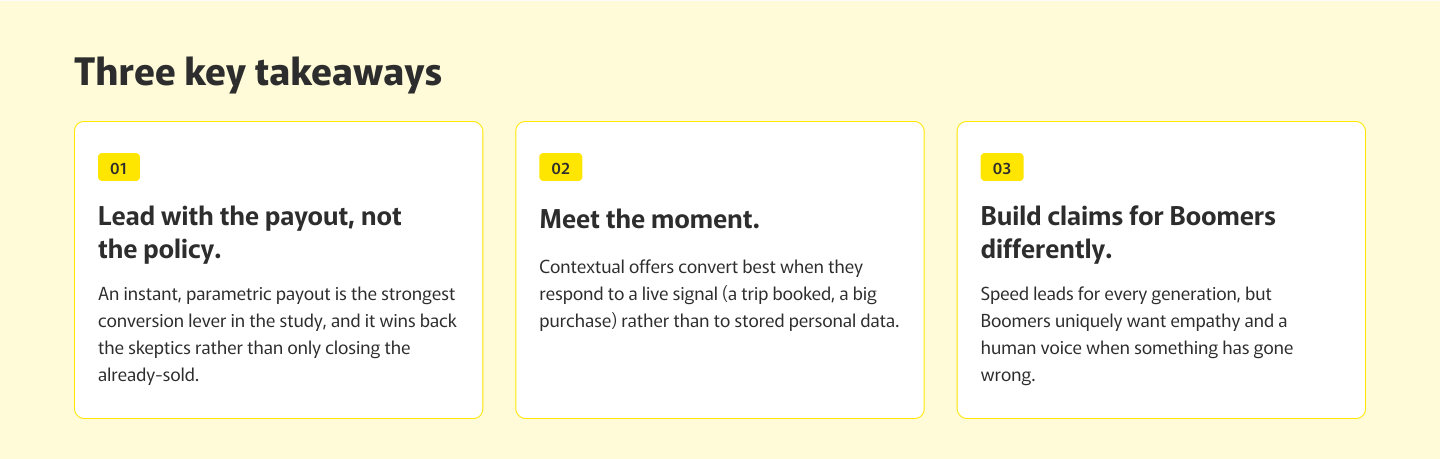
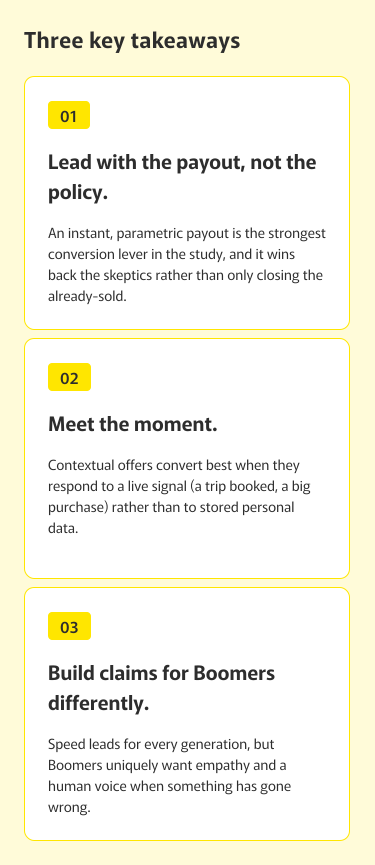
75% would buy more protection if payouts were automatic, and 71% would switch platforms to get it, the strongest purchase driver in the study. The reason is because it removes the single worst moment in the protection experience: the claim. It’s the part where a customer has to fight to be paid, and that’s why it outperforms price, brand, and every other lever tested.
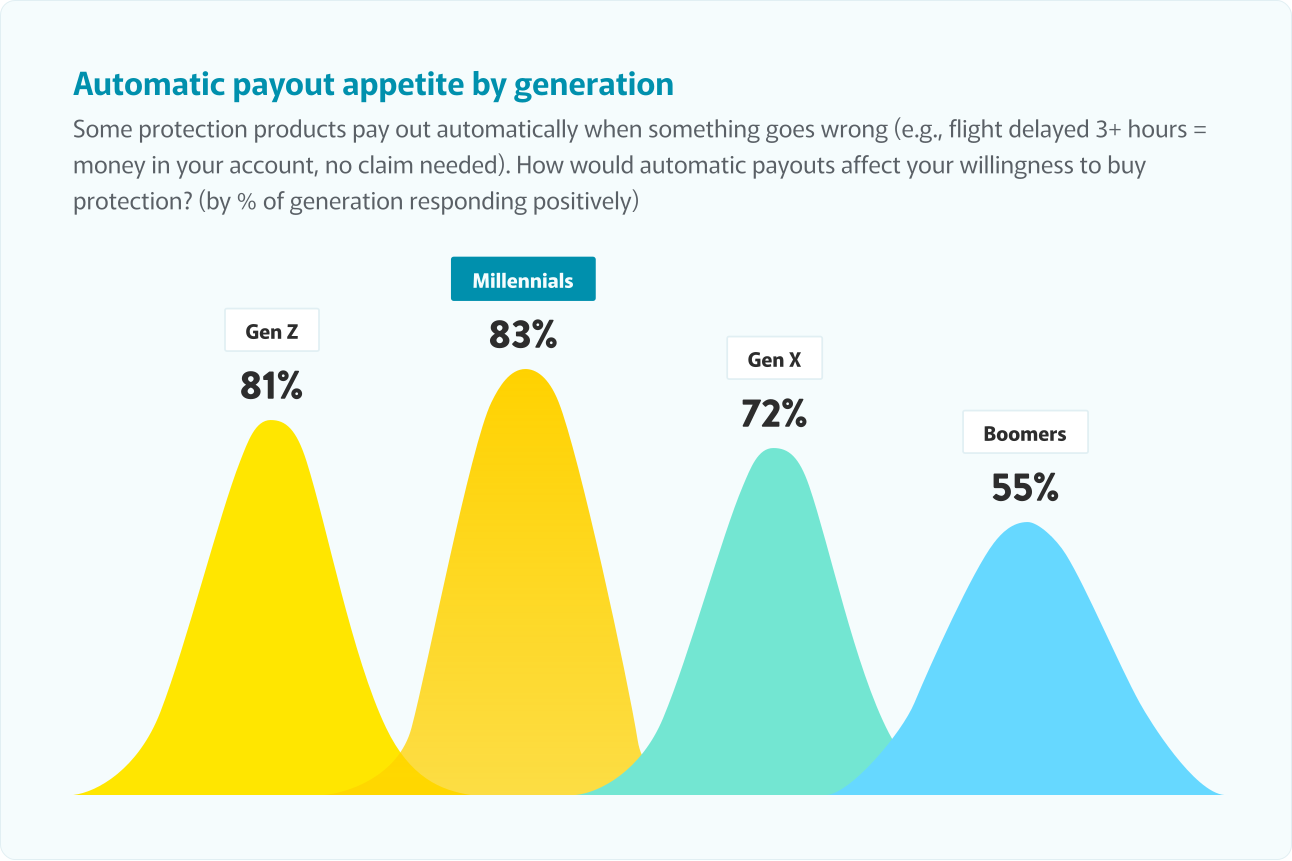
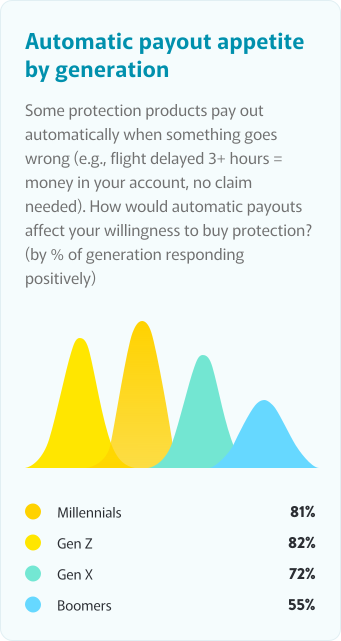
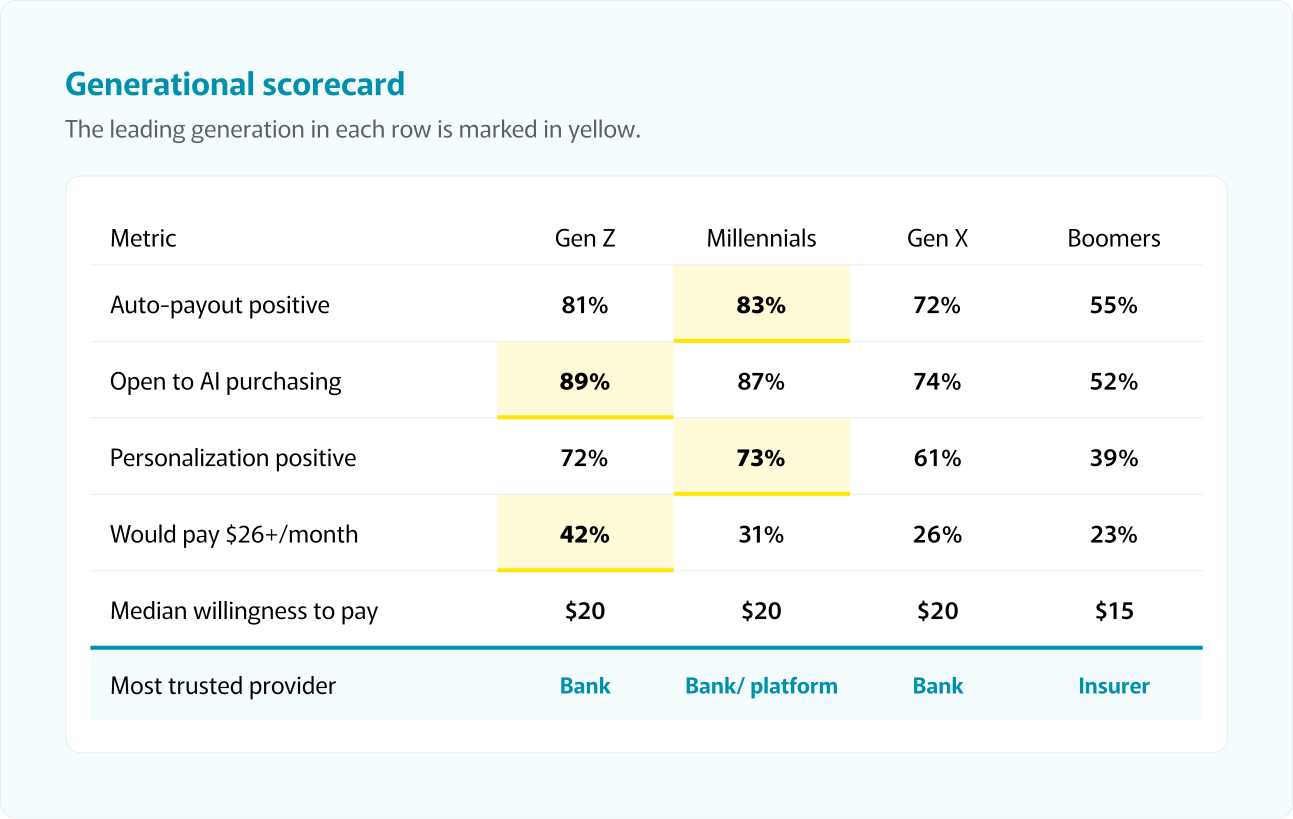
Millennials and Gen Z have a stronger appetite for automatic payouts than Gen X and Boomers, but the demand remains relatively high among all generations. A no-claim payout removes the friction that turns first-time buyers into lifelong decliners. It could also win back the customers who declined protection after a bad past claim experience, beyond the ones already inclined to buy.
Automatic payouts strip friction out of the claim after something goes wrong. Contextual, personalized offers strip it out before by putting the right coverage in front of the customer at the exact moment of risk. Both are the same play: make protection effortless.
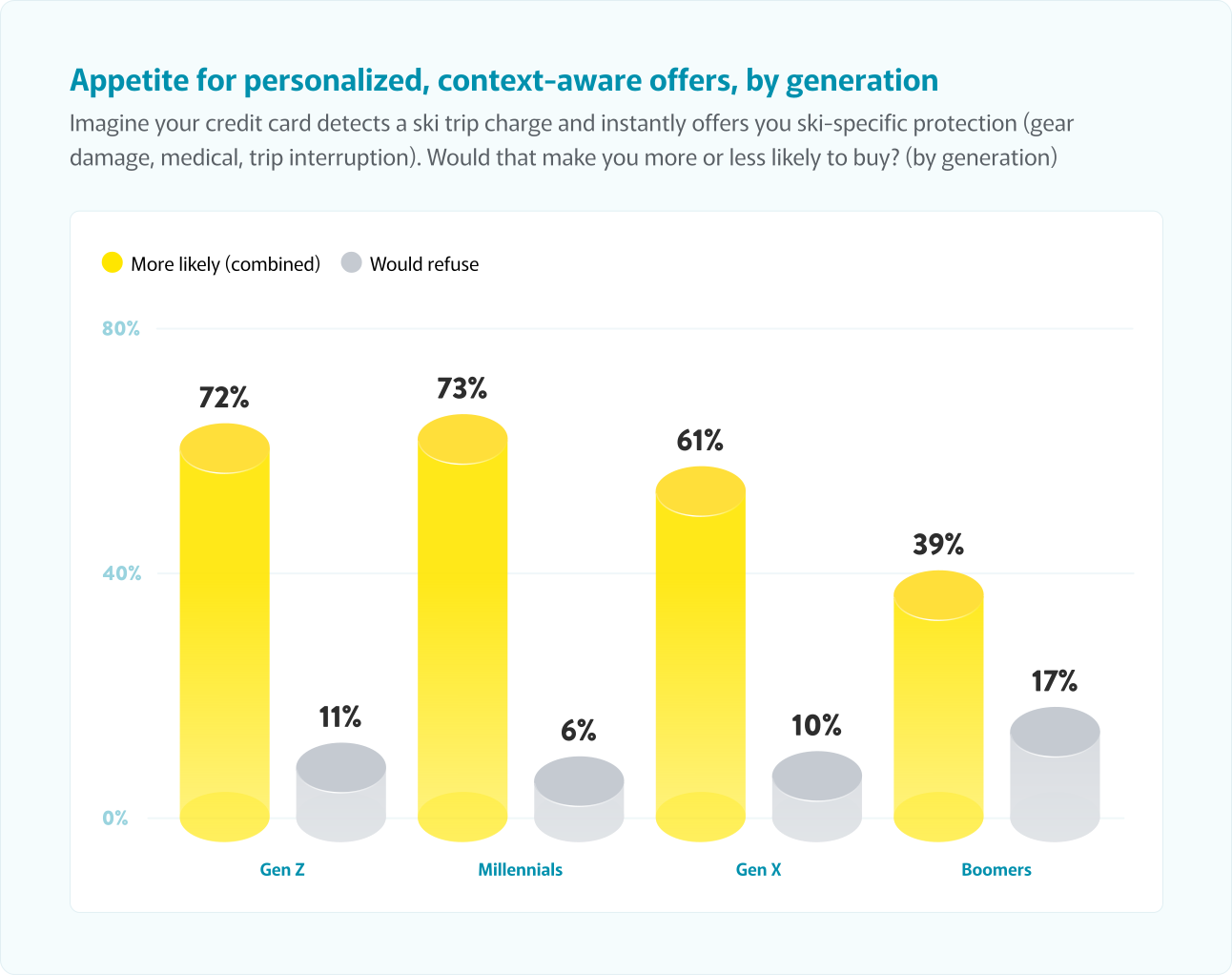
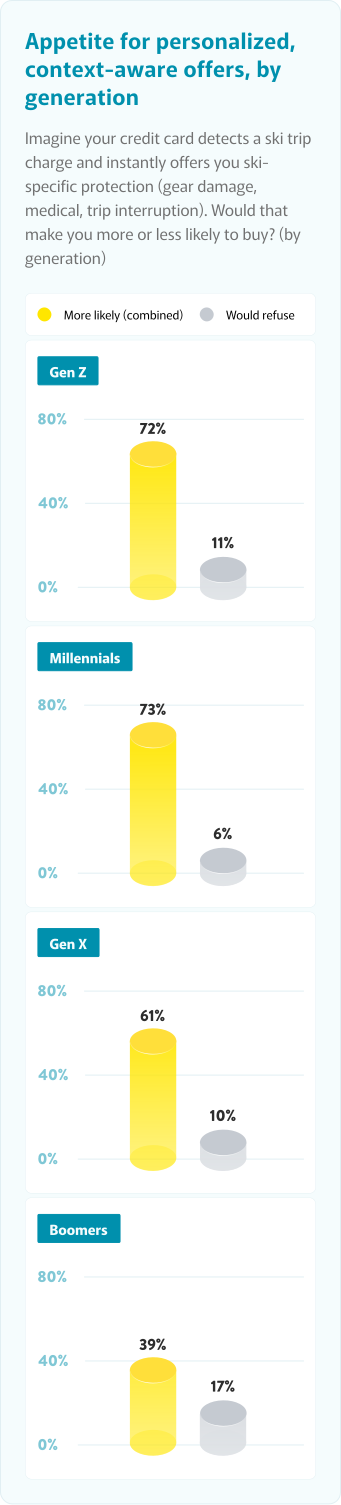
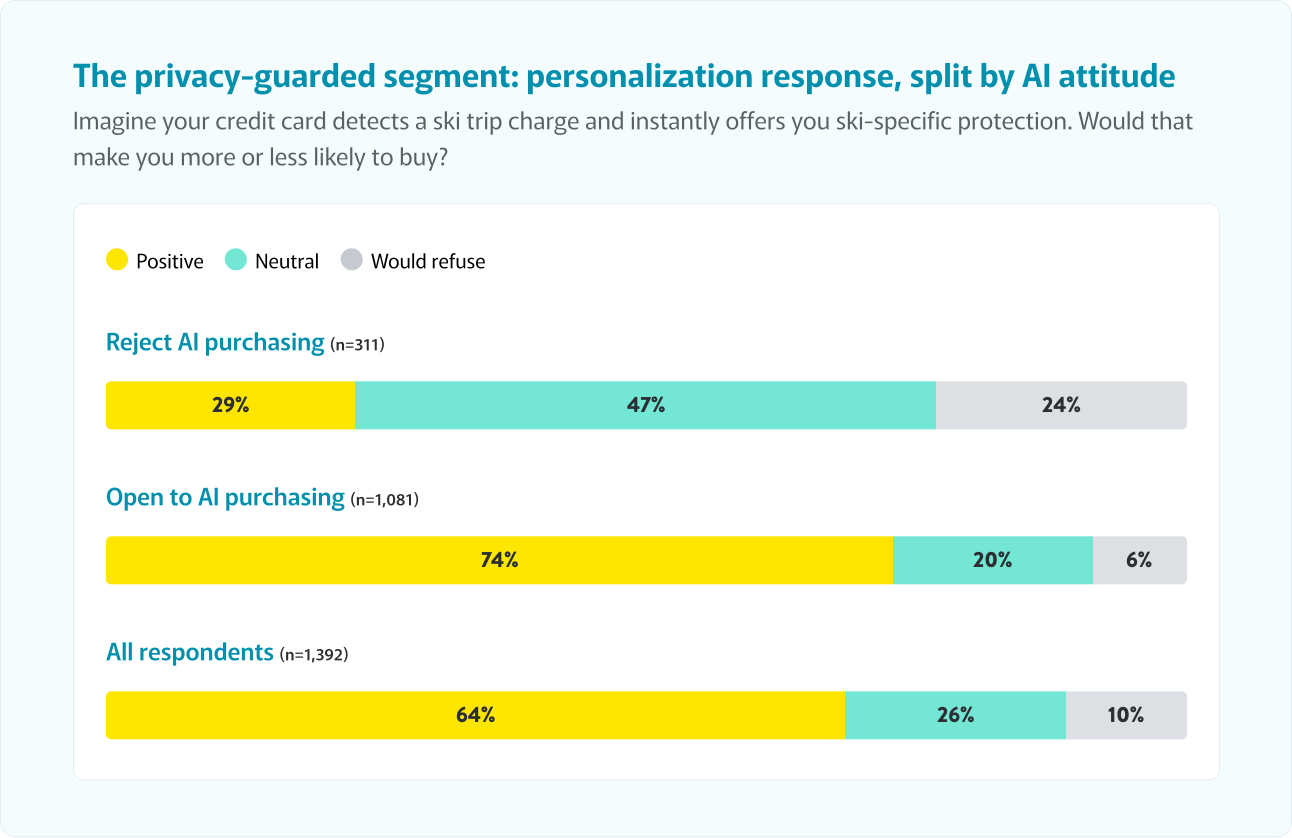
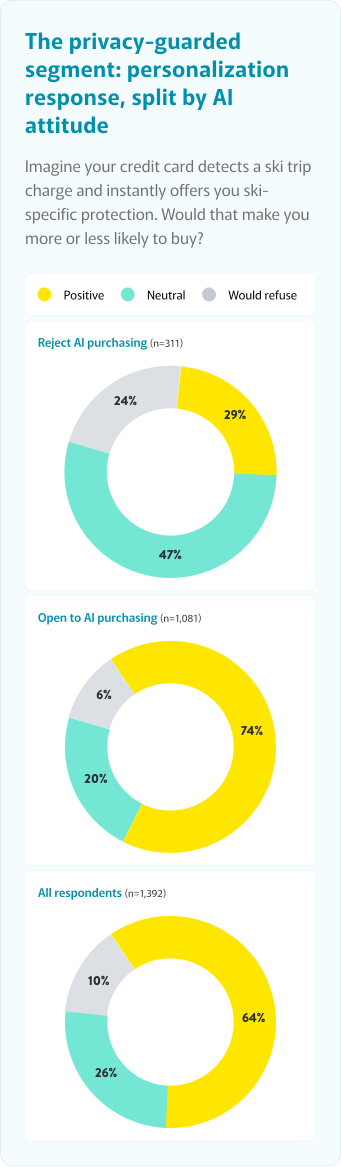
Personalization is a young-buyer lever: it lands with Millennials and Gen Z but loses force with older cohorts, and 17% of Boomers actively refuse it. A welcome offer and an intrusive one can carry the identical personalization; what separates them is how surveilled the customer feels receiving it. The offers that resonate respond to the moment (a ski trip or a flight booking) rather than to a file the company keeps on the customer.
Chapter 3
Consumers want AI to advise, not decide
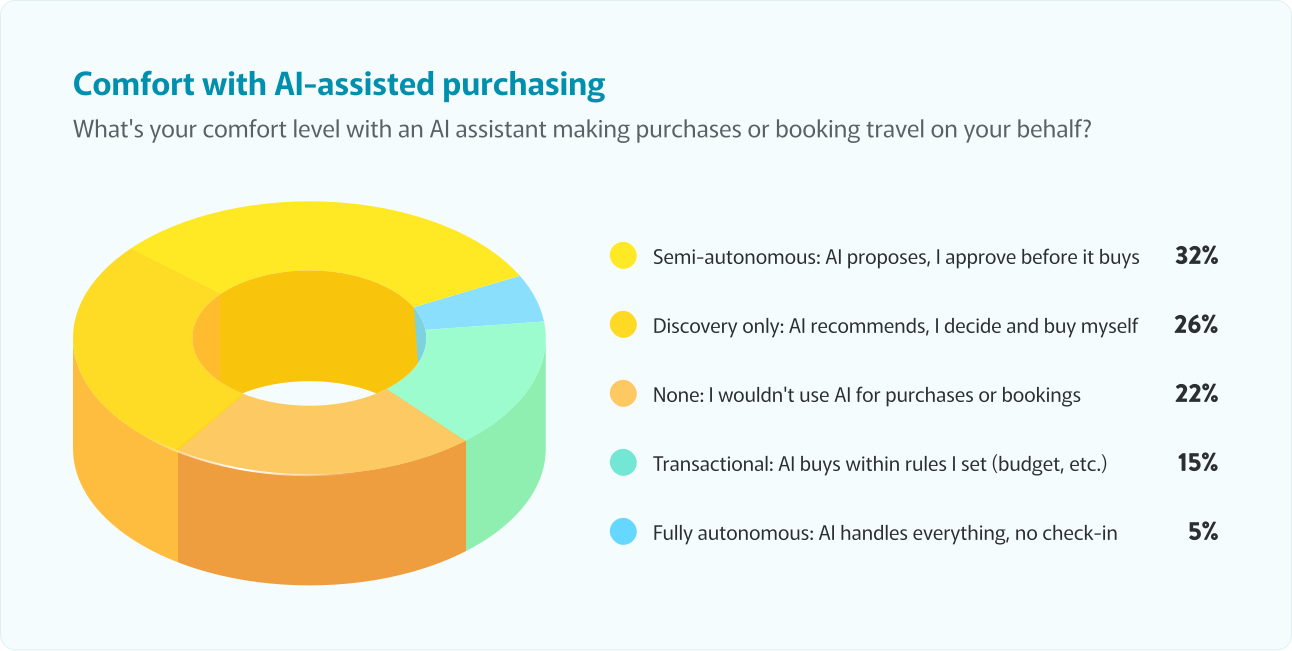
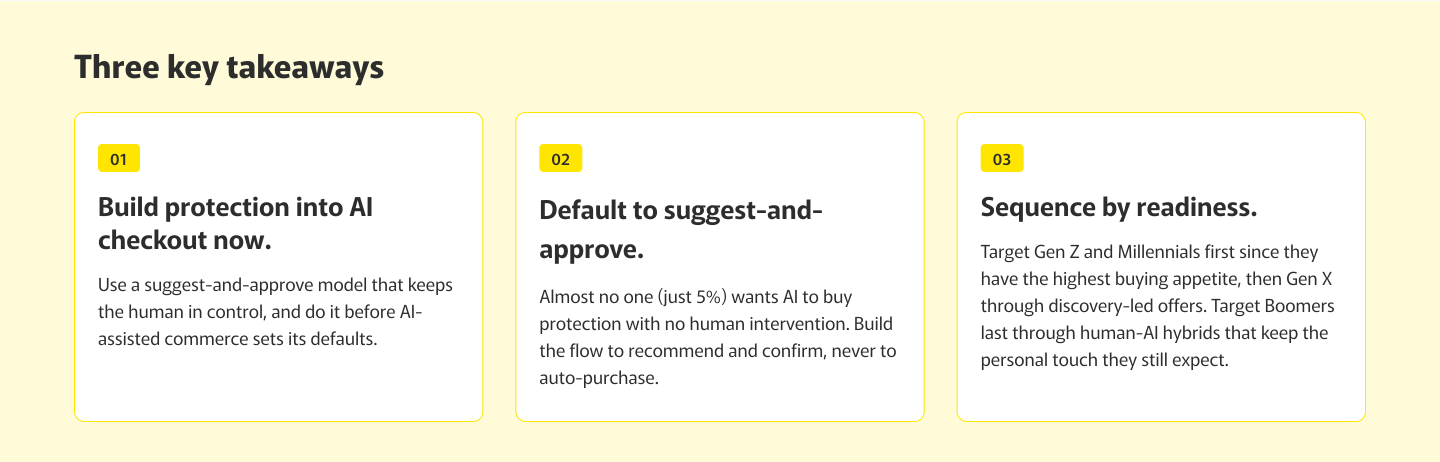
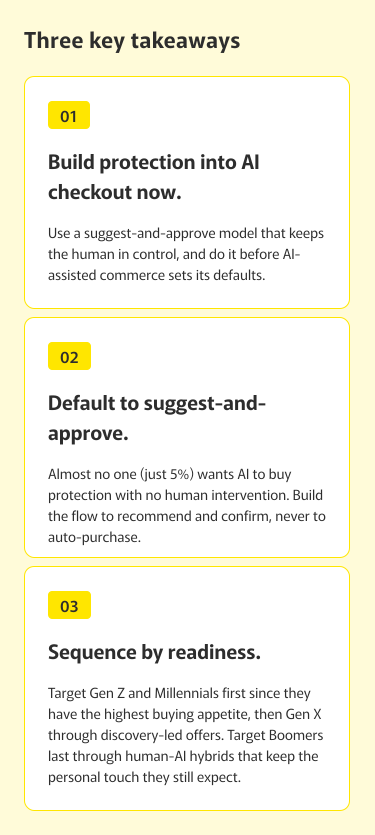
AI-assisted commerce is arriving fast, and it changes who makes the buying decision. The research shows consumers are broadly willing to hand the browsing and the booking to an AI, but they draw a hard line at the final call: they want AI to recommend protection, but not to buy it for them unprompted. The partners who wire a suggest-and-approve protection step into AI checkout now will own the default before the habit forms.
Across every cohort, only 5% want full autonomy. The rest want AI to suggest while a human makes the final call, suggesting that most consumers still don’t trust AI to make complex buying decisions on their behalf.
Among the 22% who won’t use AI for purchases at all, 24% also refuse personalized offers, more than double the 10% sample-wide refusal rate. The same privacy-guarded segment sits behind both objections, so winning their trust once opens both doors.
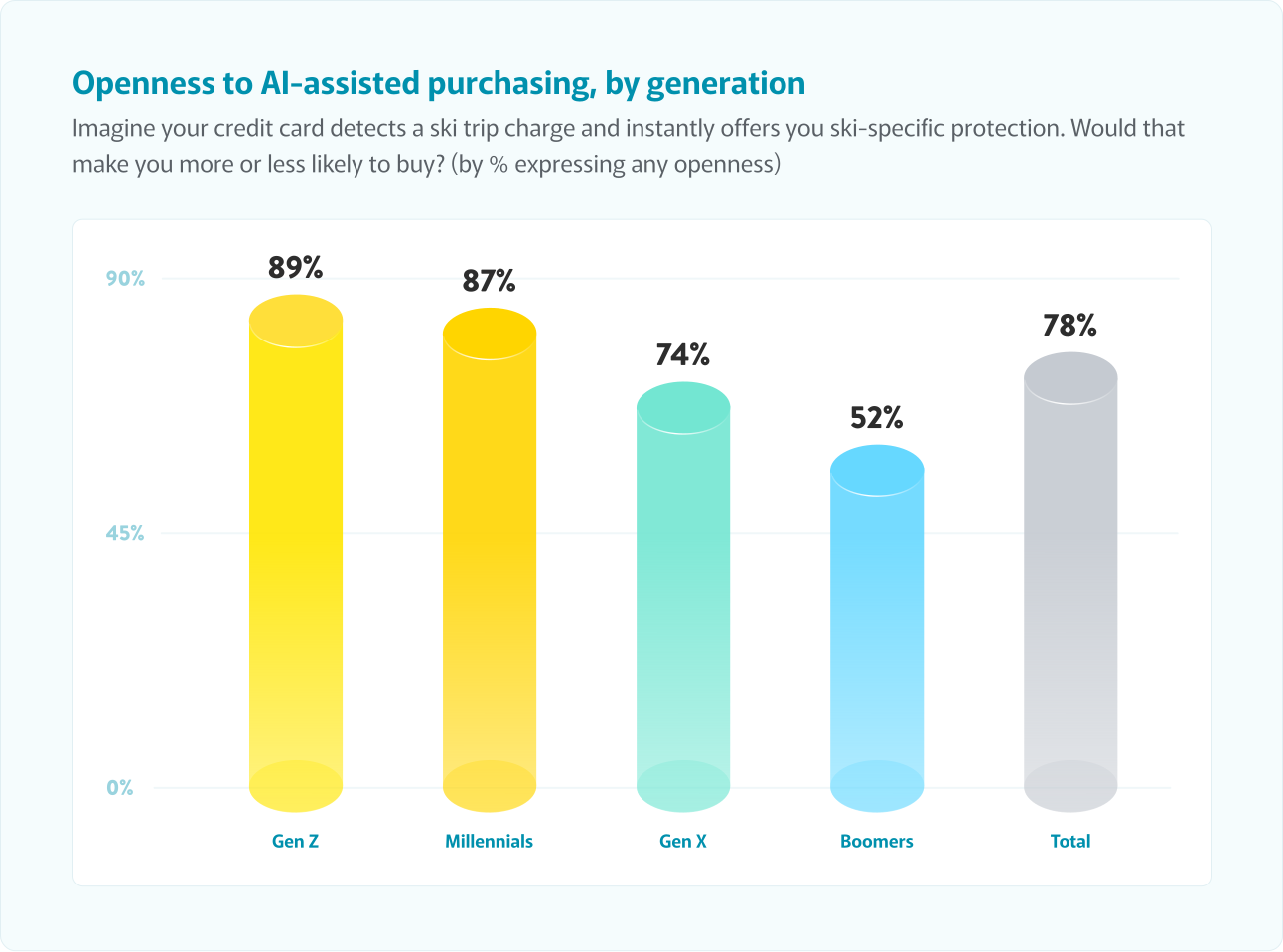
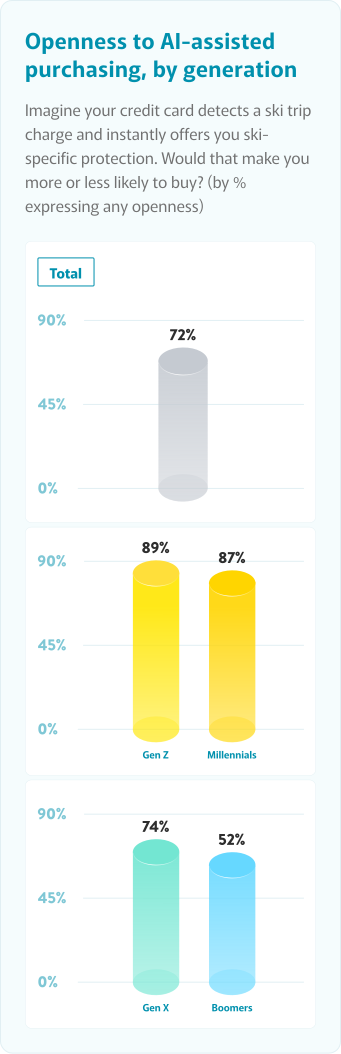
Openness to AI-assisted purchasing is broad, but the breadth is misleading. Consumers are open to using AI as an assistant, but they’re resistant to AI making decisions on their behalf. They want AI to find the option and tee up the decision, then stop and let them make the call. The instinct is remarkably consistent across generations: even the youngest, most AI-native consumers want to keep a hand on the wheel, so the design brief writes itself.
The winning AI protection experience is the one that recommends well and asks before it acts. Build for assistance and provide a tailored protection offering the customer approves in one tap to align with what nearly the entire market wants. When considering offering tailored protection, consider targeting younger cohorts first.
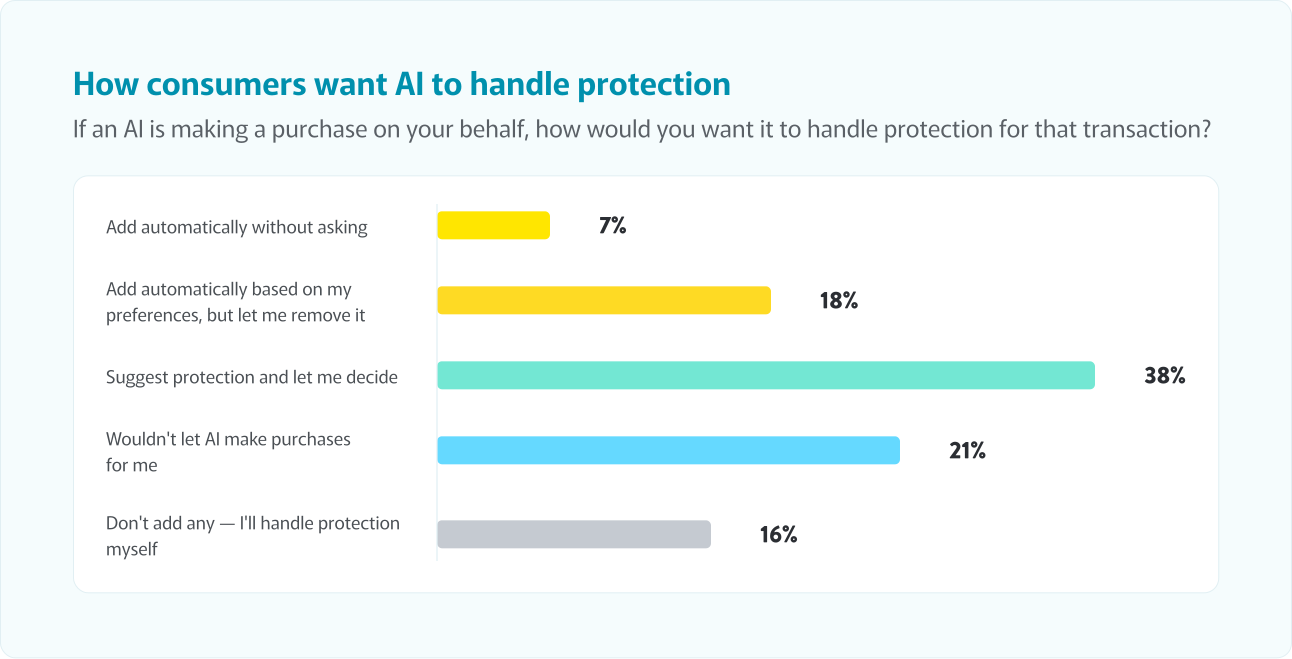
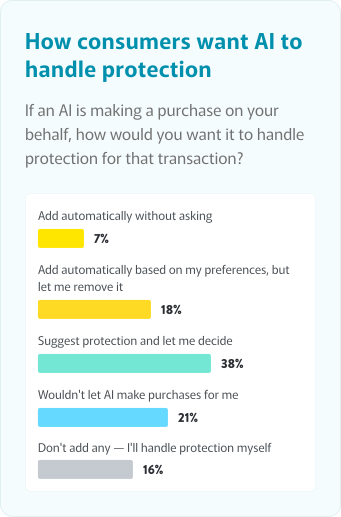
When asked specifically how AI should handle adding protection on a purchase, the same instinct holds: 38% want it to suggest and let them decide, and only 7% would let it add cover automatically without asking. Even among consumers comfortable handing over the transaction, protection is a decision they want to keep.
Chapter 4
Four audiences, four strategies
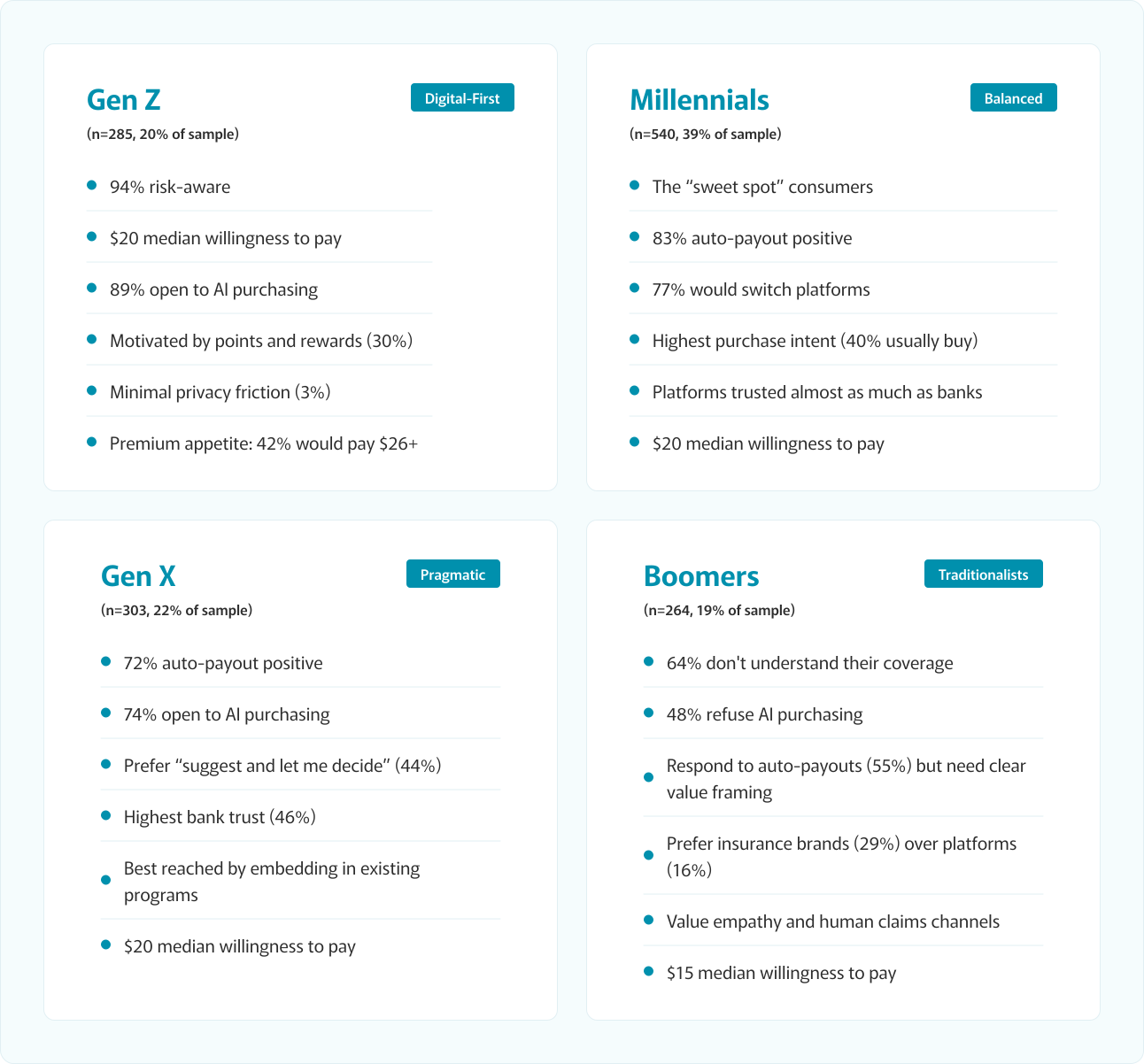
Embedded protection doesn’t have one consumer. These four profiles each have different starting points, priorities, and barriers to engagement.
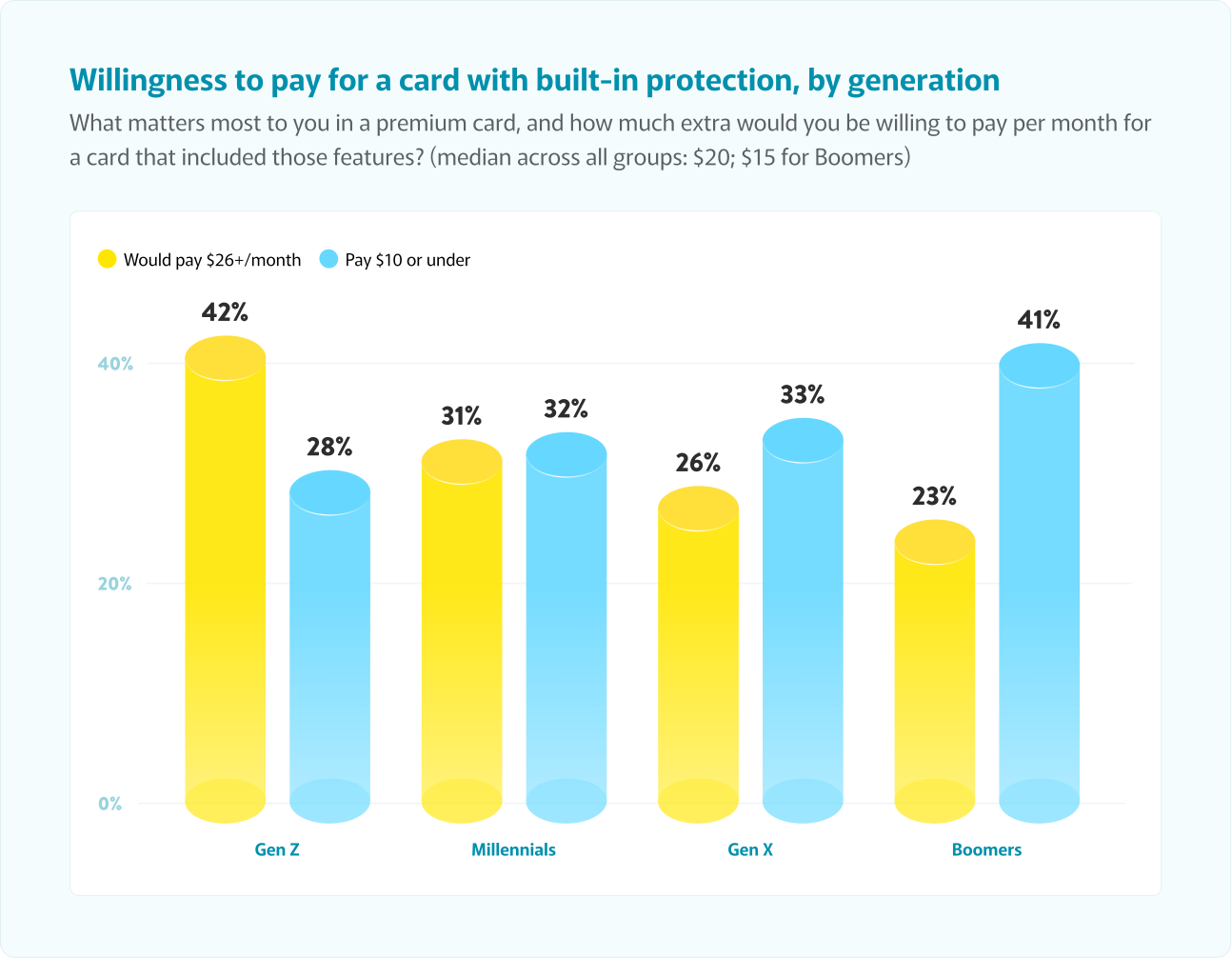
Willingness to pay splits cleanly by age, and that split is why business should avoid offering a single flat price for built-in protection. The premium tier is widest among the younger generations: Gen Z and Millennials are more than twice as likely as Boomers to pay $26 or more a month, while Boomers concentrate at $10 or under. Businesses should consider offering a two-tier structure for protection benefits: offer a $10 to $15 baseline that drives broad adoption across every generation, and a $20 to $25 premium tier built for the younger, higher-frequency buyers.
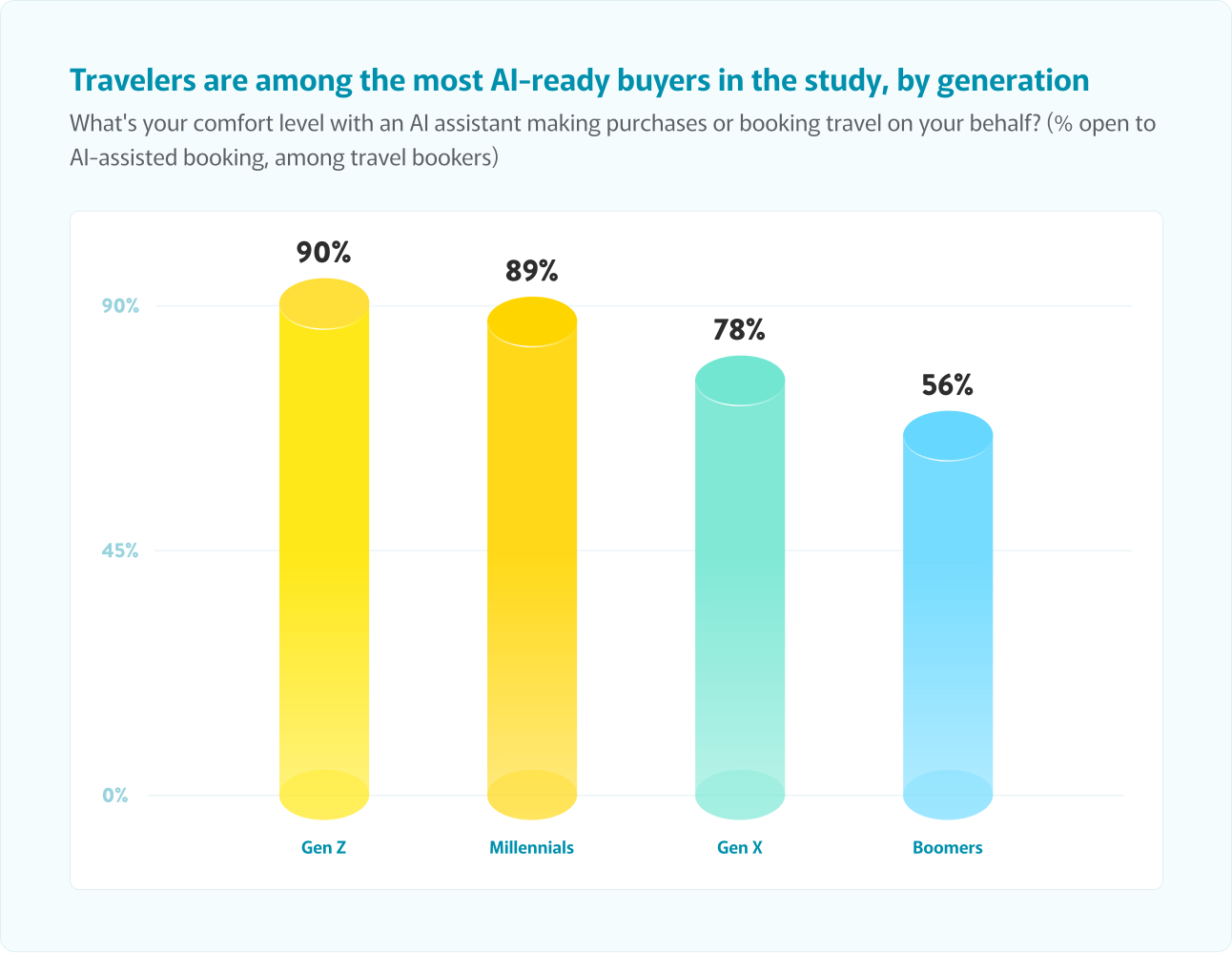
One pattern emerges: engagement with embedded protection cools with age. However, the peak isn’t always the youngest generation. Millennials, not Gen Z, top the metrics that convert to revenue, automatic-payout appetite (83%), personalization (73%), and willingness to pay a premium, while Gen Z leads only on openness to AI. That makes Millennials the commercial center of gravity for embedded protection and Gen Z the technology frontier, two different roles that call for different strategies.
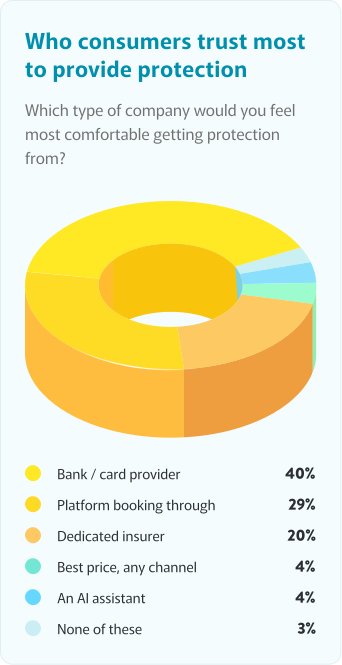
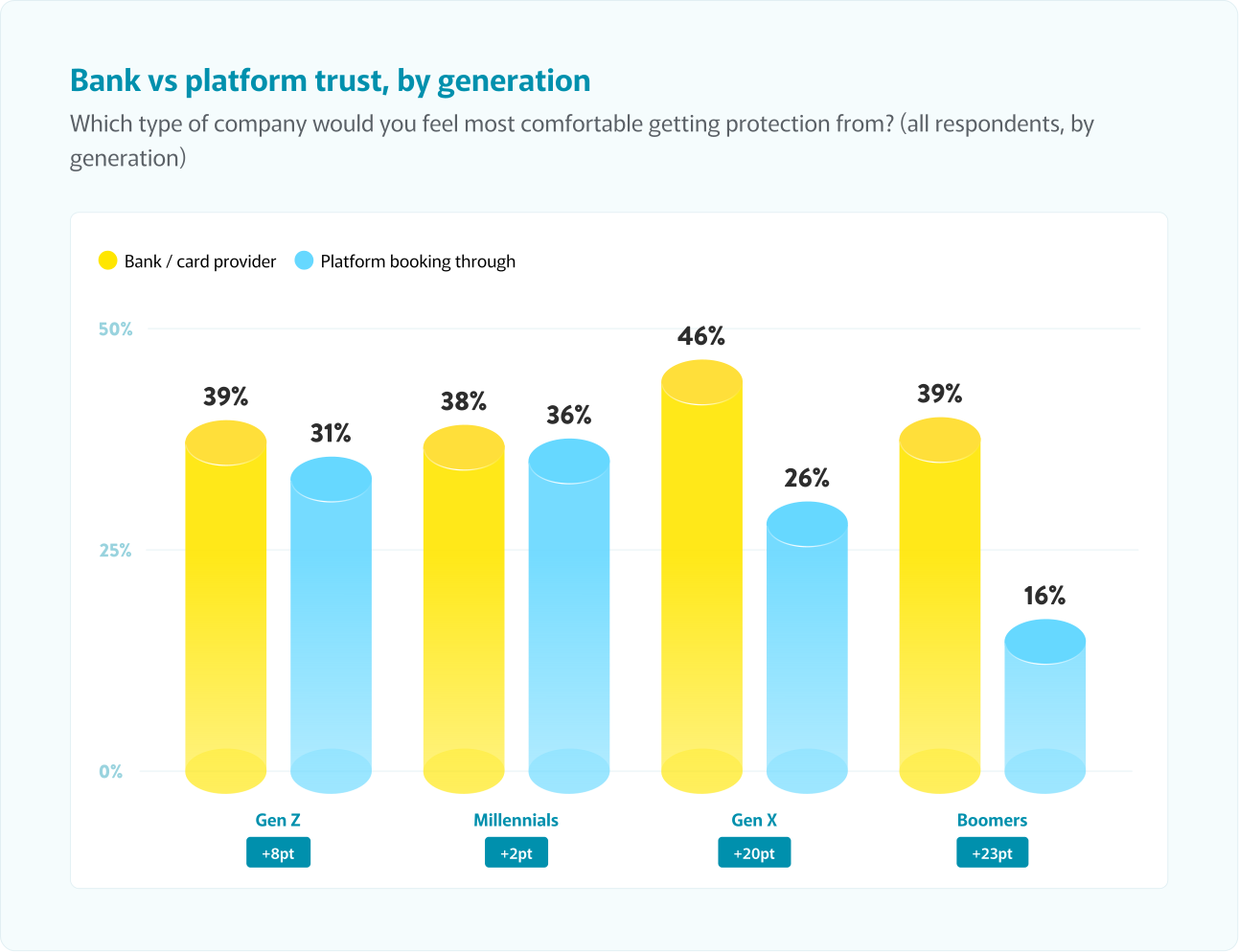
Every cohort except for Boomers tends to trust their bank the most when purchasing protection. Reach them through the institution and the human touch they already trust, not the app-native, automated flows that win the younger three.
Chapter 5
What this means for travel companies
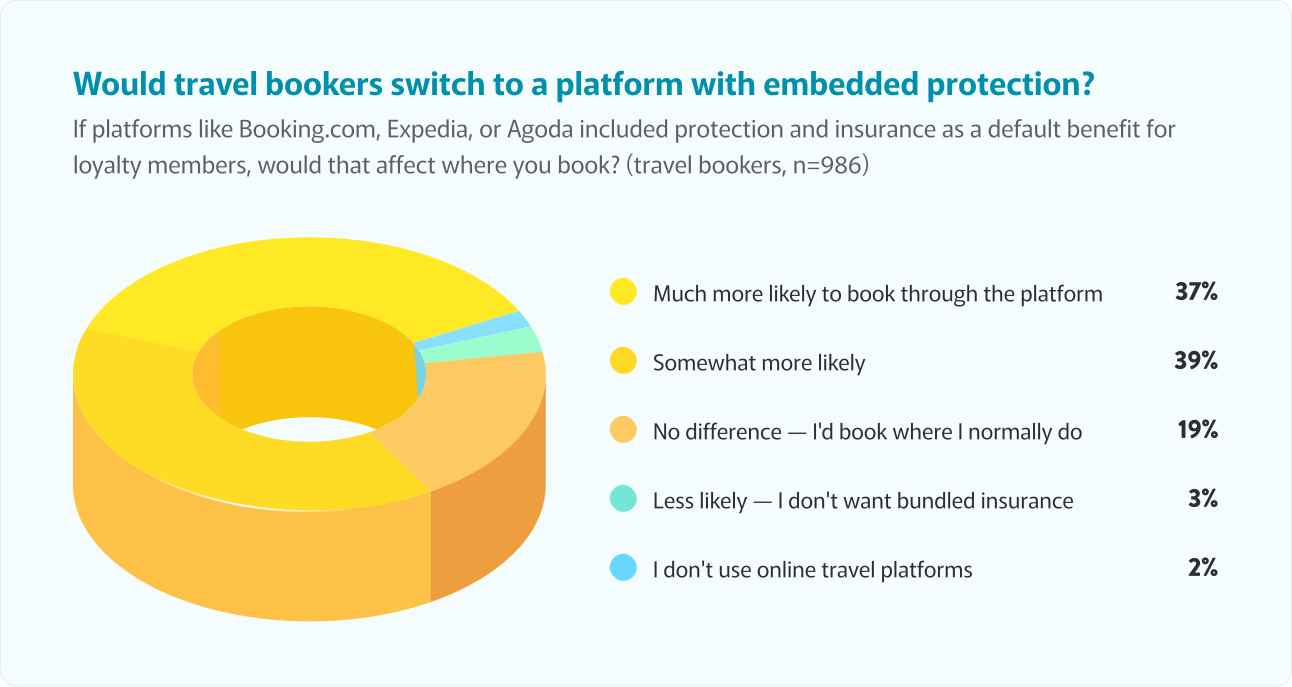
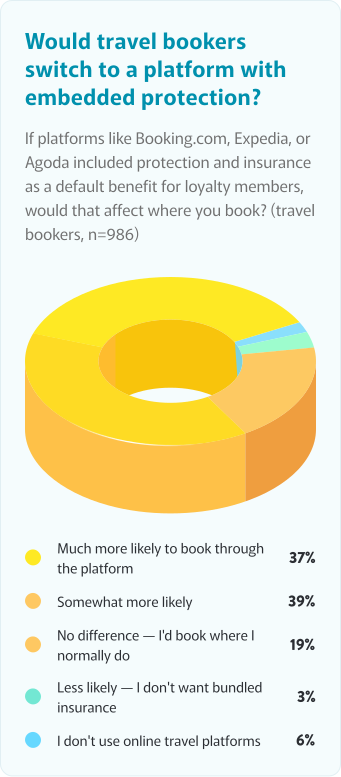
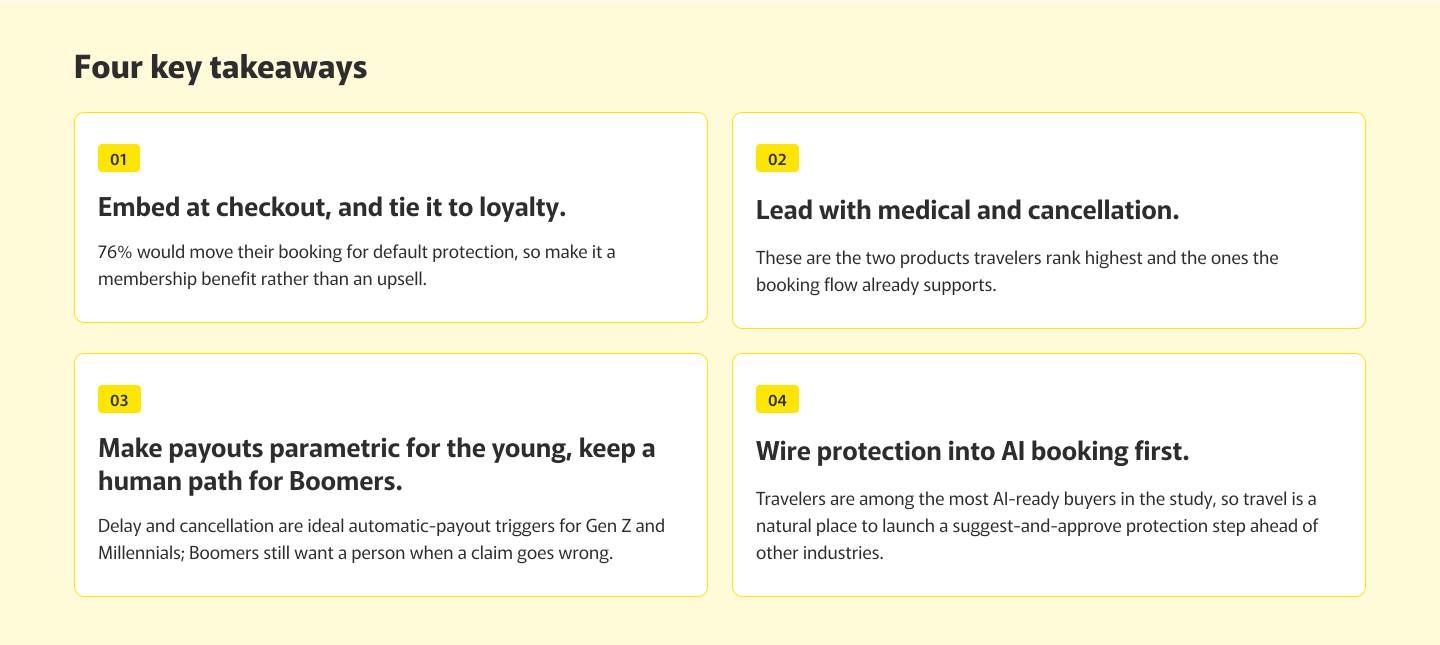
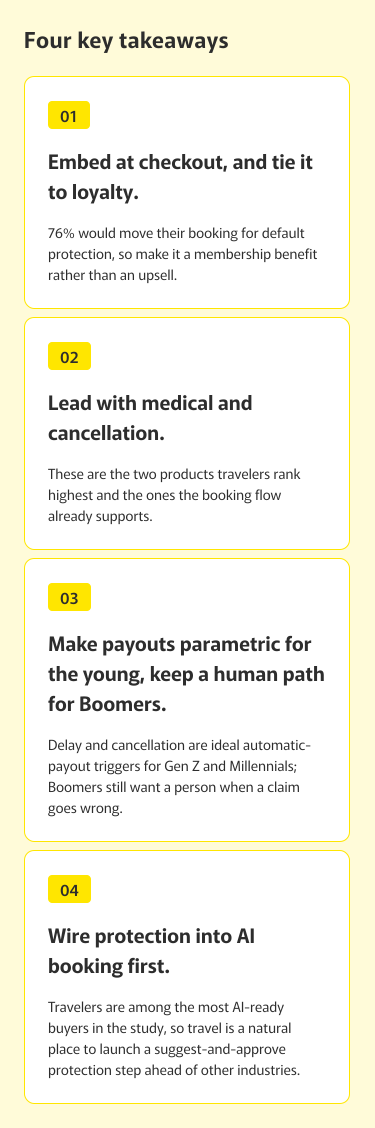
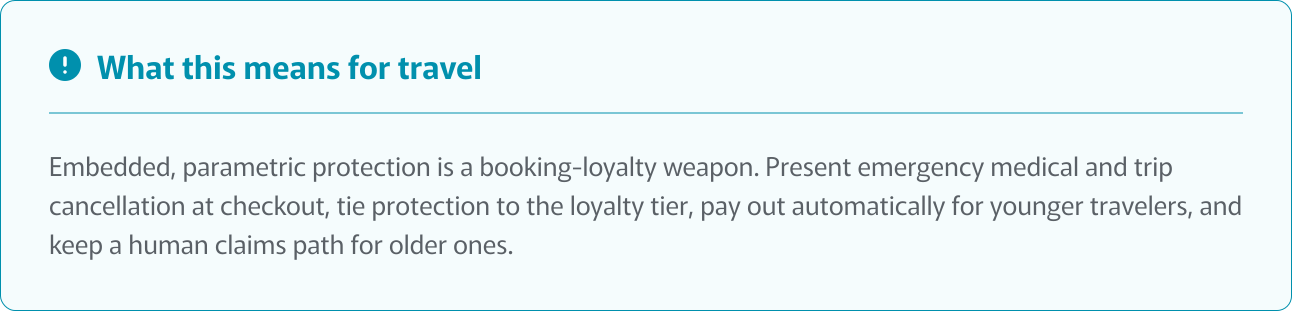
Travel companies spend fortunes to win a booking and more still to win it back. The data points to a cheaper lever hiding in the checkout flow: make protection a default loyalty benefit, and three in four travelers will move their booking to get it.
The number to sit with here isn’t the 76%, it’s the shape of the other 24%. Almost none of it is resistance: just 3% would be less likely to book with a platform that bundled protection, and 2% don’t use these platforms at all. The remaining 19% are simply indifferent, not opposed. In practice, that means a platform faces no meaningful downside risk in making protection a default loyalty benefit, only an upside among the three in four who’d actively reward it. That upside is real, not soft: the ‘much more likely’ and ‘somewhat more likely’ cohorts are almost the same size, so nearly half of all positive intent is the committed kind, not a shrug of mild approval.
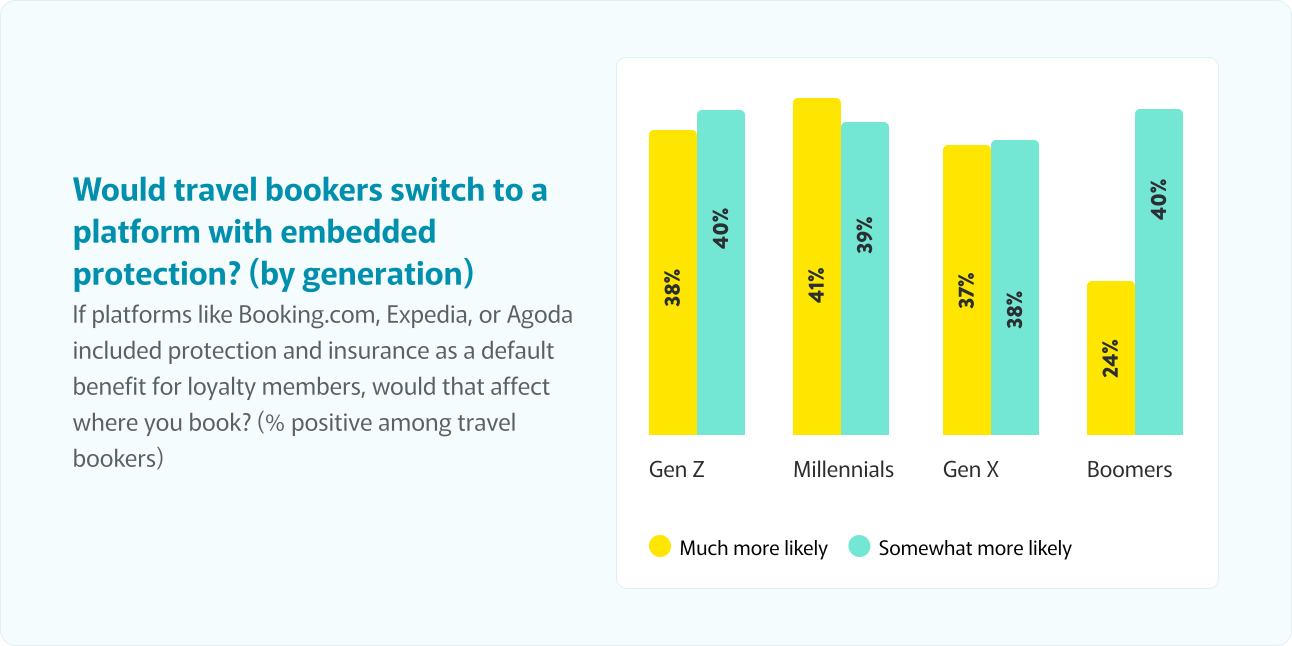
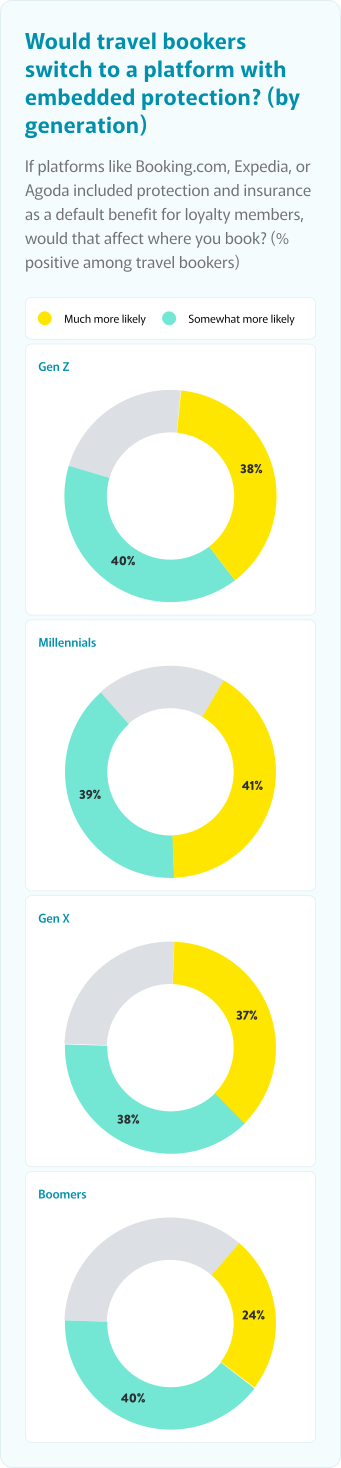
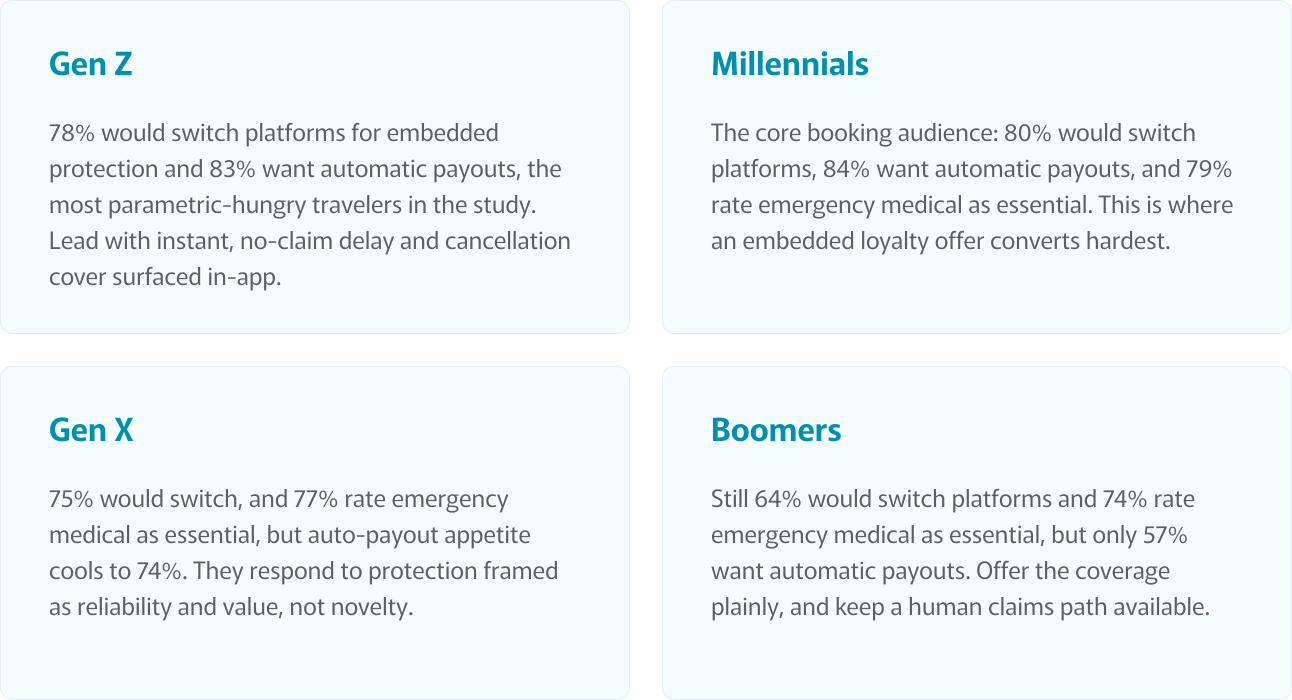
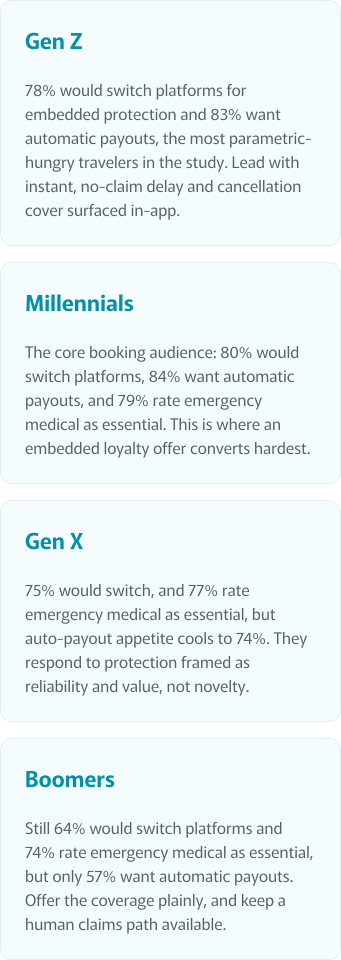
Every cohort is likely to switch platforms for embedded protection, but what separates them is conviction. Combined intent is nearly identical for Gen Z, Millennials, and Gen X. Millennials, 41% are ‘much more likely’ to switch, but Boomers only sit at 24%. Millennials will change their booking behavior for embedded protection, while Boomers will accept it if it’s there but won’t cross the street for it.
For younger travelers, embedded protection is an acquisition lever: they’ll actively move their bookings to get it. For older travelers, its presence makes them more comfortable staying, so surface offerings quietly at checkout and in account messaging. The same benefit does two different jobs; it wins the young and holds the old, and a platform that treats it as one-size-fits-all will overspend on the cohort that needs no convincing and underuse it on the cohort it could win.
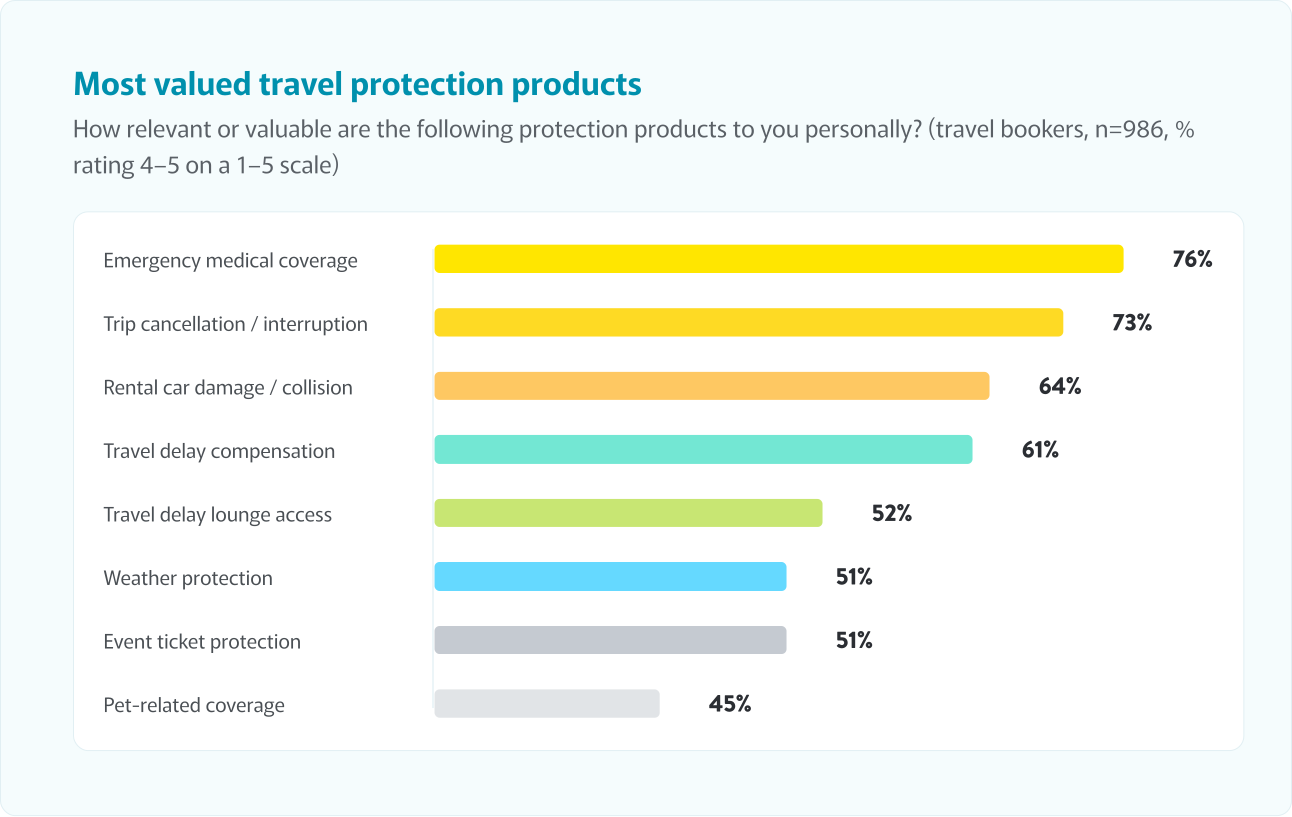
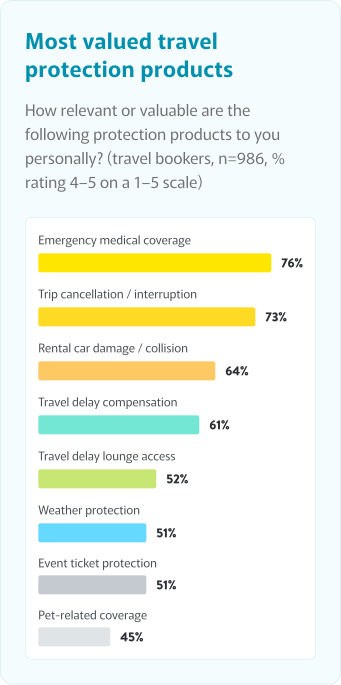
Emergency medical outranks trip cancellation as the top travel priority, so checkout should surface emergency medical and trip cancellation first, ahead of lower-ranked add-ons. The ranking also argues against a long menu. Lounge access, weather, and event coverage all cluster around 50%, useful as options but not as the headline. A checkout that leads with medical and cancellation and tucks the rest behind a ‘more cover’ expander will convert better than one that shows eight equal choices.
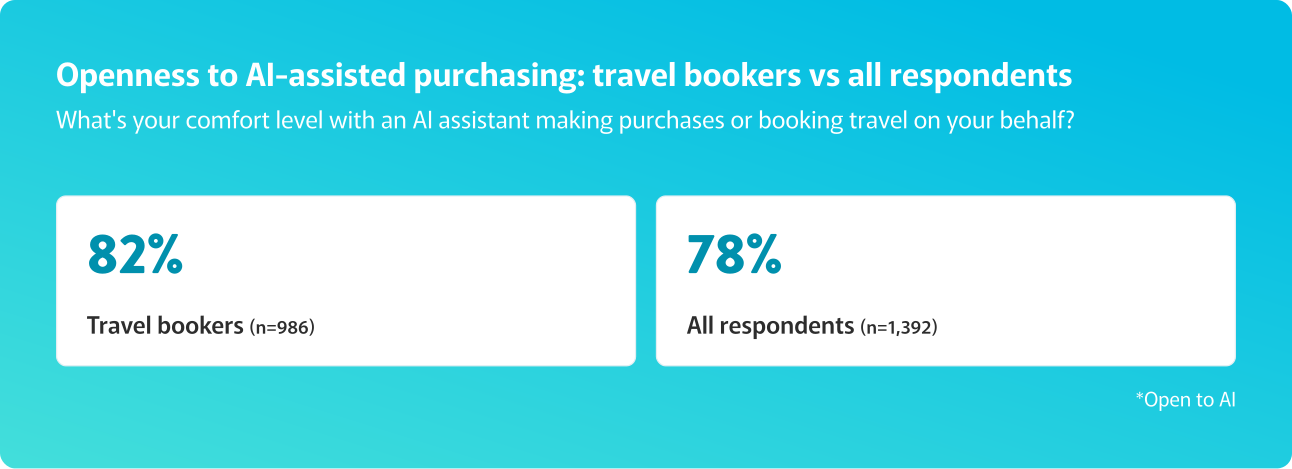
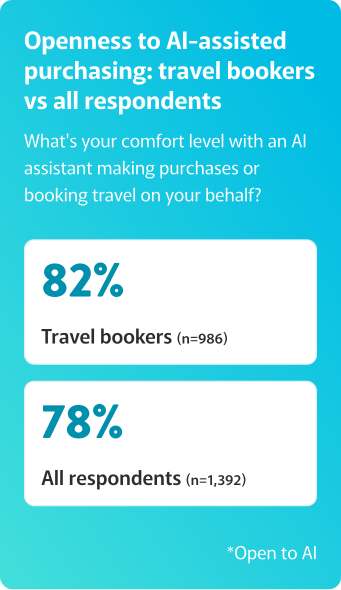
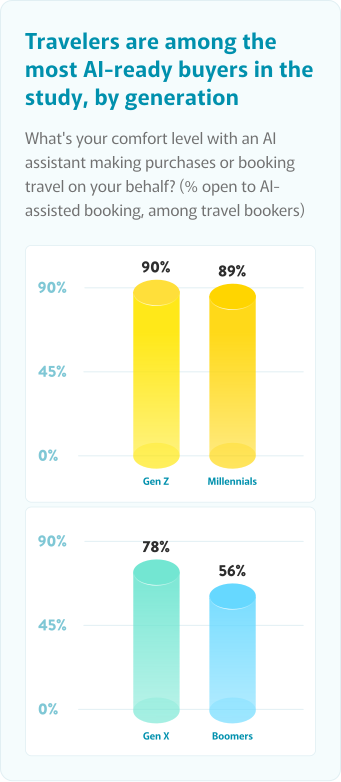
Travel bookers are more open to AI-assisted purchasing than the average consumer, at 82% against 78% across all respondents. Notably, the gap is driven by outright refusal: just 18% of travel bookers rule out AI entirely, against 22% of all respondents. Travel is where AI commerce will arrive first, which makes it the vertical where protection most urgently needs to be wired into the AI checkout flow. The platform that builds a suggest-and-approve protection step into its AI booking assistant now will own the default before the habit sets, while a human keeps the final call, which is what 95% of travelers still want.
Read the booking audience by generation
Chapter 6
What this means for banking and fintech
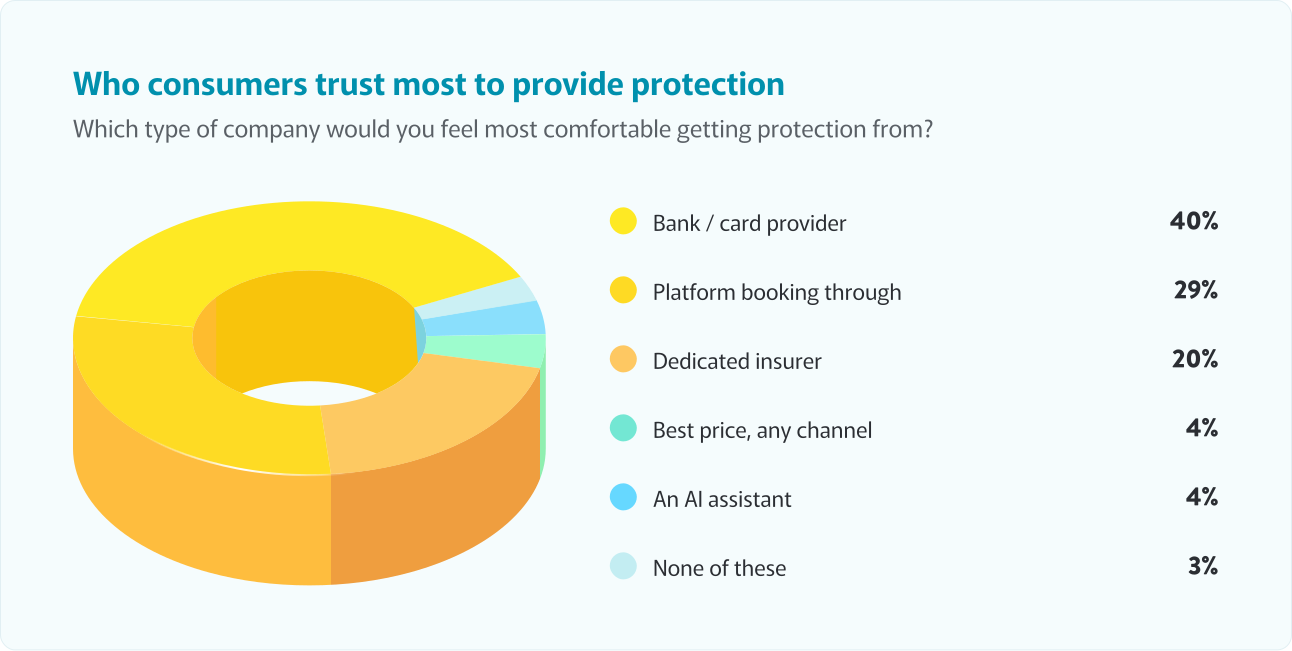
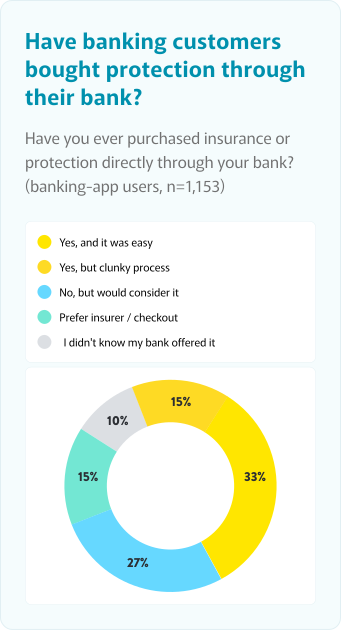
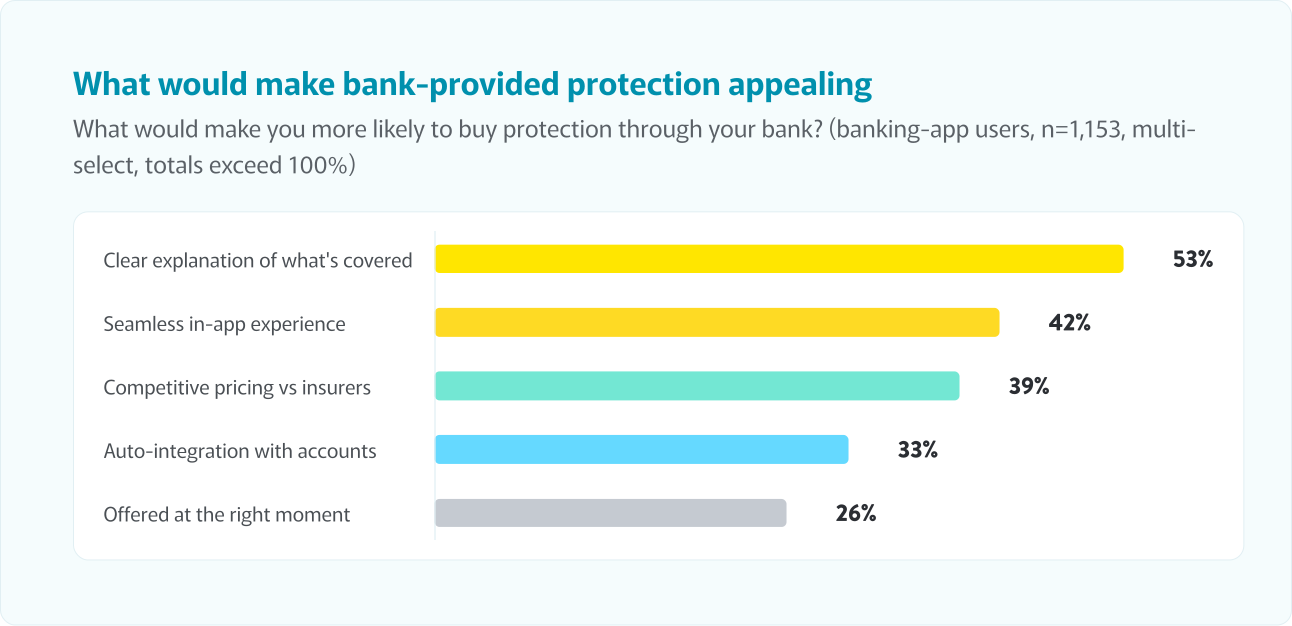
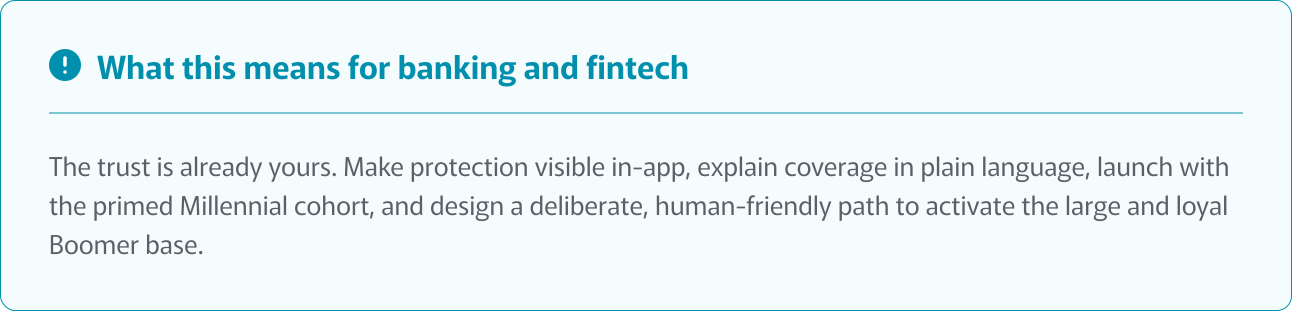
Banks are the most trusted place consumers would buy protection, and they already own the distribution: the app, the card, and the transaction data. What they haven’t built is awareness. The protection benefits banks pay for are largely invisible to the customers holding them, which means the loyalty those benefits are meant to buy never materializes.
Trust is the banks’ single biggest asset, and it’s the one they’re using least. Banks are in a starting position most challengers would pay considerably for, yet embedded protection programs are often underutilized.
A bank’s trust advantage over booking platforms is widest among the oldest customers and all but vanishes among the youngest, where consumers trust a platform to sell them protection about as readily as their own bank. Banks aren’t necessarily losing trust; their standing is stable across every generation. However, platforms are catching up, earning at the point of transaction the contextual trust that banks used to own by default. A bank that bets on this lead being permanent will watch it quietly erode. The window to convert standing trust into embedded, visible offers is now, while market trust is still wide enough to matter.
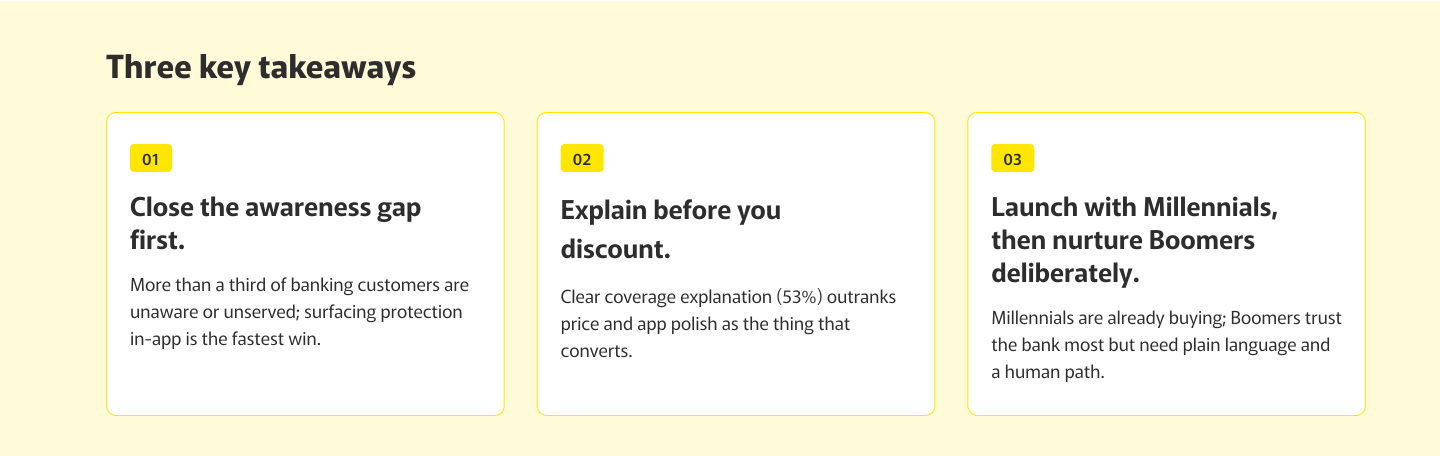
More than a third of the most trusted channel sits unactivated, either unaware or poorly served. Banks can close that gap with in-app prompts at the moment of relevant spend, plain-language coverage summaries, and one-tap activation, turning passive benefits into a visible reason to stay.
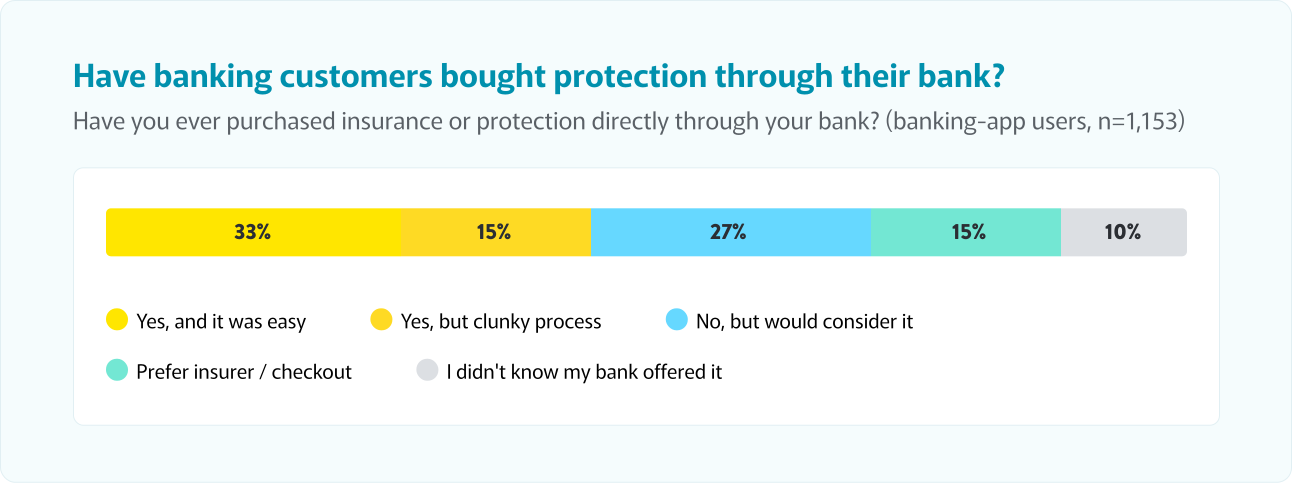
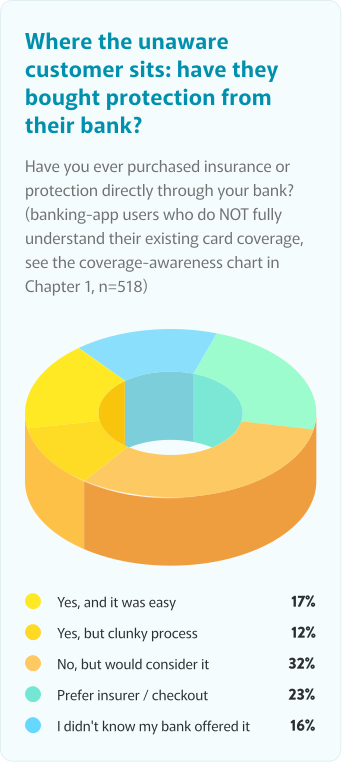
The invisibility problem compounds. Of the 518 banking customers who don’t fully understand the protection already on their card (the group identified in chapter 1), approximately one third say they would consider buying protection from their bank but never have. Another 16% didn’t know their bank sold protection at all. This is a significant cohort of underserved potential customers, sitting as addressable demand inside the bank’s own channel.
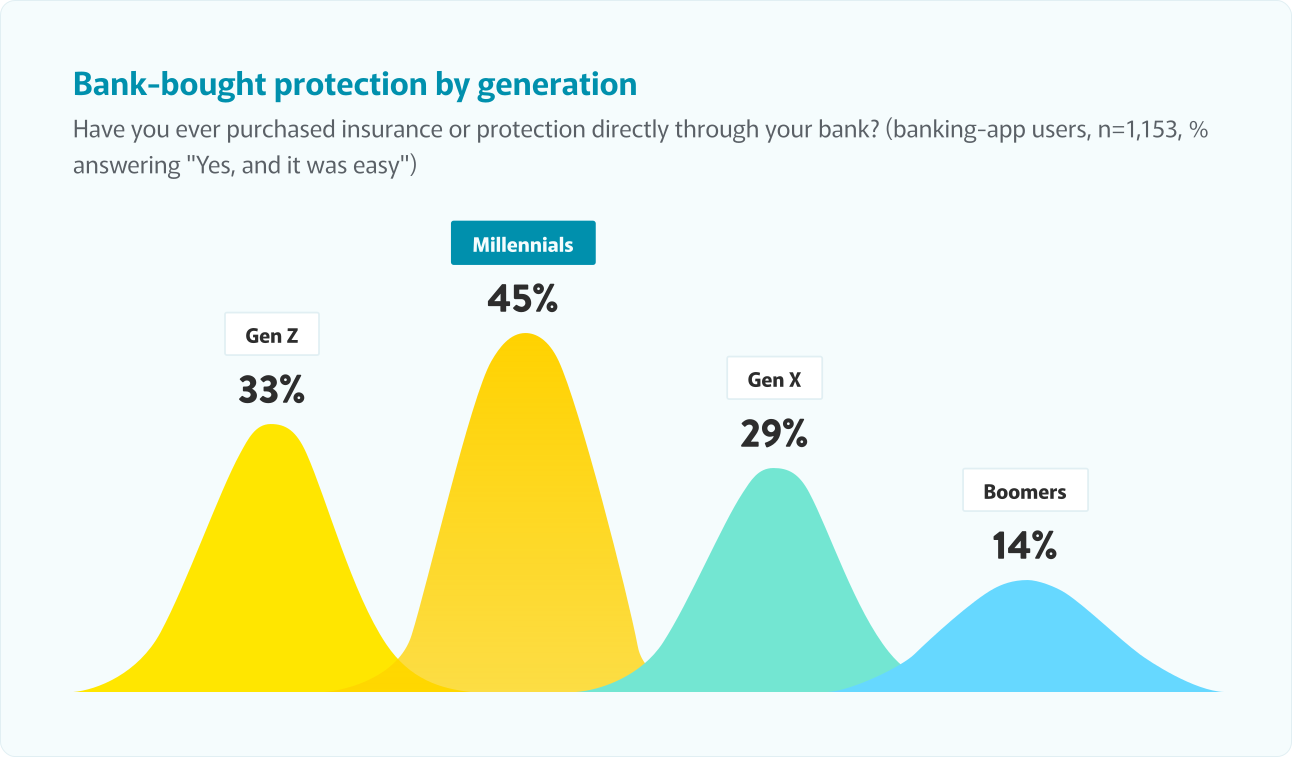
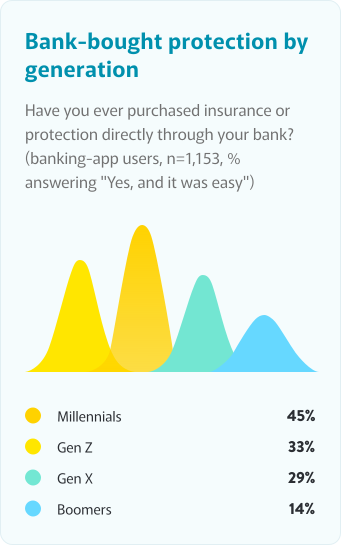
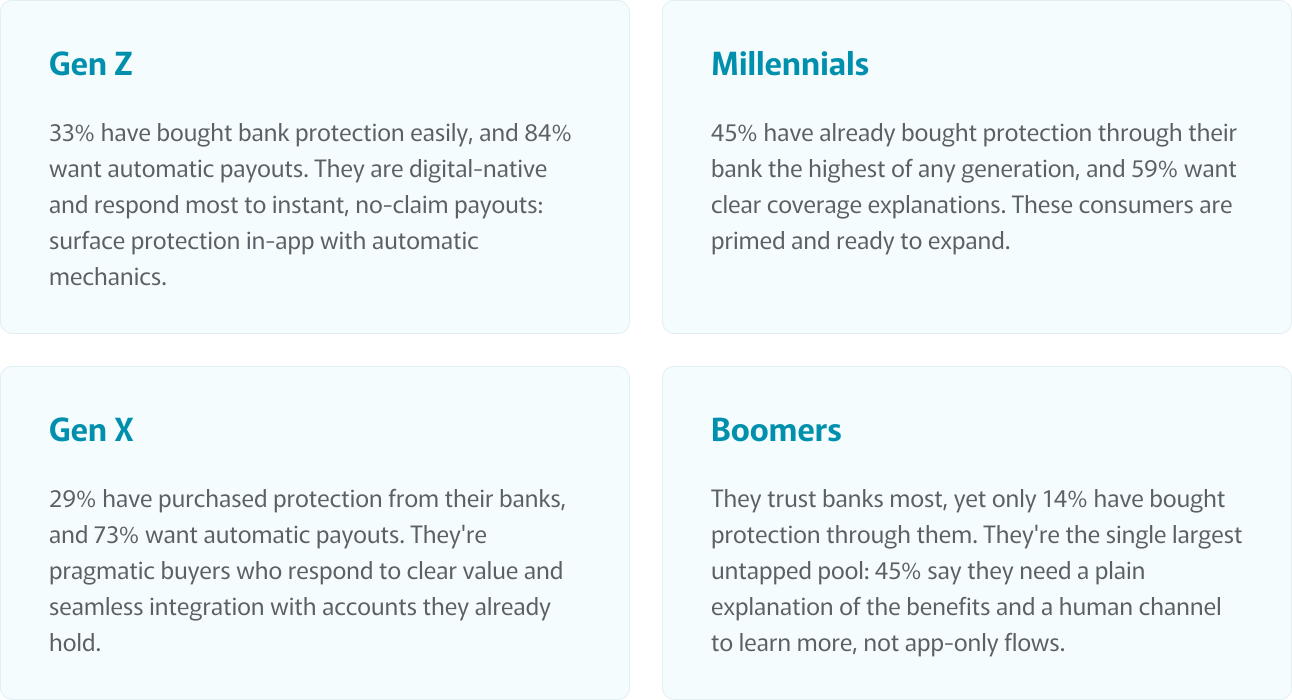
For those who have purchased protection directly through their banks, the activation gap is sharply generational. Millennials are where to launch first: they already buy protection through their bank at higher rates than any other group, which makes them the easiest cohort to expand. Boomers, despite trusting banks most, are almost entirely untouched, a large untapped pool if the offer is made visible and simple. That combination — the most trusted brand plus the account, the card, and the spending data — is one no platform or standalone insurer can easily replicate. The bank’s only real task is to make the protection it already offers visible to the customer. It only has to make the offer visible.
Clarity beats price. In a category where 43% of consumers don’t understand the coverage they already hold (the bottom four segments of the coverage-awareness chart in Chapter 1), the bank that explains protection plainly wins before it competes on price.
Read the banking audience by generation
Chapter 7
What this means for shipping and logistics
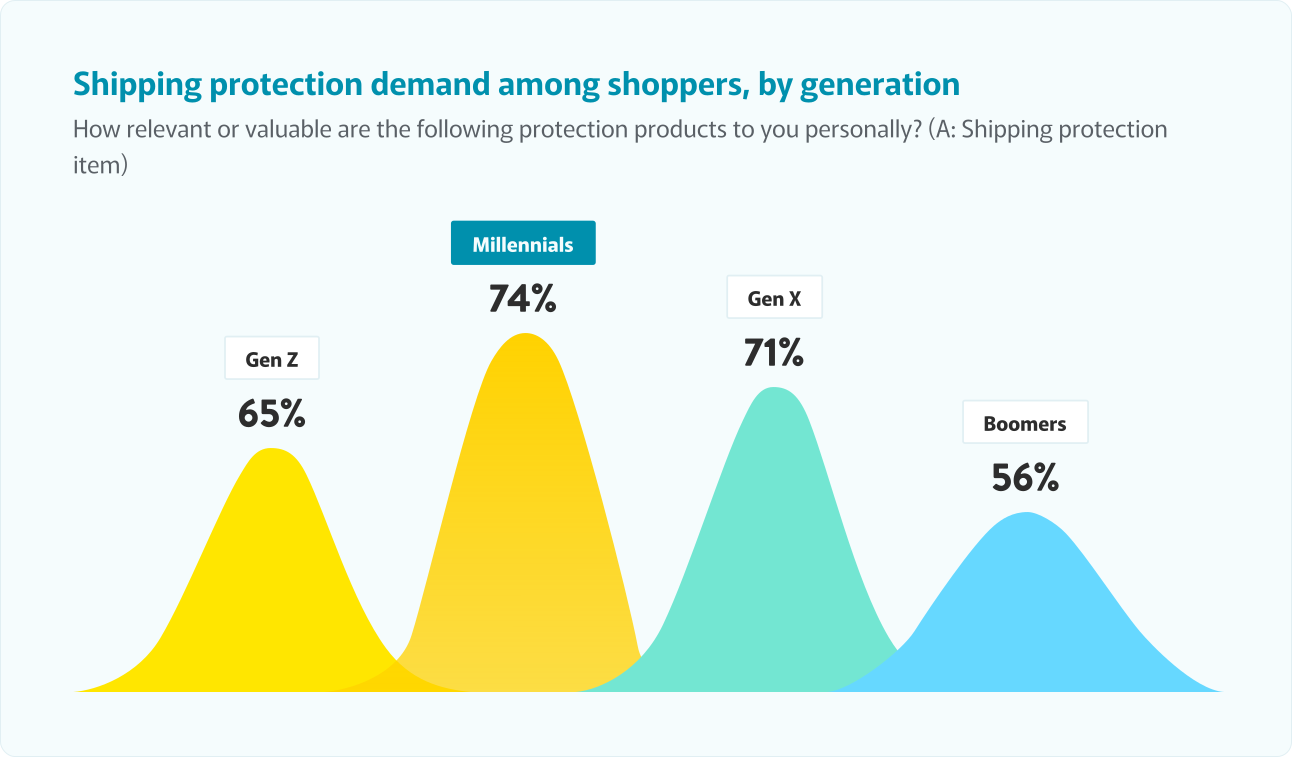
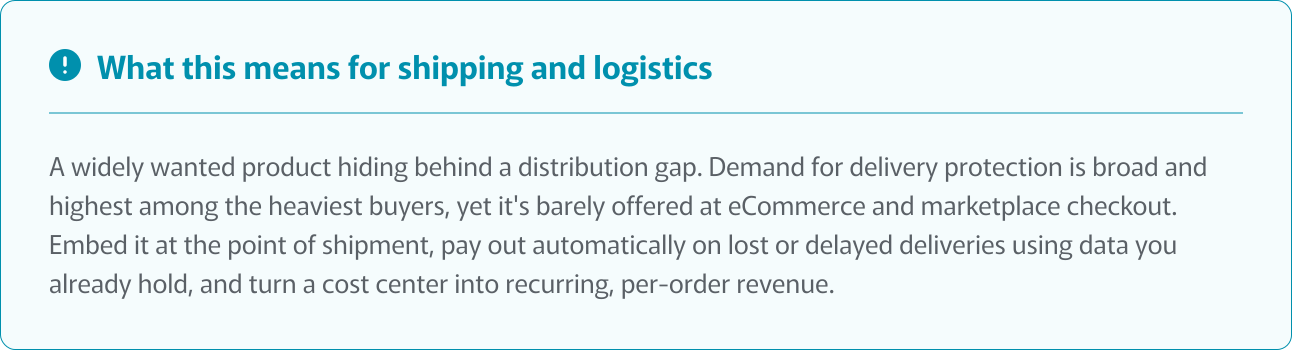
When a package is lost, damaged, or stolen off a doorstep, the frustration attaches to the brand that sold the item, not the carrier that lost it, which is exactly why the selling brand has a reason to offer coverage. Consumers want delivery protection at high rates across every generation, and most of all the frequent online buyers who face the risk most often. For shipping and logistics companies, the constraint has never been demand. It’s because platforms aren’t offering coverage at the moment it would actually convert.
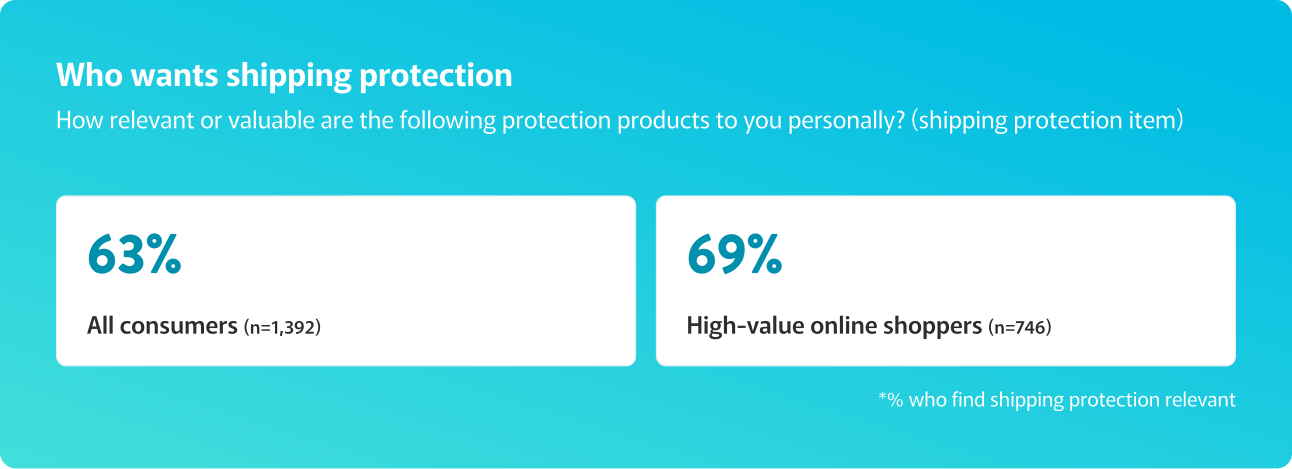
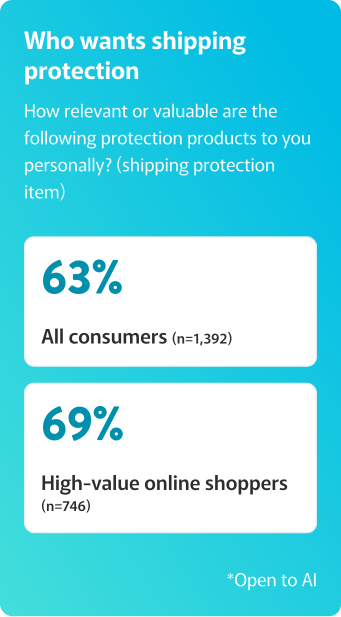
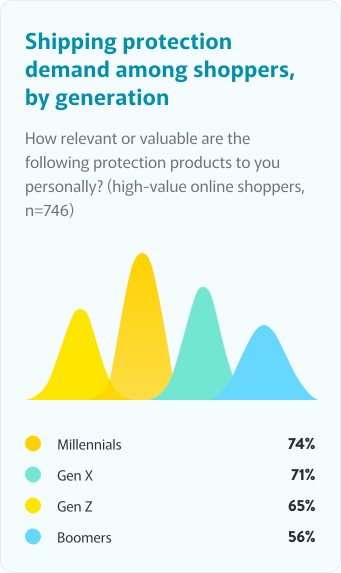
Nearly two-thirds of all consumers rate shipping protection as valuable, and that rises to 69% among high-value online shoppers, the people most exposed to delivery risk. Demand is strongest exactly where the packages are, and it’s a product that still rarely appears at checkout.
Demand runs highest exactly where order volume is highest. The heaviest online buyers are also the most protection-hungry, which means attach opportunity compounds with basket frequency rather than fighting it.
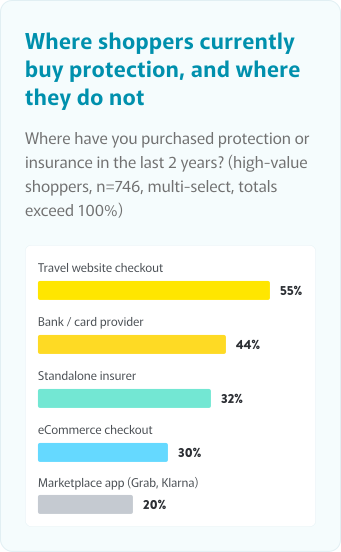
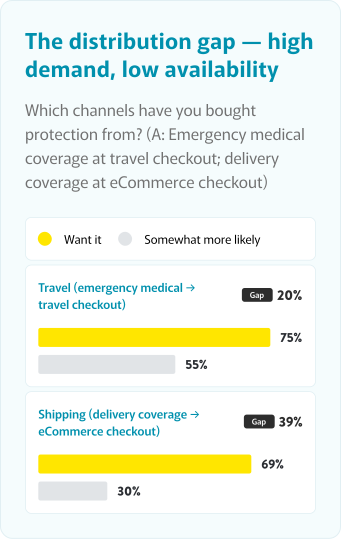
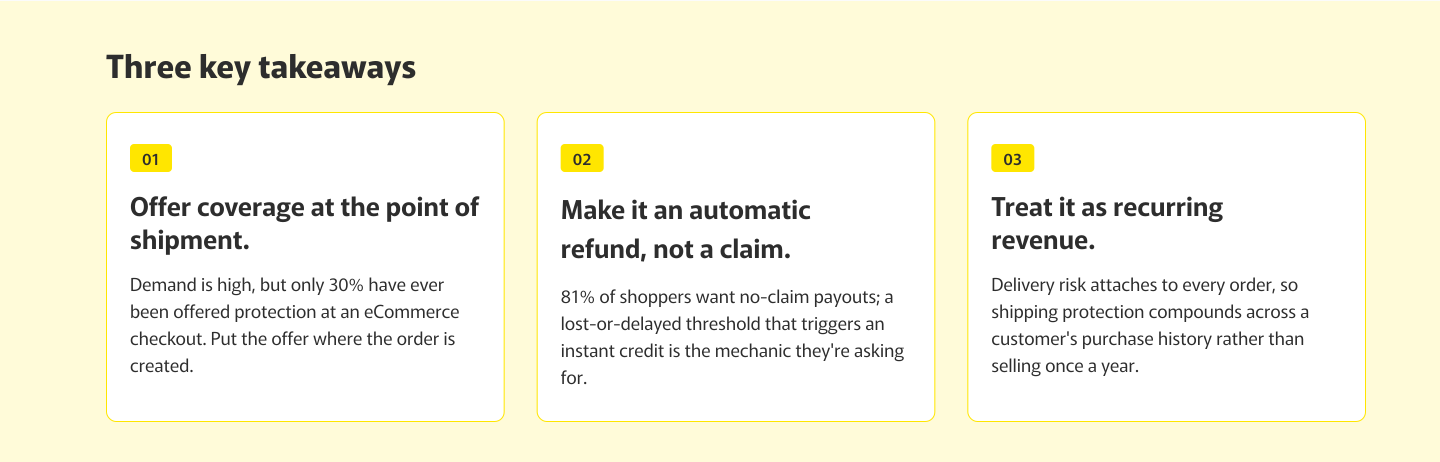
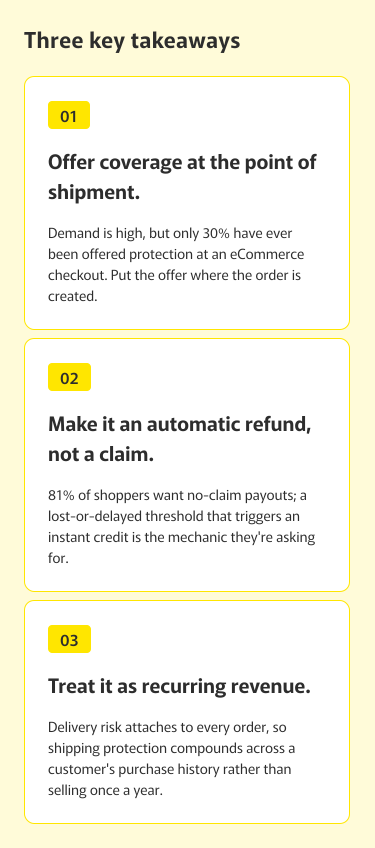
Travel companies have built the checkout muscle to convert the demand for travel coverage, but eCommerce and shipping haven’t. Among high-value online shoppers, 69% value shipping protection but only 30% have ever bought protection at an eCommerce checkout, a 39% gap between what people want and where it’s offered. The equivalent gap in travel is half that, at 20%. The distribution surface exists. The offer is missing from it.
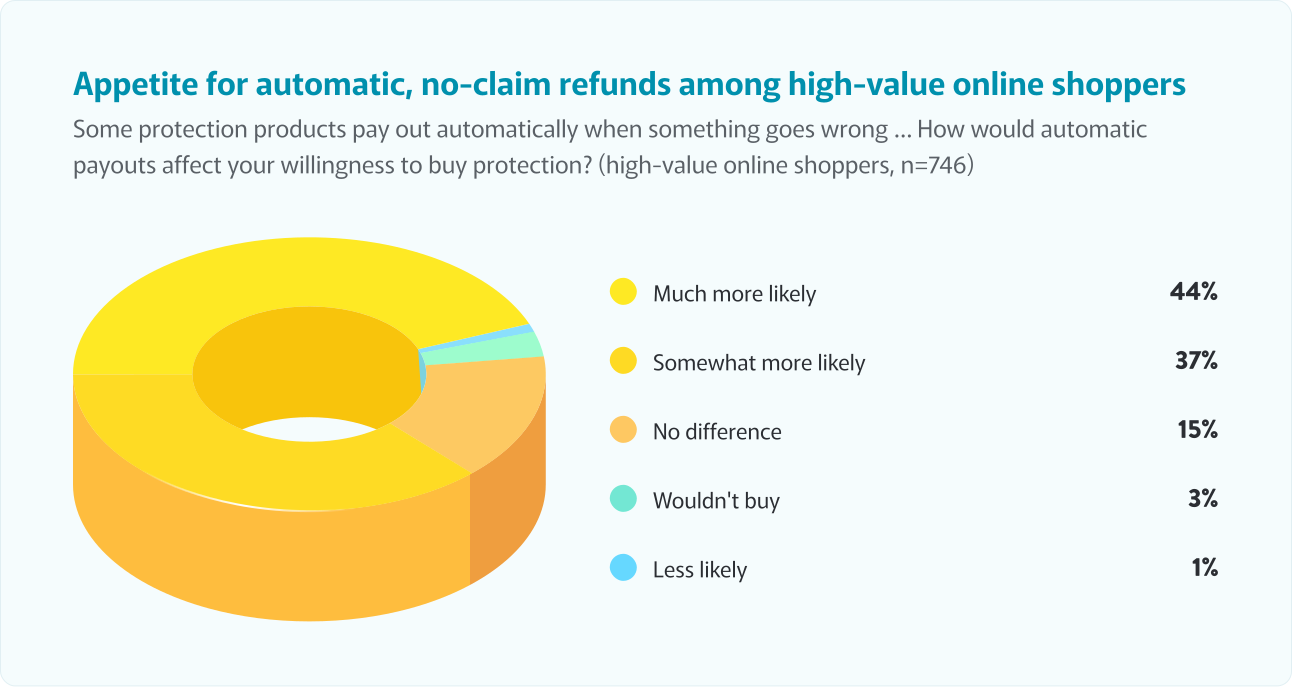
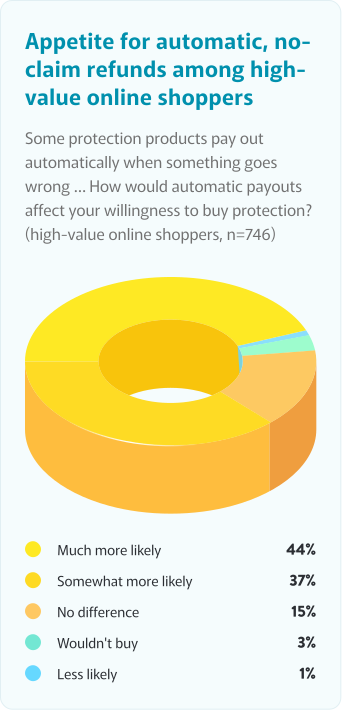
81% of high-value shoppers respond positively to automatic payouts, and 44% say it would make them much more likely to buy, the strongest of any segment in the study. For shipping and logistics companies, this is the whole model in one number. A delivery confirmed lost or delayed past a threshold triggers an instant credit, with no claim form and no call. It’s the parametric flight-delay mechanic moved to the doorstep, and shipping data flows already exist to trigger it automatically. Since retailers and marketplaces sit right at the point of sale, they’re well positioned on the trust question too: consumers are most comfortable buying protection from the party they’re already transacting with.
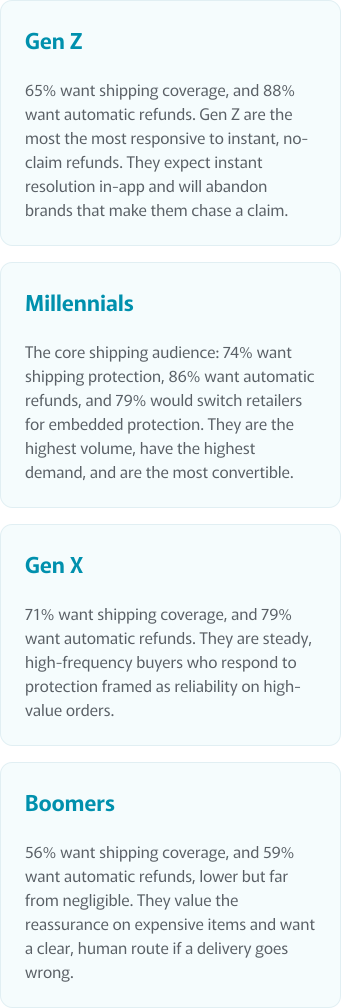
Read the high-value online shopper by generation
Note on this chapter: the study didn’t screen for a standalone shipping audience. This chapter draws on shipping protection as a rated product across the full sample, and on high-value online shoppers as the closest behavioral proxy for delivery-risk exposure.
The consumers are ready. The question is whether the infrastructure is.
Our findings point to the same story: consumers want protection, weigh risk when they transact, and (in most cases) already have coverage they aren’t aware of. When they did purchase protection, they were satisfied.
The barriers that remain are all execution problems, the kind you can fix:
Coverage is invisible
Protection lineups are still built mostly around trips, even as demand shifts to everyday and delivery risks
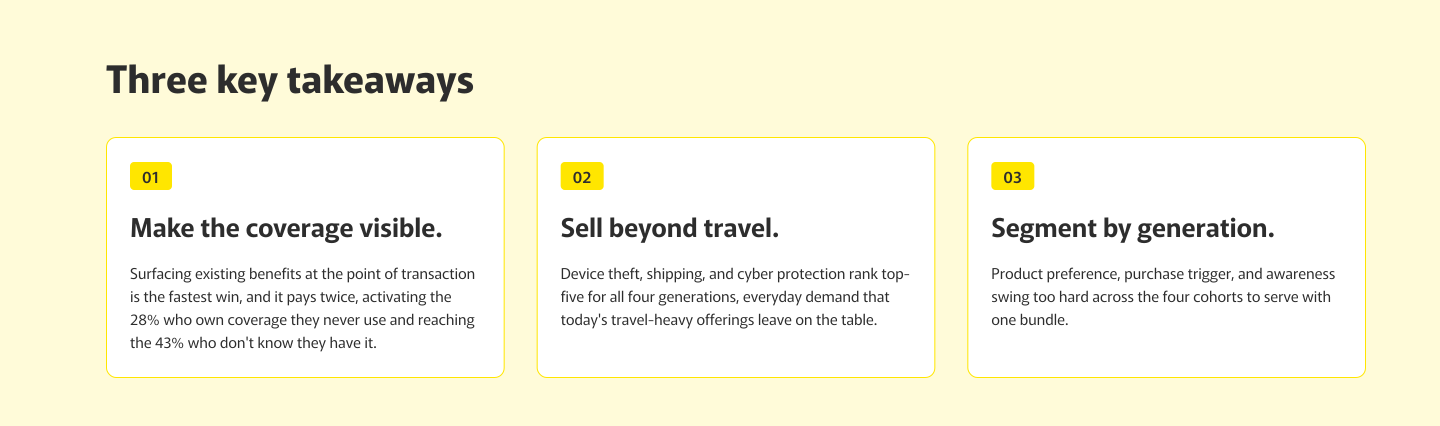
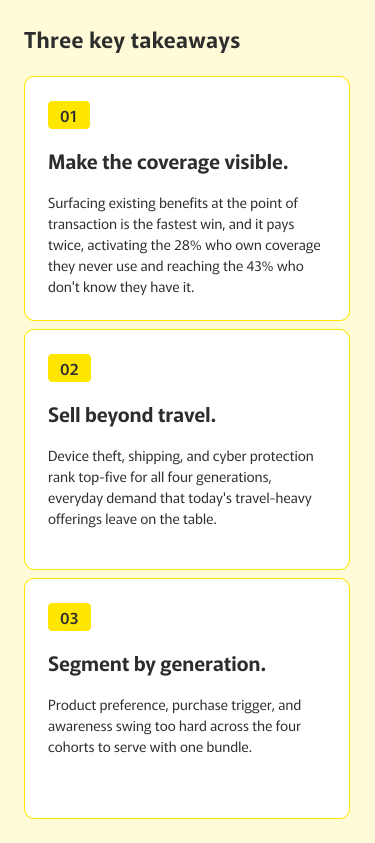
None of these is a demand problem; every one is a build problem. The generational detail in this report is what makes the fix targeted instead of generic. The demand is already here. The question is who builds the experience to meet it first.
Methodology
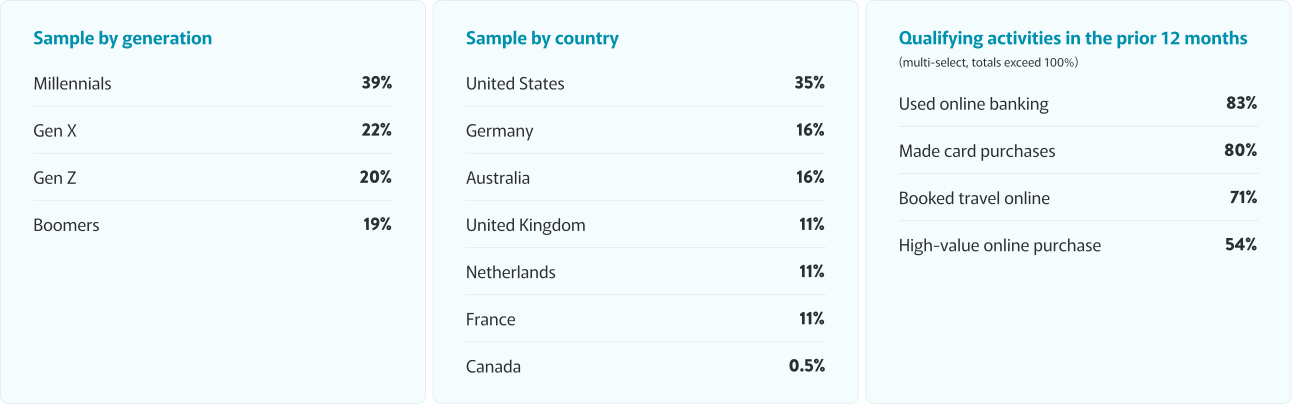
This report is based on a structured survey of 1,392 consumers conducted in March and April 2026 across seven countries and four generations. Participants completed 23 core questions covering risk awareness, protection preferences, purchase behavior, and attitudes toward emerging delivery models. To qualify, respondents had to have engaged in at least one qualifying financial or travel activity in the prior 12 months and to have previously been offered a protection or insurance product.
Some questions allowed multiple answers, so those percentages may exceed 100%. Single-select charts use largest-remainder rounding so they total exactly 100%. All figures are rounded. Research by Cover Genius and Gather.
LET’S GROW TOGETHER
We love talking to companies who want to protect their global audience.